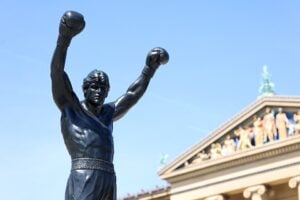
“Yo Adrian.” That’s the famous movie catchphrase that has been spoken by the general populace for five decades now. It comes from the original Rocky, which celebrates its 50th anniversary on November 21, ahead of its December 3 nationwide release anniversary. Rocky has remained one of the most culturally relevant films in all of cinema. This is amazing considering the film’s background.
Filmed in 28 days for roughly $1 million, Rocky (1976) grossed over $225 million worldwide and won the Academy Award for Best Picture. Sylvester Stallone drove the film’s success, writing the script and refusing offers unless he could play Rocky Balboa, the resilient Philadelphia boxer.
Rocky’s 50th anniversary coincides with the release of I Play Rocky, a biographical drama about Stallone’s struggle to bring the film to life. These developments have renewed appreciation for Rocky, its cultural impact, and the franchise’s global appeal.
The film’s influence extends beyond boxing, celebrating perseverance, overcoming adversity, and pursuing the American Dream.
The Unlikely Beginnings of Rocky
Before the success of Rocky, Sylvester Stallone was a struggling actor whose first leading role was in The Lords of Flatbush (1974). Stallone eventually began writing his own screenplays and received inspiration from a boxing match he witnessed. In March 1975, underdog heavyweight Chuck Wepner lasted fifteen rounds with the legendary Muhammad Ali, even knocking him down. Wepner’s performance, along with inspiration from boxing legend Rocky Marciano, influenced Stallone to write the first draft of Rocky in just three days.
Producers Irwin Winkler and Robert Chartoff loved the script, and United Artists offered up to $360,000 for the rights. However, the studio wanted established stars like Burt Reynolds or Ryan O’ Neal in the lead. Despite having barely over $100 in his bank account, Stallone refused to sell unless he played Rocky himself. United Artists finally relented by slashing the budget to roughly $1 million, leaving Winkler and Chartoff to assume the financial risk.
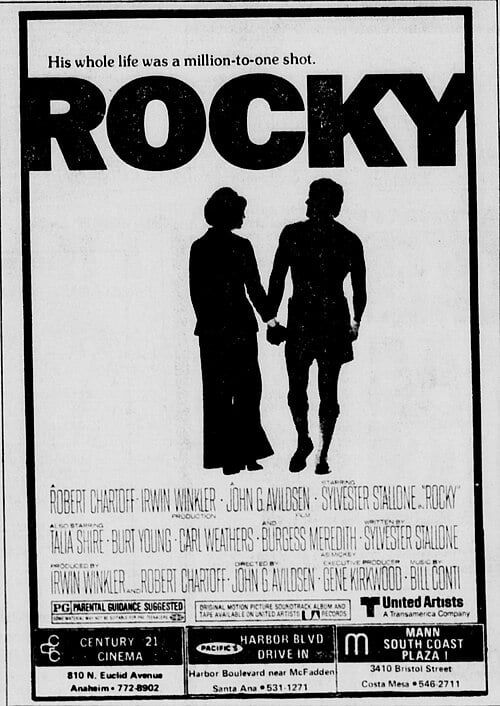
To make the shoestring budget work in 28 days, director John G. Avildsen embraced raw, guerrilla-style filmmaking. Working out of a van in Philadelphia without permits or paid extras, Avildsen used a non-union crew, pioneering Steadicam shots, and real street bystanders to capture authentic emotion.
Sylvester Stallone and the American Underdog
The character of Rocky Balboa resonated with audiences because he was not portrayed as an invincible champion that was out of reality’s reach. Rather, he’s a flawed, working-class fighter who is trying to prove his self-worth. It’s a relatable character that resonates with audiences of all different backgrounds. Portrayed by Sylvester Stallone in Rocky and all of its sequels, Rocky Balboa is a character that proved that the ultimate life victory is not always the biggest trophy but rather the endurance of life’s hardest hits.
Working-Class Roots in Philadelphia
At the beginning of Rocky, the audience sees that the character of Rocky Balboa does not live a glamorous life. He lives in a modest apartment and makes his living working as a part-time enforcer for a local loan shark. In addition, Balboa lacks formal education as well as the social and financial advantages that usually characterize cinematic heroes. These working-class and poverty-stricken features made the character relatable to a broad range of moviegoers. Despite Balboa’s economic disparity and stressful profession, he displays a gentle, compassionate nature. Rather than taking out any negative feelings he has towards his situation on others, he looks out for the well-being of others, especially the neighborhood kids, who are susceptible to bad influences.
Struggles as a Small-Time Boxer
It is established in Rocky (1976) that the character of Rocky Balboa is a small-time boxer who, at age 30 and having fought in dingy local venues, is considered washed up and unneeded by most. This sentiment even resonates with his trainer, Mickey Goldmill, played by Burgess Meredith, who feels his protégé has wasted his talent and has become a lost cause. That is also another relatable aspect to both the character and film, as many people can identify with the concept of youth and life opportunities fading over time.
Relationship with Adrian
In addition to boxing, another memorable aspect of Rocky, and many of its sequels for that matter, was that of love. This love occurs between Balboa and the character of Adrian (Talia Shire). Adrian is a shy pet store clerk who, although on the surface, is seemingly the complete opposite of Balboa, shares with Rocky the features of an isolated outsider. Together, these two ‘outsiders’ find confidence through the love they develop for each other over time.
Despite Balboa’s rough exterior and background as a fighter, he does not use machismo or typical masculine traits to pursue Adrian. Instead, he wins her trust by revealing that, just like her, he’s a person lost in the world, looking for some kind of personal validation. Adrian gave Rocky a reason to believe in himself beyond the boxing ring, while his love helped her break free from her overbearing brother, Paulie.
The Unexpected Shot Against Apollo Creed
In Rocky, heavyweight champion Apollo Creed (Carl Weathers) needs a last-minute opponent for a Philadelphia Bicentennial exhibition match. Creed selects Rocky Balboa because of his nickname, “The Italian Stallion.” In the film, Creed jokingly connects the matchup to America’s Italian heritage, referencing Christopher Columbus. While Creed views the bout as an exhibition, Balboa sees it as an opportunity to redeem himself and prove his abilities.
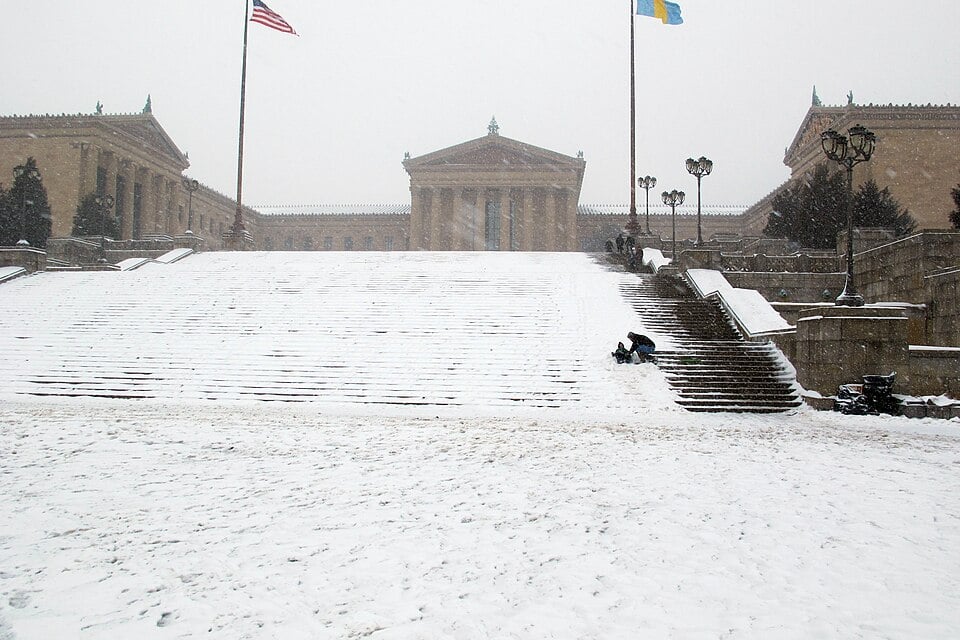
The training for the main bout in Rocky was also presented in a relatable, down-to-earth fashion. Without high-tech equipment, Balboa trains in the winter cold, runs through rainy streets, punches frozen beef, and climbs the Philadelphia Museum of Art steps.
Perseverance and Fighting Till the End
Adding to the realistic aspect of the film, Balboa is fully aware that he’s not the kind of boxer that can ultimately prevail against Creed. Instead, he wishes to prove that he can ‘go the distance’ and last all fifteen rounds with the champ. It’s a change from other, more typical underdog stories, whereby the underachiever, even with no effort, defeats the overachiever. Rather, it’s a showcase that winning can be obtained by sticking it out all the way, no matter how hard the obstacles are.
Philadelphia Shines
The city of Philadelphia is a character in and of itself in Rocky. Philadelphia’s working-class buildings, train tracks, and gray skies reflected Rocky Balboa’s character. It emphasized that Balboa’s struggles, both inside and outside the ring, were never easy.
Philadelphia’s working-class setting also reflected the historical backdrop of America’s 1976 Bicentennial. Philadelphia played an important role in America’s founding. The Declaration of Independence was adopted there in 1776, and the U.S. Constitution was drafted there in 1787. The working-class neighborhoods in Rocky contrasted with the era’s patriotic celebrations. Many characters in Rocky, including Balboa, lead stagnant lives but remain determined to persevere. Early in the film, Rocky struggles to climb the Philadelphia Museum of Art steps. At the end of his training, Rocky sprints to the top and triumphantly overlooks the city.
The Soundtrack and Training Montage that Changed Sports Cinema
Other than the atmosphere of Philadelphia, yet another important component of Rocky is its soundtrack. The theme of the film was captured by Bill Conti’s score, which follows the evolution of Rocky from his self-doubt to success. At the beginning of the movie, Bill Conti has utilized soft and gloomy sounds to illustrate Rocky’s difficulties and lack of self-confidence. However, as Rocky begins to train, Conti uses strong brass sounds to show his confidence.
The song “Gonna Fly Now” was written by Carol Connors and Ayn Robbins and became number one on the Billboard Hot 100 on July 2, 1977.
The film’s iconic training montage music has become a lasting part of pop culture. Beyond “Yo Adrian,” the training montage and its score have been widely imitated in film and television. The footage of the training montage in Rocky conveys weeks of grueling preparation without a single word of dialogue. The music captures Rocky’s early struggles during his dawn training runs. As the music builds, Rocky’s intense training culminates in his iconic run up the Philadelphia Museum of Art steps.
From an Independent Production to an Academy Award-Winning Film
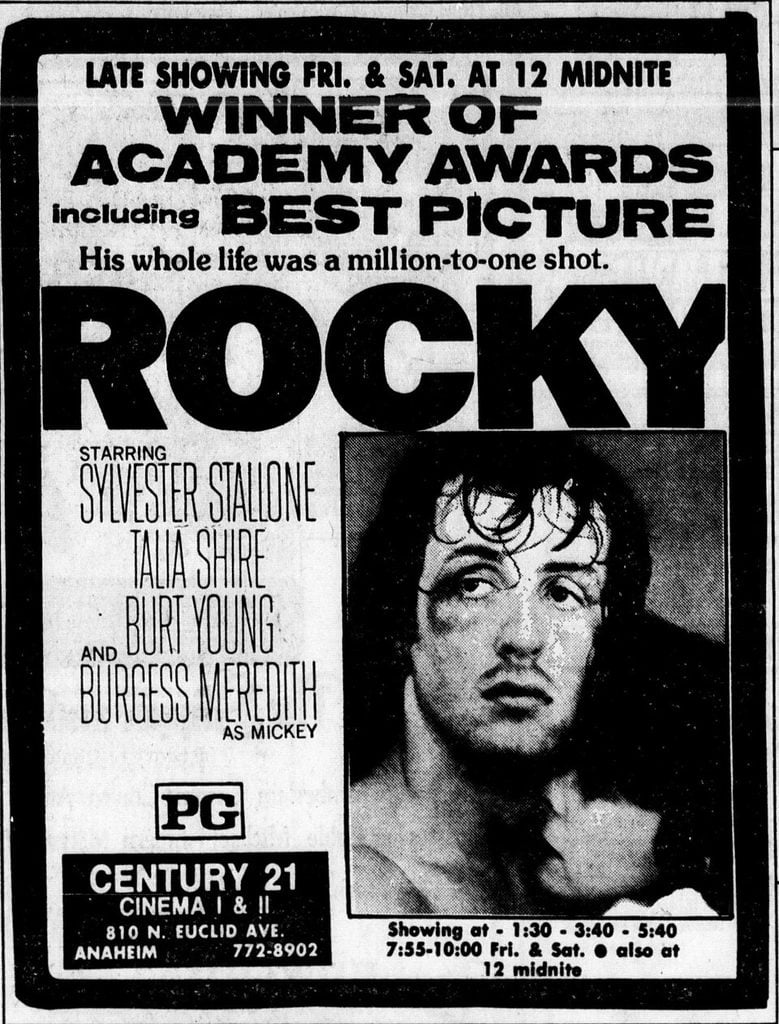
The 1976 release of Rocky marked a change from an independently produced movie to one with tremendous success both commercially and critically. With a budget of about $1 million, the movie generated more than $225 million in revenue around the world and became the most successful film of the year. The underdog storyline of the movie was highly appealing to the public and reviewers, leading to the nomination of the movie in 10 categories at the 49th Academy Awards ceremony. Rocky won three major awards, including Best Picture, Best Director for John G. Avildsen, and Best Film Editing.
Five Decades of Influence: From Rocky to Creed
The success of Rocky (1976) prompted moviemakers to make a sequel. Released in 1979, Rocky II became a hit, matching the original’s box-office success. The film popularized another Rocky quote: “Yo Adrian, I did it.”
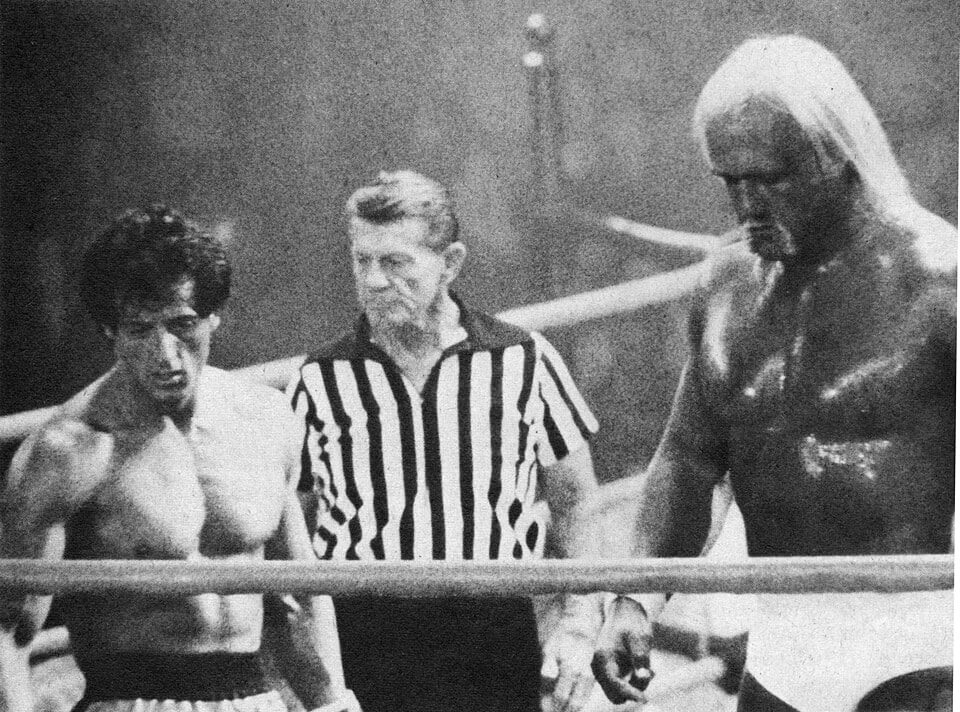
In Rocky III (1982), Stallone introduced a new kind of opponent when Rocky faced professional wrestler Thunderlips, played by Hulk Hogan.
Rocky IV (1985) captured Cold War tensions as Rocky faced Soviet boxer Ivan Drago, who killed Apollo Creed.
Although Rocky V (1990) explored Rocky and his family’s return to their Philadelphia roots, it received a less favorable reception. The franchise returned in 2006 with Rocky Balboa, featuring an older, widowed Rocky fighting one last time to prove he could still go the distance.
The Evolution of the Rocky Franchise
Although Rocky Balboa (2006) was the last standalone film centered on the character, Rocky returned in a new franchise during the 2010s.
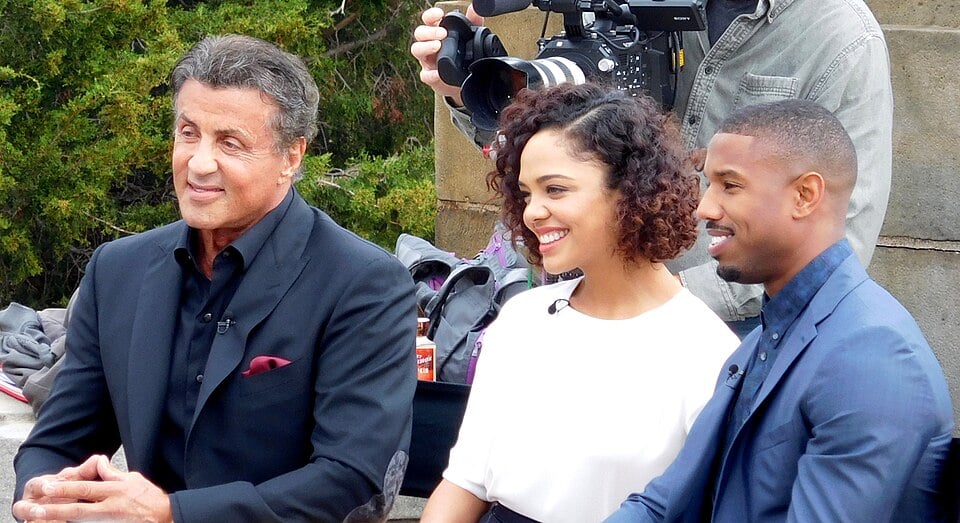
In 2015, Ryan Coogler pitched Creed to Stallone as a tribute to the original series and its next generation.
Rather than rebooting the franchise, the Creed trilogy continued its story with modern filmmaking and hip-hop soundtracks. As Apollo Creed’s son, Adonis (Michael B. Jordan) leaves his corporate career to prove himself as a fighter. Jordan brings both explosive athleticism and raw emotional vulnerability to the role. His performance explores abandonment, anger, and the burden of living up to a name he barely knew.
Rocky initially refuses but eventually agrees to train Adonis, following the example of his former trainer, Mickey Goldmill. The character of Rocky struggles with cancer in Creed, and it is Adonis who gives him hope for continuing to fight. The Creed films modernize the setting and style while preserving the original’s themes of self-belief, perseverance, and going the distance.
Conclusion: Why Rocky Still Matters 50 Years Later
Fifty years after its release, Rocky remains an icon of American cinema, sports, and popular culture. From revolutionizing the sports genre to motivating stadium songs and training scenes alike, its legacy continues to live on. Rocky’s 50th anniversary has renewed interest in Sylvester Stallone’s struggle to bring the film to the screen, explored in projects like I Play Rocky.
Rocky Balboa is the quintessential underdog because he wins with dignity, respect, and by proving that he can endure.
Sources:
American Film Institute (AFI) – Rocky (1976)
Academy of Motion Picture Arts and Sciences – 49th Academy Awards
HISTORY – Sylvester Stallone Starts Filming Rocky
BBC Sport – The Bayonne Bleeder: Meeting the Real Rocky
The Numbers – Rocky (1976) Box Office
HISTORY – Gonna Fly Now Reaches No. 1
Billboard – Rocky Theme Gonna Fly Now at 50
Amazon MGM Studios – I Play Rocky
Paramount – Rocky 50th Anniversary Celebration
Editor’s Disclaimer: This article examines the cultural influence and cinematic legacy of Rocky (1976) in recognition of its 50th anniversary. It includes historical information, film analysis, and commentary on the franchise’s lasting impact on American cinema and popular culture. The views expressed are intended for informational and cultural discussion.
