
Hawaii is one of two U.S. states, along with Alaska, that are not part of the continental United States. Formerly a U.S. territory, Hawaii became the nation’s most recent state on August 21, 1959. Therefore, when it comes to U.S. Presidential elections, Hawaii has the shortest list of all.
On a presidential level, Hawaii is considered one of the most Democratic states in the nation, having given Democratic nominees some of the largest margins of victory. Although Hawaii hasn’t voted Republican since Ronald Reagan’s 1984 victory or decided a presidential election by single digits since 2004, Republicans made modest gains in the past two elections.
Hawaii’s First Presidential Election
Hawaii first voted in a U.S. Presidential election in 1960, a little over a year after it was admitted as a state in the nation. For years, when Hawaii was a territory of the U.S., its Republican Party held a lot of power. However, by the 1950s, the Democratic Party had taken over. Therefore, 1960 saw a very close race in Hawaii with Democratic nominee John F. Kennedy winning the election over Republican nominee Richard Nixon by merely 92 points.
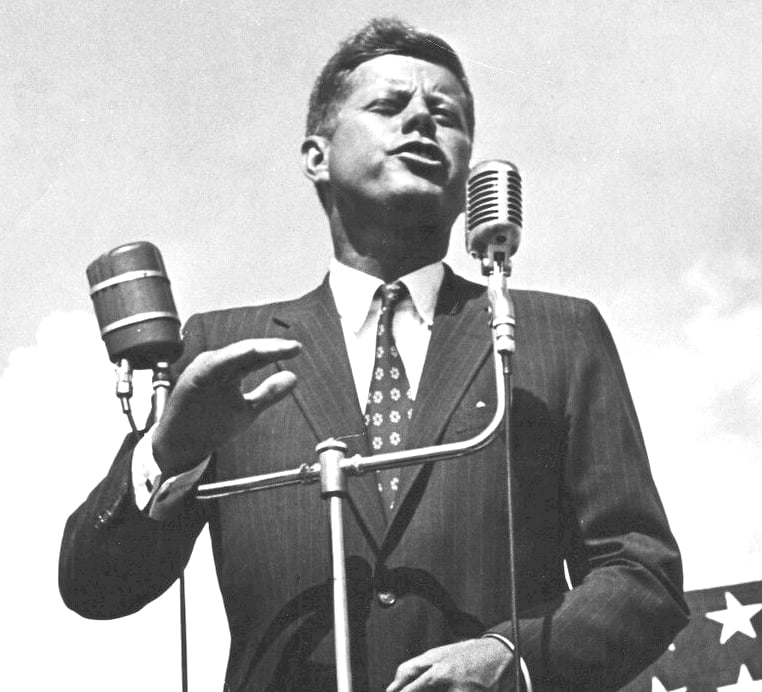
File:John F. Kennedy campaigning in Florida 1960 (cropped1).jpg – Wikimedia CommonsDeed – Public Domain Mark 1.0 Universal – Creative Commons
First Signs of Democratic Dominance
The 1964 U.S. Presidential election took place a little over a year after the assassination of John F. Kennedy. With the nation still mourning JFK’s assassination and many viewing Republican Barry Goldwater as too conservative, most voters backed President Lyndon Johnson. Hawaii gave Johnson his third-largest margin of victory in 1964, hinting that it would one day become a Democratic stronghold.
Four years later, Johnson’s Vice President, Hubert Humphrey, won Hawaii decisively, giving the state two consecutive Democratic landslides.
First Republican Landslides
The 1972 U.S. Presidential election pitted President Richard Nixon, who had won the race four years prior, against Democratic nominee George McGovern. Like Barry Goldwater in 1964, Democratic nominee George McGovern was seen as too extreme for the mainstream in 1972.
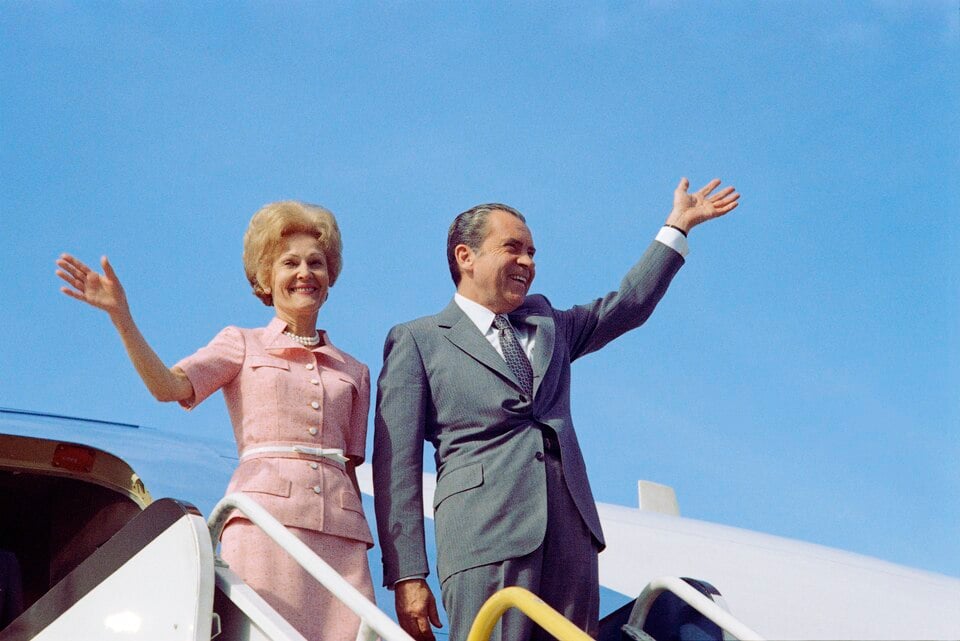
File:President Richard Nixon and Pat Nixon Exit from an Aicraft and and Greet Well-Wishers in Hawaii – DPLA – cb6b6b4ec8d0c6647b747ce869dcdf40.tiff – Wikimedia Commons
Deed – Public Domain Mark 1.0 Universal – Creative Commons
Despite backing Democrats by wide margins in 1964 and 1968, Hawaii joined 48 other states in overwhelmingly supporting Nixon in 1972
In fact, Nixon’s 1972 victory in Hawaii is the largest of the only two times it has voted Republican in a U.S. Presidential election. Evidently, McGovern’s anti-war platform didn’t resonate with moderate Democratic voters in Hawaii and its heavily-dominated military population.
It showed that Hawaii had not yet fully become a Democratic stronghold.
Close Democratic Wins
President Nixon ended up resigning from the presidency in 1972 following the aftermath of Watergate. Gerald Ford would assume the office.
By the 1976 election, moderate Republican Gerald Ford had retained some political capital by distancing himself from his predecessor. The Republican Party’s conservative wing, however, split with Ford in 1976, as Ronald Reagan came close to winning the Republican nomination.
However, much of the nation had gained a distrust of Washington politics. Democratic nominee Jimmy Carter presented himself as a moderate outsider promising to restore trust in the presidency.
The 1976 U.S. Presidential election proved to be a narrow win for Carter, and Hawaii’s results reflected that as well. Carter was able to pull off a win of fewer than 7,000 votes in Hawaii.
While he could appeal to voters in the state looking for alternatives to Washington as well as labor unions, Ford, on the other hand, gained support among both moderate voting Hawaiians as well as the military. Also, Hawaii was starting to have a lot of socially liberal voters. Many of these individuals were skeptical of Carter because of him being an evangelical.
The 1980 Election
By 1980, Carter’s presidency had been hurt by double-digit inflation, high unemployment, and the Iranian Hostage Crisis. In addition, the more liberal wing of the Democratic Party broke as Teddy Kennedy challenged Carter. Meanwhile, the conservative Ronald Reagan, who had nearly won the 1976 Republican nomination, was gaining steam.
However, even though voters were frustrated with Carter, many moderates and union workers viewed Reagan as ‘too conservative’, as they had with Barry Goldwater years before. In addition, John Anderson, a socially liberal Republican who had unsuccessfully run for the Republican nomination in 1980, became the Independent Presidential nominee that year, offering an alternative to people frustrated with Carter but hesitant about Reagan.
These huge divisions resulted in another close win for Carter in 1980 as he carried the state this time by 1.9 points. Hawaii was one of only six U.S. states that Carter won that year.
The 1980 results in Hawaii proved to be one of only two times, the first being in 1960, in which the winner of Hawaii did not win all of the state’s counties.
Back in the Republican Fold One Last Time
Reagan eventually gained much popularity nationwide, even among some liberal voters, as the economy began to show signs of recovery by the time of the 1984 presidential election. Whether or not he was directly responsible for this is still much debated. Regardless, Reagan’s charisma arguably made up for any questioning that people had. In 1984, like in 1972, Hawaii joined 48 other states in supporting the Republican nominee, and decisively too. However, Reagan’s 1984 victory in Hawaii would end up being the last Republican win for the state in a presidential election as well as the last time a Republican won any of Hawaii’s counties.

File:President Ronald Reagan at a Reagan-Bush Rally in Endicott New York – DPLA – 5ee6ec3059d58d02727a4e3d7c3c203e.jpg – Wikimedia Commons
Deed – Public Domain Mark 1.0 Universal – Creative Commons
Back to the Democratic Party
Four years after Reagan’s second and much larger landslide win, his vice president, George H.W. Bush, pulled off a third consecutive decisive win for the Republican Party at the presidential level. However, Bush was not able to get the same amount of liberal and urban voters as Reagan had and even witnessed a drop in Republican support among certain blue-collar voters that belonged to labor unions as well as parts of the Farm Belt in the midst of the Farm Crisis.
In 1988, even in the midst of a third Republican national landslide, Hawaii voted for the Democratic nominee by a comfortable margin. The labor union constituents of the state felt more comfortable voting Democratic again, and even some of the military-oriented voters liked Dukakis’s more neutral stance on foreign policy.
This was the beginning of consecutive Democratic wins in Hawaii at the presidential level. All of them, except for one, have been by double digits as well.
Hawaii becomes a Democratic State.
In 1992, George H.W. Bush’s high-approval ratings following Desert Storm had evaporated as there had been a slight recession and the Republican Party had been fractured as Pat Buchanan, a more conservative Republican, had challenged Bush during the primary. To add to matters, a charismatic and young candidate, Bill Clinton, who won the Democratic Nomination, presented himself as a ‘New Democrat’ who would maintain certain conservative policies along with liberal ones. Also, Ross Perot, a Texas billionaire, ran as the Independent nominee, offering an alternative to conservative voters who felt Bush hadn’t maintained some of the policies of Reagan and others who had problems with what were perceived as Bill Clinton’s ‘character issues.’ Clinton won Hawaii in 1992 easily.
As was expected, in 1996, President Bill Clinton won Hawaii decisively over Republican nominee Bob Dole. In addition, Clinton got the majority of the vote in Hawaii this time, as Ross Perot’s presence was not as much a factor this go around. While this election also continued the Democratic wins in Hawaii that started in 1988, 1996 also started the success of Democratic nominees consistently winning the majority of the vote in Hawaii.
In 2000, the country was split as, although the economy had been healthy during the Clinton years, a combination of Democratic fatigue and backlash after President Clinton’s impeachment due to the Monica Lewinsky scandal caused some to consider voting Republican this time. The 2000 U.S. Presidential Election proved to be the closest presidential election since 1960. Nonetheless, Democratic Nominee Al Gore, who had served as Clinton’s vice president, obtained a comfortable win in Hawaii that year over Republican nominee George W. Bush, the son of George H.W. Bush, who won the election after a controversial Supreme Court decision in Florida.
The Last Effort by Republicans
The first year of George W. Bush’s administration witnessed the tragedy of 9/11, and the then-incumbent president maintained a high level of popularity across the country. However, by 2004, the country was split once again as Bush’s decision to invade Iraq and Afghanistan had caused some people to sour on him. It turned out to be another close race. Democratic nominee John Kerry won Hawaii with the majority of the vote. However, unlike all other Democratic wins in Hawaii after 1984, this one was in the single digits. This could possibly be attributed to the amount of military personnel from Hawaii that were deployed to Afghanistan; many of these individuals were behind Bush. 2004 would prove the last time a Republican nominee lost Hawaii by single digits and cracked 40 percent of the vote in the state.
Democrats Regain Control
As Bush’s presidency ended, his administration faced growing disappointment over the weakening economy and the wars in the Middle East. Like how one can debate whether economic recovery can be directly attributed to whoever is in office, the same can be said for who the incumbent is during an economic downturn. Regardless, both are usually associated with who is the president and party in charge.
The 2008 U.S. Presidential Election pitted Democratic Nominee Barack Obama, who was actually born in Hawaii, against Republican Senator John McCain. Although McCain tried to distance himself from the unpopular Bush, Obama ran a successful campaign centered on “Change.” He won the 2008 election in an Electoral College landslide, widely considered the last presidential landslide by that measure. In Hawaii, Obama won over 70 percent of the vote, a feat not seen since Lyndon Johnson’s 1964 victory.

File:Barack Obama February 2 2008.jpg – Wikimedia Commons
Deed – Attribution 3.0 Unported – Creative Commons
Four years later, despite a closer national race, Obama again won over 70 percent of the vote in his home state of Hawaii—a feat unmatched in any state since.
Continued Democratic Dominance but Republican Improvement
The 2016 presidential election was one of the biggest upsets in U.S. history, as Donald Trump narrowly won the Electoral College while Hillary Clinton won the popular vote. Nevertheless, many states shifted to the right despite still voting decisively Democratic. Hillary Clinton won Hawaii in 2016, but her 62.2 percent vote share was well below Obama’s. Much of this can be attributed to Hillary Clinton’s unpopularity. Although Donald Trump was also unpopular, he had greater momentum as a political outsider than Hillary Clinton.
The year 2020 also saw a unique election as it occurred in the midst of the COVID-19 pandemic. With the economic troubles that resulted, voters were looking for who they thought could continue handling the dilemma, whether Incumbent President Trump, who, despite having been impeached by this time, had maintained some political capital, or Joe Biden, who had previously served as vice president under Obama and was seen as a good centrist choice to unite voters. The social distancing and stay-at-home rules that were still in place for many people by the time the 2020 U.S. Presidential election took place resulted in a record number of mail-in votes. Biden beat Trump in the popular vote by a substantial margin, but although the former won the Electoral College, many states were extremely close and did not replicate the numbers of the man Biden had been vice president under, Obama.
Changing Dynamics in Hawaii
Although the majority of states in the 2020 U.S. Presidential Election shifted Democratic, there were a handful of states that shifted Republican, and one of these was surprisingly Hawaii. Although Biden increased the Democratic percentage in Hawaii, his margin of victory was less than Clinton’s. This can probably be attributed to the high voter turnout that, while large for both nominees, had seen more conservative-leaning voters who had skipped previous elections than left-leaning ones. Also, Trump gained ground among many Filipino voters in Hawaii.
The 2024 Election Continues the Trend
By 2024, although aspects of the economy had improved since COVID, there were still people feeling the effects of it and the preceding double-digit inflation. The Democratic Party was vulnerable.
However, with Donald Trump, who, after campaigning on a hope to return to the White House and restore the economy, became the Republican nominee, there were still skeptics who thought a man who had been impeached twice and been convicted could be elected.
Nevertheless, Trump pulled off a narrow victory in 2024, becoming the first U.S. President since Grover Cleveland to be elected to two Consecutive terms. As expected, 2024 Democratic Presidential Nominee Kamala Harris won Hawaii by a huge margin over Republican nominee Donald Trump. However, her margin of victory and percentage of votes were less than both Biden’s and Clinton’s had been.
Evidently, Trump had maintained some of the voters he had gained while there was a small shift in voters who were Asian-Americans to the Republican Party in 2024. Despite Harris’s decisive win in Hawaii in 2024, Trump’s percentage of votes in the state was the best since George W. Bush’s in 2004.
Looking Forward
Since Hawaii became a U.S. state, it has mainly voted Democratic. Although it took a while, Hawaii eventually became one of the most Democratic states in the nation. There have only been two Republican wins in the state of Hawaii: Richard Nixon’s in 1972 and Ronald Reagan’s in 1984.
Although these were decisive wins, they both occurred during elections where most of the state voted heavily Republican. There have been some pretty close races. Since Republicans had power in Hawaii when it was still a territory, 1960 was the closest race in the state.
Even after Hawaii shifted Democratic, some Democrats proved less popular than others, as shown by Jimmy Carter’s narrow wins in 1976 and especially 1980. Sometimes, depending on the climate of the country and who the candidates are, a Republican nominee can make modest gains in Hawaii, as evidenced by George W. Bush losing the state by single digits in 2004, and Donald Trump later gaining ground, earning a relatively strong Republican vote share in a solidly Democratic state.
Looking Ahead to 2028
Time will tell what the political and economic climate will be during the 2028 U.S. Presidential election. Considering past trends, it’s arguably most likely that Hawaii will be considered Safe Democratic.
However, as the past two elections and several earlier races have shown, Republicans can make modest inroads depending on their messaging and the state of the economy and foreign affairs. Along with Hawaii, Alaska is the only other state outside the continental United States.
Alaska has a history of voting solidly Republican. However, over the past few elections, Democratic nominees have gained ground in the Last Frontier.
It’s strange that Hawaii, while still voting solidly Democratic, has been trending Republican, while Alaska, despite remaining solidly Republican, has been trending Democratic.
Sources:
State of Hawaii Office of Elections – Presidential Elections
270toWin – Hawaii Presidential Voting History
State of Hawaii Office of Elections – U.S. PRESIDENT AND VICE PRESIDENT
The American Presidency Project (University of California, Santa Barbara)
270toWin – Historical Presidential Election Information by State
Federal Election Commission (FEC)
Encyclopaedia Britannica – Hawaii
National Archives – Electoral College
MIT Election Data and Science Lab
Library of Congress – Presidential Elections
Editor’s Disclaimer: This article is intended for historical and informational purposes only. It summarizes Hawaii’s presidential voting history using publicly available election data and historical records. Discussions of voting trends and electoral shifts are based on historical outcomes and, where noted, analysis of publicly reported political developments. References to voter behavior or possible factors influencing election results are presented as analysis rather than definitive conclusions. Presence News does not endorse any political party, candidate, or viewpoint.
