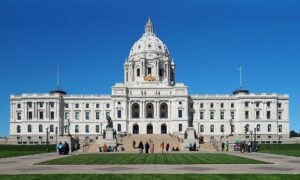
The Minnesota State Capitol stands in St. Paul, Minnesota. The Capitol serves as the seat of Minnesota's state government and is home to the state's Legislature and governor's office. The Minnesota State Capitol in St. Paul, Minnesota, serves as the seat of the state's government and houses the offices of the governor and the Minnesota Legislature. Photo by McGhiever / Wikimedia Commons (CC BY 4.0).https://commons.wikimedia.org/wiki/File:Minnesota_State_Capitol_2017.jpg https://creativecommons.org/licenses/by-sa/4.0/
Photo: Presence News
Views:564
Minnesota is a state that has a long history of voting Democratic. However, it tends to swing either way more so than other Democratic voting states. This wasn’t always the case for the state, though.
The state of Minnesota was first welcomed as the 32nd state in the year 1858. The newly formed state took part in the first 18 presidential elections and voted only for the Republican candidate. The state’s early political alignment reflected its loyalty to the Union during the Civil War and the rise of the Republican Party.
Despite this Republican dominance, Democrats came close to winning Minnesota on two occasions before the Great Depression. In 1912, former President Theodore Roosevelt split the Republican Party by running as the Progressive Party (“Bull Moose”) candidate against President William Howard Taft. The split Republican vote allowed Democrat Woodrow Wilson to make significant gains, although Minnesota remained Republican.
Wilson performed even better in 1916. His slogan, “He Kept Us Out of War,” appealed to voters who favored American neutrality during World War I, helping him come close to carrying Minnesota. Four years later, however, Republican dominance returned as the party won three consecutive national landslides during the 1920s.
The Great Depression Brings Democratic Gains
In the year 1928, the Republican candidate Herbert Hoover achieved victory in Minnesota after a great victory, thus marking the third consecutive Republican win in this state. In contrast, the Democratic candidate, Al Smith, performed better than his predecessors. Moreover, being the first Catholic candidate running for a major political party, Smith won the support of many Roman Catholic voters.
The political landscape changed dramatically with the onset of the Great Depression.
Minnesota followed suit when, in 1932, it voted for Democratic candidate Franklin D. Roosevelt, whose win was decisive against Hoover’s. He continued to win in 1936 but won by a closer margin in both 1940 and 1944. The nation was involved in the Second World War during those years.
In 1948, President Harry S. Truman won one of the most surprising elections in American history, defeating Republican Thomas E. Dewey despite widespread predictions of defeat. Truman carried Minnesota by a larger margin than Roosevelt had four years earlier, benefiting from the strength of the state’s growing Democratic-Farmer-Labor coalition while overcoming divisions that had affected Democratic support during the 1944 election.
The Eisenhower Years
By the 1952 presidential election, public approval of the Truman administration had declined amid concerns over the Korean War and other domestic and international issues. Republican nominee Dwight D. Eisenhower, the highly respected Supreme Allied Commander during World War II, won a decisive national victory and carried Minnesota by a comfortable margin.
Notably, the 1952 election remains the last time a Republican presidential nominee has won Minnesota by double digits.
Eisenhower won the state again in 1956, although by a considerably smaller margin. Historians have cited several factors for the closer result, including dissatisfaction among some Minnesota farmers with aspects of the administration’s agricultural policies. Eisenhower’s 1956 victory would also prove to be the last time a Republican carried Minnesota in a presidential election until Richard Nixon’s victory in 1972.
Democratic Dominance Returns
The 1960 presidential election was one of the closest in American history. Democratic nominee John F. Kennedy narrowly carried Minnesota, reflecting the state’s increasingly competitive political landscape.
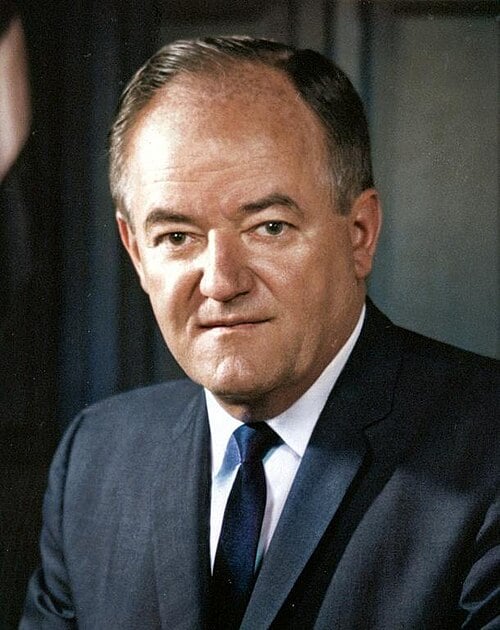
Four years later, the nation was still mourning Kennedy’s assassination. President Lyndon B. Johnson, who had assumed office following Kennedy’s death, sought election in his own right in 1964. The massive national support combined with Barry Goldwater’s conservative platform, helped Johnson emerge victorious in one of the biggest landslides in America. Hubert H. Humphrey, the Senator from Minnesota and running mate of Johnson, boosted the Democratic ticket’s strength in his home state, allowing him to win a decisive victory.
After Johnson declined to seek re-election in 1968, Humphrey became the Democratic presidential nominee. As expected, he carried his home state by a comfortable margin. Nationally, however, Humphrey narrowly lost to Republican nominee Richard Nixon in one of the closest presidential elections of the twentieth century.
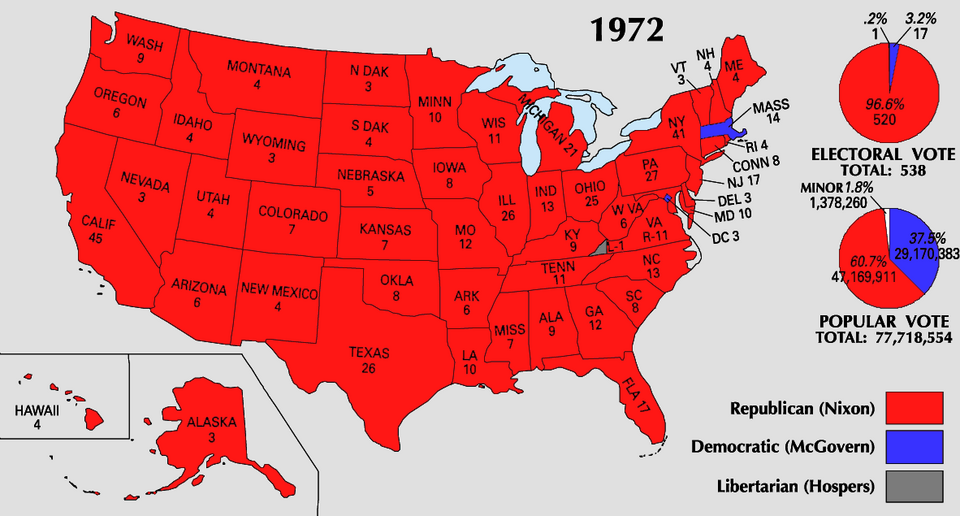
President Richard Nixon sought a second term in 1972 and won one of the largest landslides in presidential history, carrying 49 of the 50 states. Democratic nominee George McGovern struggled to build broad national support, and Minnesota joined nearly every other state in voting for Nixon.
Although Nixon won Minnesota, his margin was smaller than his national performance. Humphrey remained one of the state’s most influential political figures, and the Democratic-Farmer-Labor Party continued to maintain a strong political organization. In addition, McGovern’s opposition to the Vietnam War resonated with many progressive and anti-war voters in Minnesota, helping keep the race relatively closer than in much of the country.
The 1972 election remains the last time a Republican presidential nominee has carried Minnesota. As of 2026, that 54-year streak is the longest active Democratic presidential voting streak of any state.
By 1976, the Republican Party was recovering from the political fallout of the Watergate scandal and President Nixon’s resignation. President Gerald Ford, who had assumed office following Nixon’s resignation, sought election in his own right but faced lingering public distrust of Washington.
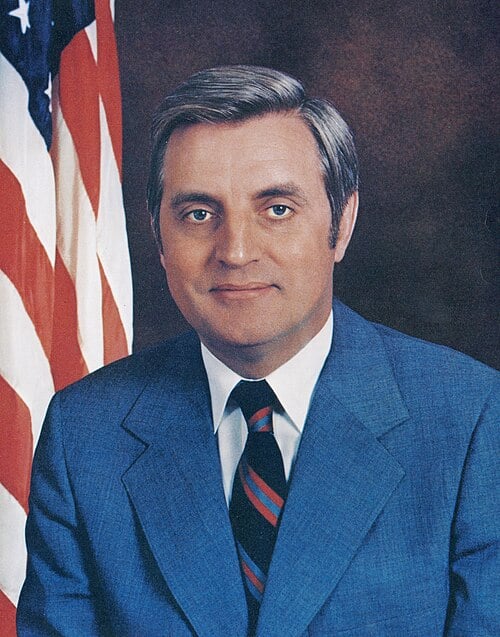
The candidate of the Democratic Party, Jimmy Carter, who was once the governor of Georgia, campaigned as a political outsider, vowing to be honest and to bring about reforms. Carter picked Senator Walter Mondale from Minnesota as his vice-presidential partner. Mondale brought years of political experience in Washington and familiarity with labor unions and the Democratic-Farmer-Labor Party, something that benefited Carter, who in fact was considered an outsider.
Carter narrowly won the presidency nationwide, while Minnesota gave the Democratic ticket a considerably larger margin, reflecting both Mondale’s popularity in his home state and the state’s growing Democratic coalition.
Carter’s Presidency and Ronald Reagan
The Carter administration was already facing tough political issues like inflation, unemployment, problems related to energy, and the Iran hostage crisis by the time of the 1980 election campaign. The Republican candidate, Ronald Reagan, who had previously served as governor of California, ran a successful campaign for economic regeneration and national defense.
Despite Reagan’s landslide, Minnesota remained loyal to the Democratic ticket. Carter carried the state by a single-digit margin, making Minnesota one of only a handful of states to support the Democratic nominee in 1980. Minnesota’s support was aided by the presence of Vice President Walter Mondale, a Minnesota native, on the Democratic ticket.
The political environment had changed dramatically by 1984. Following an improving economy and a period of renewed national optimism, Reagan entered his re-election campaign with high approval ratings. Mondale secured the Democratic nomination but faced a difficult political climate. Reagan won 49 states in another historic landslide, while Mondale carried only his home state of Minnesota and the District of Columbia.
Minnesota’s result, however, was remarkably close. Mondale won the state by less than half of one percentage point, making the 1984 election the closest a Republican presidential nominee has come to carrying Minnesota since Nixon’s victory in 1972.
Democrats Bounce Back in Minnesota
The 1988 presidential election featured Vice President George H. W. Bush as the Republican nominee following the end of Ronald Reagan’s second term. Massachusetts Governor Michael Dukakis secured the Democratic nomination. Nationally, Bush won a decisive victory, giving Republicans their third consecutive presidential election win.
Minnesota, however, continued its Democratic voting streak. Dukakis carried the state by approximately seven percentage points despite his national defeat. His running mate, Texas Senator Lloyd Bentsen, and the Democratic ticket performed well among many urban voters and organized labor constituencies, helping Democrats maintain their strength in Minnesota.
A New Democrat and Third-Party Strength
By 1992, the United States had experienced an economic recession, and President George H. W. Bush’s approval ratings had declined after the Gulf War. The Democratic candidate Bill Clinton ran a campaign as a “New Democrat,” presenting himself as a moderate with regard to economic questions and addressing a wide group of voters.
Ross Perot, the Independent candidate, carried out an effective campaign based on the message of federal deficits, trade, and reforms in the government. His nomination became a significant success as Perot managed to draw the attention of voters from different parties and became a notable third-party candidate in the American political system.
Clinton carried Minnesota by a double-digit margin in 1992 while winning the presidency nationwide. Four years later, he again won the state by a comfortable margin and received a majority of the vote as Perot’s support declined during the 1996 election.
Minnesota Becomes More Competitive Again
As the 2000 presidential election approached, the Democratic Party sought to retain the White House following two terms under President Bill Clinton. Despite the Clinton administration overseeing a prosperous economy, the president was impeached, and the Monica Lewinsky affair became an issue in the campaign.
Al Gore, as Vice President, became the nominee of the Democratic Party, while George W. Bush, the current governor of Texas and son of previous President George Bush, became the Republican nominee. He claimed during the campaign to be a “compassionate conservative” and emphasized reform in education, tax reduction, and restoration of public trust in the presidency.
The 2000 presidential election became one of the closest and most controversial in American history. Minnesota reflected the nation’s competitiveness, with Gore narrowly carrying the state while Bush came closer to winning Minnesota than any Republican nominee since Ronald Reagan in 1984.
Many different things led to the close outcome in the state. The republican party improved its performance in some rural areas, with Ralph Nader of the Green Party getting a share of the vote. Political scientists have been debating the impact of Nader’s candidacy on Gore’s margin both in the state of Minnesota as well as across the country.
Although Gore won Minnesota, Bush ultimately won the presidency following the disputed Florida recount and the U.S. Supreme Court’s decision in Bush v. Gore.
The 2004 Election
Following the September 11, 2001, terrorist attacks, President George W. Bush experienced historically high approval ratings. However, by the time of the 2004 election, public opinion had become more split owing to the ongoing wars in Iraq and Afghanistan. With Kerry being the candidate of the Democrats, he criticized the administration of Bush and the approach taken by Bush to the Iraq War, while Bush focused more on his leadership quality during the September 11 incident and the issues of security.
The election proved to be another closely contested race. Minnesota once again mirrored its competitive nature, with Bush coming close to carrying the state. Kerry ultimately won Minnesota with a majority of the vote, improving slightly upon Al Gore’s performance in 2000 and extending the state’s Democratic presidential voting streak.
The Last State Landslide
However, before the 2008 presidential election, the USA was already experiencing the repercussions of the Great Recession, and the people lost faith in President George W. Bush because of problems related to the economy and the wars in Iraq and Afghanistan. While the presidential candidate for the Democrats, Barack Obama, ran on a platform of change, the presidential candidate for the Republicans, John McCain, tried to separate himself from certain aspects of the policies of the Bush administration.
Obama won a decisive national victory, and Minnesota reflected that trend by supporting the Democratic nominee by a double-digit margin. His coalition included strong support from urban and suburban voters while remaining competitive in many other parts of the state. As of 2026, the 2008 election remains the last time that any presidential nominee has carried Minnesota by a double-digit margin.
Minnesota Becomes Increasingly Competitive
The 2012 presidential election was more competitive than the previous cycle. President Obama continued his fight for the presidency while Mitt Romney was busy campaigning on platforms revolving around the economy and reducing the federal deficit. Despite Obama winning the presidency across the country, he managed to win in the state of Minnesota by a margin of just more than seven percentage points, showing a more competitive political atmosphere compared to the previous presidential election.
The election in 2016 produced one of the major political surprises in the USA. Republican candidate Donald Trump triumphed over his Democratic counterpart, Hillary Clinton, in the electoral college, while Clinton prevailed in the popular vote.
Trump devoted considerable attention to Midwestern states, including Minnesota, where he came within approximately 1.5 percentage points of winning. Since Richard Nixon’s success in 1972, Ronald Reagan’s slim defeat in Minnesota in 1984 marks the only time when any Republican candidate has come so close. Besides, third-party candidates had reportedly received a substantial number of votes in Minnesota, which resulted in one of the narrowest elections in the history of the state.
In 2020, the presidential election was held during the COVID-19 pandemic, and this resulted in high turnout in many states. The candidates included the incumbent Donald Trump and Joe Biden, who was nominated by Democrats. The candidates focused on the pandemic, the economy, health care, and security. Biden won several key Midwestern states, including Michigan, Pennsylvania, and Wisconsin.
Minnesota also voted for Biden, who won the state by just over seven points—improving on Hillary Clinton’s 2016 margin but falling short of Barack Obama’s 2012 performance. Although Minnesota remained Democratic, the result continued its trend of close presidential races.
The 2024 Election
The 2024 presidential election featured a rematch of many of the political issues that had dominated recent election cycles. Former President Donald Trump sought to return to the White House, while Vice President Kamala Harris became the Democratic nominee after President Joe Biden ended his re-election campaign.
Economic issues, immigration, foreign policy, and the future direction of the country became central themes of the campaign. Harris chose Minnesota Governor Tim Walz as her running mate, giving Democrats another home-state advantage.
Trump won the presidency, becoming only the second U.S. president, after Grover Cleveland, to win two non-consecutive terms. In Minnesota, however, Harris carried the state by approximately 4.2 percentage points. Although Democrats extended their winning streak, Minnesota remained more competitive than many consistently Democratic states.
Minnesota’s voting history is unique. Since Richard Nixon’s 1972 victory, every Democratic presidential nominee has carried Minnesota, giving the state the nation’s longest active Democratic voting streak.
Even so, Minnesota has often been more competitive than other states that regularly support Democratic presidential candidates. Republicans Ronald Reagan, George W. Bush, and Donald Trump all came within single-digit margins of carrying Minnesota.
This sets Minnesota apart from states like Massachusetts and Rhode Island, where Democratic presidential victories have generally been more decisive. While Minnesota has remained reliably Democratic, its presidential victories have often been narrower than those in many other Democratic-leaning states.
With many recent close elections, Minnesota is expected to remain a presidential battleground.
Editor’s Disclaimer: This article is intended for informational and historical purposes only. It provides an overview of Minnesota’s presidential voting history based on publicly available election results and historical records. It does not endorse or oppose any political party, candidate, or viewpoint. Readers are encouraged to consult official election authorities and historical sources for additional information.
William Barber is an Editor and freelance journalist with Presence News based in Jackson, Mississippi. He regularly reports on community news, business, wellness, culture, entertainment, and human-interest stories throughout Mississippi while helping maintain the publication’s editorial standards. Before joining Presence News, William built professional experience in journalism, librarianship, copywriting, and digital publishing. As a certified copywriter, he has written hundreds of articles spanning wellness media, blogs, digital campaigns, scholarly publications, and poetry. One of his most recognized contributions to Presence News is DDPY: The Workout That’s Changing Lives, which became one of the publication’s most-viewed articles. Through his reporting, William has gained recognition within his local community for covering businesses, nonprofit organizations, entrepreneurs, artists, and community leaders making a positive impact. As an Editor, he has publishing authority at Presence News and works closely with contributors to ensure articles are accurate, informative, and aligned with the organization’s commitment to original, people-first journalism. One of William’s long-term goals is to relocate to New York City, where he hopes to provide regular on-the-ground coverage of local news, business, culture, and community events for Presence News. Story ideas, press releases, and editorial inquiries can be sent to william@presencenews.org More by William Barber