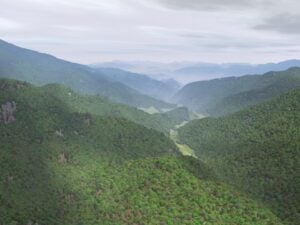
The American chestnut was a dominant feature in the lives of many people living in the eastern region of the United States for centuries. Today, the story of American chestnut restoration is reshaping how we think about these trees and their important role in our forests. Some historical accounts described the forests as an almost continuous corridor of chestnut trees.
The American chestnut was sometimes referred to as the ‘redwood of the East’ because of its size and importance. For many Americans, the chestnut tree served as an essential part of daily life.
Its wood was used to build barns, cabins, fences, furniture, railroad ties, and coffins. Its nuts fed wildlife and families alike. In many rural communities, chestnut season meant food, trade, and tradition. Many eastern forest ecosystems became heavily dependent on the abundance of trees. Then, in the span of only a few decades, it was almost entirely erased.
The Tree That Once Ruled Eastern Forests
In 1904, a strange fungal blight was discovered on chestnut trees at the Bronx Zoo in New York. The fungus, later identified as Cryphonectria parasitica, had arrived from Asia on imported chestnut species that carried natural resistance. American chestnuts had none. The disease spread quickly through wind, rain, insects, and bark contact, cutting off water and nutrients until trees died above ground. By the middle of the 20th century, roughly four billion American chestnut trees had been destroyed.
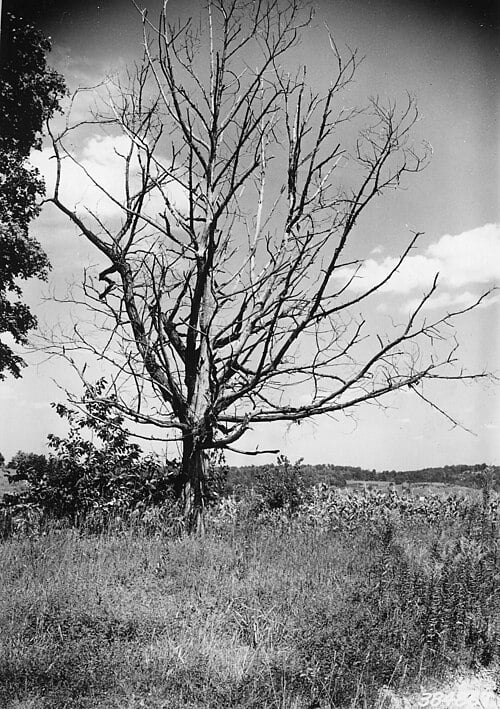
National Archives and Records Administration via Wikimedia Commons (Public Domain)
Wikimedia Commons – Photograph of Chestnut Killed by Chestnut Blight Disease Epidemic
Public Domain Information (U.S. Government Works)
Many ecologists regard the loss as one of the most significant ecological disruptions in eastern American forest history.
And yet, more than a century later, there are signs that the story may not be over.
Across forests, research stations, and small citizen-led planting projects, scientists and conservationists are attempting something that once sounded impossible: bringing the American chestnut back.
The work is painstaking. As The American Chestnut Foundation puts it, “There is no silver bullet.” But after decades of setbacks and experimentation, restoration efforts are beginning to show real momentum. The return of the American chestnut has become a long-term restoration effort aimed at recovering a species lost from most eastern forests before many Americans were born. What makes the story remarkable is not just the science involved, but the patience behind it.
Trying to Bring a Giant Back
The American Chestnut Foundation, one of the leading organizations in the effort, describes its mission simply: to return the tree to its native range in eastern forests.
For decades, conservation programs have focused largely on traditional hybrid breeding methods. In that process, American chestnuts have been crossed with naturally resistant Chinese chestnut trees. The goal was to create a hybrid that retains the form and ecological role of the dominant tree from our American landscape while containing enough disease-resistant traits to withstand the chestnut blight.
At the State University of New York College of Environmental Science and Forestry, researchers expanded that effort even further. Their American Chestnut Research & Restoration Project has spent years studying the genetics of disease resistance and developing experimental approaches to help the species survive.
More Than Just Another Tree
What makes the chestnut especially difficult to restore is that it was never just another tree. It was what ecologists call a “foundation species,” shaping entire forest systems around itself. Before the blight, some forests in Appalachia were composed of nearly one in every four hardwood trees being chestnuts. Their annual nut production fed deer, bears, turkeys, passenger pigeons, and countless smaller species. Their rot-resistant lumber became economically indispensable in rural America.
The disappearance left a lasting cultural memory in many Appalachian communities. In some Appalachian families, stories of chestnut forests survived longer than the forests themselves.
Researchers at SUNY ESF note that chestnut wood was once used for nearly everything imaginable: telegraph poles, shingles, instruments, paper pulp, and homes. Because the tree grew quickly and resisted decay, it became deeply woven into rural life across much of the eastern United States.
The forests that emerged afterward differed significantly from those that had once been chestnut-dominated.
A Vanishing Forest
For decades, many restoration efforts faced repeated setbacks. Chestnut trees still sprouted from old root systems across eastern forests, but most died from blight before reaching maturity. Living chestnuts persisted mostly as small sprouts beneath forests that had changed dramatically.
Conservationists sometimes say the species exists in a state of “functional extinction” — still alive in fragments, but no longer capable of fulfilling its historic role in eastern forests.
Increasingly, some researchers believe advances in restoration science may improve long-term ecosystem recovery efforts.
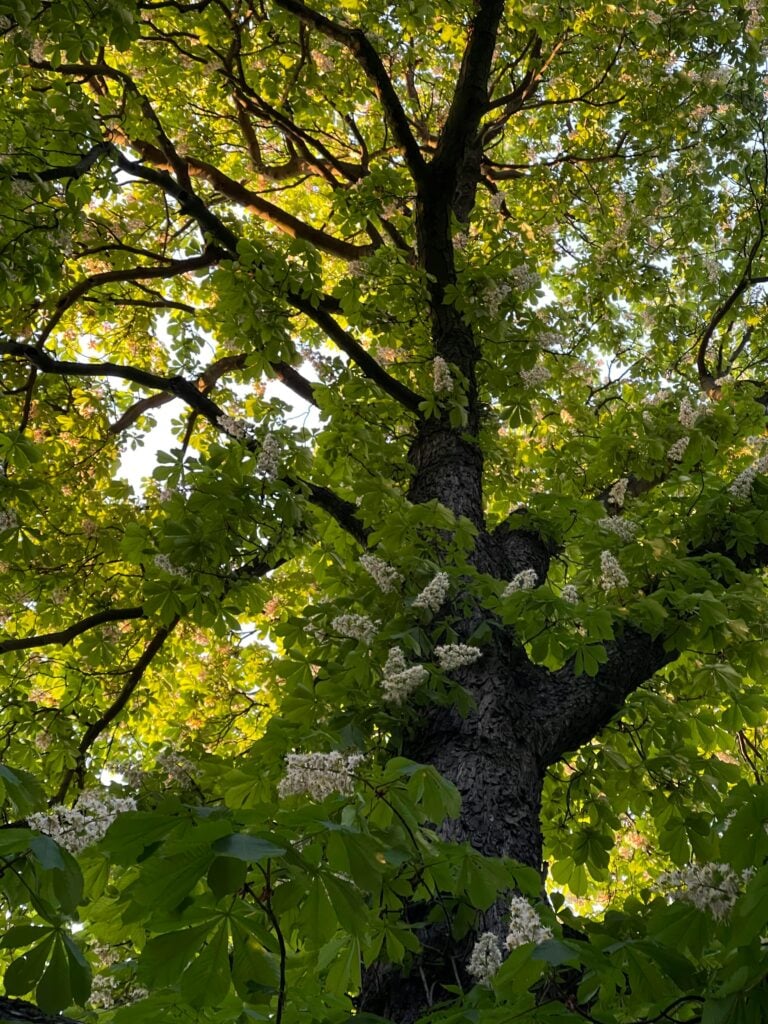
Photo by Anna Zh13 via Pexels
Pexels – Blossoming Chestnut Tree
Pexels License
Recent advances in technology, such as genetic analysis, molecular markers, and selection techniques, have increased these successes significantly. Geneticists are now able to detect disease-resistance traits earlier in the life of a tree, enabling them to significantly reduce the time required for breeding, a process that previously took many years.
Restoration Beyond the Laboratory
Some of the most hopeful work is no longer happening only in laboratories.
In New York, citizen-led restoration projects are distributing blight-resistant saplings to ordinary residents willing to plant and monitor them. The effort reflects a growing belief that restoration must happen not just through institutions, but through communities.
As one organizer told The Guardian, “When you talk to folks, they really do care about biodiversity loss,” but often feel powerless to act. Planting chestnuts offers something increasingly rare in environmental conversations: direct participation.
That emotional dimension may explain why the chestnut story resonates so deeply. The tree’s restoration is not simply about forestry science. It represents a broader question facing the modern world: can humans repair any of the damage we have caused?
Environmental news is often dominated by collapse — disappearing species, warming temperatures, shrinking forests, and poisoned waterways. The American chestnut story offers a rare example of long-term ecological restoration rather than simple decline. The work has already spanned decades and may continue for many more.
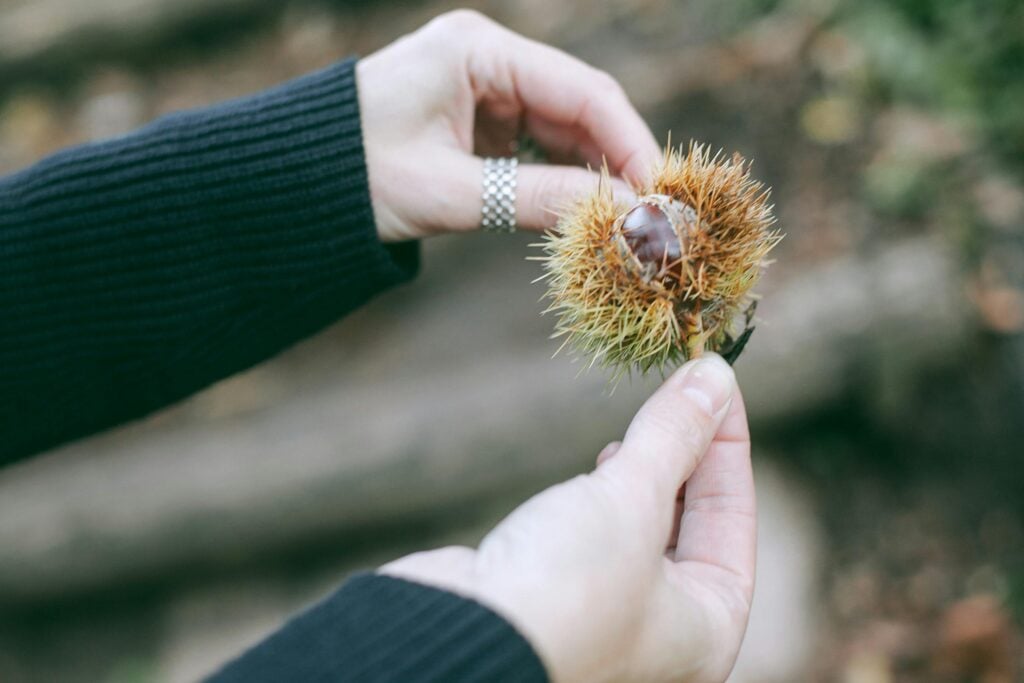
Photo by Maria Orlova via Pexels
Pexels – Holding Sweet Chesnut Outdoors
Pexels License
Hope, With Caution
There are also real disagreements about how restoration should happen.
One of the most debated approaches involves genetically engineered chestnuts designed to tolerate the blight. Early excitement around a modified tree known as Darling 58 raised hopes that biotechnology could dramatically speed restoration. But as some researchers and critics have cautioned, “The D58 isn’t going to solve chestnut restoration.” The project later encountered scientific setbacks and growing criticism from some environmental groups, who argued that the trees were being commercialized prematurely or did not perform consistently in field conditions.
Some researchers still believe biotechnology could ultimately play an important role in chestnut restoration, even if current approaches remain experimental.
Even many supporters of biotechnology now caution against treating genetic engineering as a silver bullet.
The reality is more complicated. Forest ecosystems are complex, and restoring a species requires more than simply creating a blight-resistant organism. Trees must survive changing climates, reproduce successfully, maintain genetic diversity, and integrate into living ecosystems already altered by a century of change.
Supporters argue that this complexity reflects the realities of ecological restoration.
Should the American chestnut be successfully replanted throughout its native range, it will not be due to a single breakthrough, but rather the accumulation of many small efforts: breeding trials, field tests, volunteer planting programs, long-term monitoring of trees, and scientific research conducted over many years.
The Pace of Forests
In contrast to modern expectations for rapid results, the process of restoring the chestnut tree will largely happen at the rate of its forest habitat.
So maybe this is one reason why the story of the chestnut seems to be such an encouraging one.
Many Americans alive today never saw a mature American chestnut tree in the wild. Entire generations inherited forests shaped by absence without even realizing it. Yet the memory of the chestnut persisted — in old photographs, Appalachian folklore, weathered barns, and surviving stumps still sending up hopeful shoots from ancient roots.
Some of those memories are now being reflected in new restoration plantings.
It remains unclear how successful these restoration efforts will ultimately become. Researchers caution against expecting a full recovery anytime soon, as chestnut blight still persists, many experimental trees may ultimately fail, and climate pressures will continue reshaping American forests in unpredictable ways.
But the possibility itself matters.
For much of the 20th century, many believed the American chestnut would survive only as a historical memory. Today, researchers, volunteers, and conservationists are attempting to write a different ending.
Not by pretending the damage never happened.
But by choosing, patiently and imperfectly, to repair what they still can.
Sources:
U.S. Forest Service/U.S. Department of Agriculture — “Restoring the iconic American chestnut”
The Guardian — “This isn’t a gimmick’: the New Yorkers trying to restore the American chestnut”
NC State Extension — “Chestnut Blight”
The American Chestnut Foundation — “American Chestnut Restoration”
Editor’s Disclaimer: This article is intended as a reflective feature on ongoing efforts to restore the American chestnut tree and is based on publicly available reporting, conservation research, and scientific sources available at the time of publication. Restoration initiatives remain active and evolving, and some approaches — including genetically modified chestnut development — continue to be debated within the scientific and environmental communities. Presence News does not endorse any single restoration method but aims to present the broader ecological, historical, and cultural significance of the American chestnut’s possible return.
