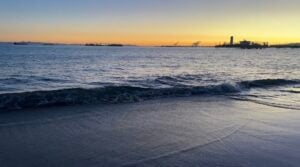
From the beach, the massive container ships visible on the horizon can look like they’re simply sitting in the ocean. But those vessels are part of a carefully organized system that connects Southern California to businesses, retailers and consumers around the world.
If you’ve spent time along the Southern California coast near Long Beach, you’ve probably noticed them: enormous container ships sitting offshore, sometimes appearing to form a line along the horizon.San Pedro Bay port complex, made up of the Port of Long Beach and the neighboring Port of Los Angeles.
Together, the two ports form a massive gateway for international trade.
A View From the Beach Into a Global Supply Chain
The ships visible from Long Beach beaches aren’t just large vessels passing through Southern California.
Many are container ships, carrying thousands of standardized steel shipping containers filled with merchandise and materials.
Those containers can contain everything from electronics, furniture and clothing to machinery, auto parts and other products moving through the international supply chain.
Once a vessel arrives at the San Pedro Bay area, it doesn’t necessarily sail directly into a terminal and immediately begin unloading.
The movement of ships through the harbor depends on factors including berth availability, vessel scheduling, terminal operations, cargo-handling capacity, pilotage, tides and other maritime considerations.
In other words, a ship offshore isn’t necessarily stuck. It is part of a much larger logistical schedule.
Two Ports, One Massive Gateway
The Port of Long Beach and Port of Los Angeles are separate government entities, but geographically they operate side by side around San Pedro Bay.
The Port of Los Angeles handled approximately 10.2 million twenty-foot equivalent units (TEUs) in 2025, making it the third-busiest year in the port’s history. (Port of Los Angeles)
A TEU is the standard measurement used in the container shipping industry. One TEU is roughly equivalent to a standard 20-foot-long shipping container.
The Port of Los Angeles alone handled more than 10 million TEUs in 2025.
The Port of Long Beach also recorded a record year, handling approximately 9.9 million TEUs in 2025. (The Helm)
Put together, the two neighboring ports move roughly 20 million TEUs a year, illustrating the extraordinary scale of the San Pedro Bay maritime complex.
The Port of Los Angeles says the San Pedro Bay port complex handles more containers per ship call than any other port complex in the world.
Why Do Ships Wait Offshore?
Seeing a ship offshore doesn’t automatically mean there is a major port backup.
Container terminals operate according to highly coordinated schedules. A vessel may remain outside the immediate terminal area while it waits for its scheduled berth or for other operational requirements to be completed.
Ships can also use designated anchorage areas, where vessels can safely wait while remaining outside the active berthing areas.
The process is similar to an airport.
An aircraft can arrive near an airport but still have to wait for a gate to become available.
At a major seaport, the “gate” is essentially the vessel’s assigned berth and the associated terminal operation.
Once the ship is cleared and its berth is ready, harbor operations coordinate its movement into port.
What Happens Once the Ship Reaches the Port?
When a container ship reaches its terminal, the real work begins.
Huge ship-to-shore cranes reach over the vessel and remove containers one by one.
The containers are then transferred through the terminal, where they may eventually travel by:
- Truck
- Rail
- Another vessel
- Distribution centers and warehouses
A container arriving from Asia could ultimately travel hundreds or thousands of miles after leaving the ship.
It might eventually end up in a warehouse in Southern California, on a truck heading across the country, or on a train traveling toward another distribution hub.
That’s why the activity visible from the beach is connected to much more than the waterfront itself.
The Port of Long Beach Is a Major Economic Engine
The scale of the Port of Long Beach extends well beyond the harbor.
According to the City of Long Beach’s economic-development reporting, the Port supports approximately 2.7 million jobs nationwide, along with about $176 billion in income and more than $309 billion in GDP. (Long Beach)
The broader San Pedro Bay port complex is similarly important to Southern California.
The Port of Los Angeles estimates that one in eight jobs across Los Angeles, Orange, Riverside, San Bernardino and Ventura counties can be connected to the San Pedro Bay port complex. (Port of Los Angeles)
That includes far more than longshore workers.
The economic network includes trucking companies, railroad workers, warehouse employees, freight forwarders, customs brokers, logistics companies, mechanics, equipment operators, construction workers and countless other businesses supporting international trade.
The Ships You See Are Part of a Much Bigger Picture
It’s easy to look toward the ocean and see a container ship as simply another vessel passing Southern California.
But each ship represents a much larger network.
Before a container reaches Long Beach, it may have traveled thousands of miles across the Pacific.
After leaving the port, the container could continue by truck or rail to another part of California or somewhere else in the United States.
The Port of Long Beach describes itself as an international gateway for the movement of goods and a critical economic driver for Long Beach and the region.
And the scale continues to grow.
The Port has set a long-term goal of eventually handling 20 million containers annually by 2050, while investing in infrastructure, rail, technology and environmental improvements. (POLB Vendor Portal)
So the Next Time You See a Ship Offshore…
The next time you’re walking along the beach in Long Beach and see a giant container ship sitting offshore, there is a good chance you’re looking at one small piece of a global supply chain.
Those ships connect Southern California to factories, businesses and consumers around the world.
And from the shoreline, you can actually watch that international trade system operating right in front of you.
The next time you see those ships on the horizon, they’re not simply waiting—they’re part of one of the world’s largest maritime gateways.
Presence News Original Video
The ships featured in the accompanying Presence News video were filmed from the Long Beach, California coastline.
Editor’s Note: Port activity, vessel movements and anchorage conditions change continuously. The presence of vessels offshore does not necessarily indicate congestion or a port backup.
