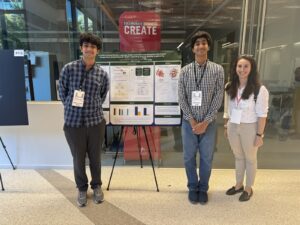
Ayush and Abhinav Iyer’s PET Lab explores how computational tools could help identify more stable enzymes for future testing.
BAY AREA, Calif. — Twin brothers Ayush and Abhinav Iyer, two Bay Area high school students, are building an international research team around a question with potential implications for plastic-waste research: Can artificial intelligence help identify changes that make plastic-degrading enzymes more stable?
The brothers co-founded Predictive Enzyme Technology Laboratory, known as PET Lab. In an email to Presence News, they described a team of more than 20 researchers spanning four countries, working at the intersection of AI and protein engineering.
Their approach uses computational screening to identify promising enzyme modifications. The founders say their team screened more than a million mutation records as part of that effort.
An abstract listed among BayLearn 2026’s accepted submissions provides further detail. Credited to both brothers, identified as students at Dougherty Valley High School, it describes a machine-learning platform designed to predict mutations that could improve protein thermal stability. The researchers report compiling 1,001,888 protein-stability records from seven public databases, focusing primarily on enzymes that break down polyethylene terephthalate, or PET.
The abstract identifies a practical challenge: Enzymes can lose activity under conditions found in industrial reactors. The project seeks to help researchers select promising candidates before committing resources to laboratory testing. 2026: Accepted Submissions
That distinction is central to understanding the work. Screening existing records and predicting promising mutations are different from experimentally testing a million new enzyme variants. The conference abstract describes a computational approach; it does not, by itself, establish a working plastic-treatment system or demonstrated environmental cleanup.
The founders say research from PET Lab was also accepted for presentation at the 2026 Biomedical Engineering Society Annual Meeting. They report having shared their work at UCLA, New York University, UC Santa Cruz and Santa Clara University.
Beyond enzyme research, the brothers describe a collaboration with the municipal government of Babolsar, Iran, to explore water-filtration testing. Their submission did not include results demonstrating the effectiveness of that proposed testing.
They also report youth participation in the Science Summit alongside the United Nations General Assembly and a U.S. provisional patent filing for a separate sustainable water-filtration invention. The filtration invention is distinct from the enzyme research described in their outreach.
For the brothers, PET Lab is also an exercise in organizing research across borders while still in high school. They have offered to discuss the experience of building the team, provide research documentation and address the scientific challenges and limitations of their approach.
More information is available at PET Lab’s website.