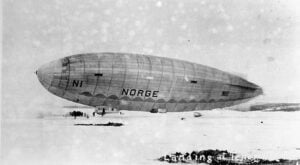
One hundred years ago this week, explorers aboard the airship Norge completed what is widely regarded as the first verified flight over the North Pole — a milestone that transformed aviation and Arctic exploration.
For centuries, the Arctic had remained one of Earth’s most difficult and dangerous regions to access, with shifting ice, brutal weather, and failed expeditions claiming countless lives. But in May 1926, a multinational airship expedition helped change how humanity viewed distance, exploration, and the planet itself.
The Guardian later described the expedition as “the first successful journey of any kind to the pole.”
Today, commercial aircraft routinely fly polar routes between continents in a matter of hours. In 1926, however, much of the Arctic was still considered one of the last largely uncharted regions on Earth.
The 1926 Norge North Pole Flight
The 1926 Norge North Pole flight symbolized the growing transition from the age of geographic exploration to the age of global aviation.
For centuries, explorers had chased the dream of reaching the North Pole. Expeditions disappeared into Arctic ice. Ships became trapped for years. Explorers endured starvation, frostbite, and isolation in pursuit of a place very few people had seen. By the early twentieth century, the race to the poles had become one of the defining challenges of exploration.
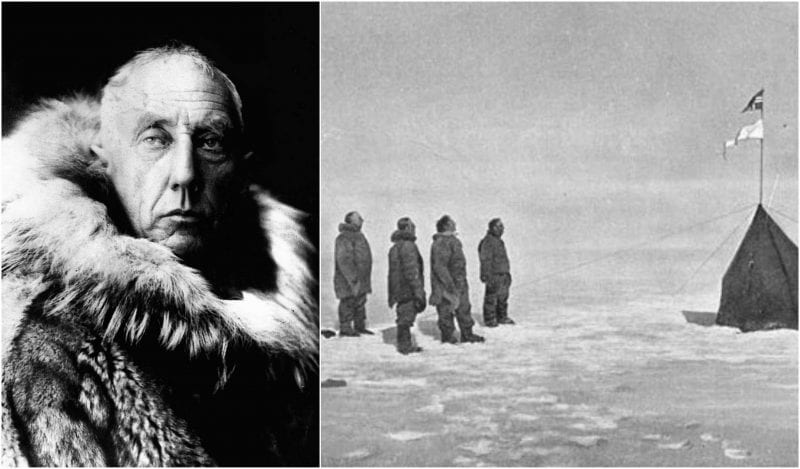
Roald Amundsen and the New Age of Exploration
Bilinmiyor / Wikimedia Commons / CC BY-SA 4.0
https://commons.wikimedia.org/wiki/File:Roald-Amundsen.jpg
https://creativecommons.org/licenses/by-sa/4.0/
Amundsen was already one of the most famous explorers in the world. As part of a historic race to reach the South Pole first, Amundsen led the expedition that reached the South Pole before Robert Falcon Scott’s British team. The Encyclopedia Britannica describes Amundsen as an innovative explorer known for extensive planning and operating effectively under extreme conditions.
By the 1920s, the nature of exploration had begun to change significantly. Airplanes and airships were creating new possibilities for long-distance exploration that previous generations could scarcely have imagined, allowing explorers to travel by air instead of across the dangerous Arctic surface below.
A Multinational Mission Above the Ice
The international crew of the Norge expedition was a reflection of this new technological age of exploration. The airship was designed and commanded by Italian engineer Umberto Nobile, while American explorer Lincoln Ellsworth helped finance the mission. The multinational crew departed from King’s Bay — now Ny-Ålesund in the Norwegian archipelago of Svalbard — after weeks of preparation in one of the northernmost settlements on Earth.
Launching From the Edge of the World
At the time, King’s Bay was a remote Arctic outpost built around coal mining and polar expeditions. Over the decades, the settlement evolved into one of the world’s most important centers for Arctic scientific research.
The Airship Norge
Yet despite the dangers, the mission represented something revolutionary: explorers could now attempt to reach the pole by air rather than by traveling across the Arctic surface.
Crossing the Top of the World
The expedition officially launched from Svalbard on May 11, 1926. After battling fog, ice accumulation, and exhausting conditions inside the cramped control cabin, the Norge passed over the North Pole during the early hours of May 12. The crew dropped Norwegian, American, and Italian flags onto the ice below before continuing onward toward Alaska.
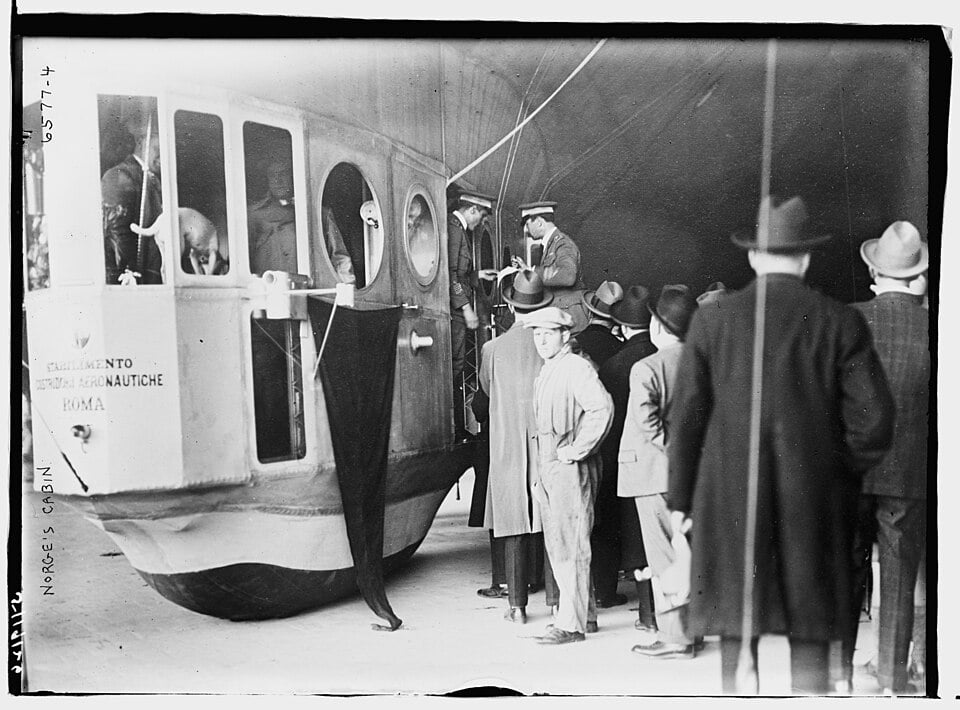
Visitors gather beside the gondola cabin of the Norge airship during preparations for the historic 1926 North Pole expedition.
Photo by Bain News Service/George Grantham Bain Collection (Library of Congress)/ and Wikimedia Commons / Public Domain.
https://commons.wikimedia.org/wiki/File:Norge%27s_cabin_LCCN2014719378.jpg
https://creativecommons.org/publicdomain/mark/1.0/
As the Fram Museum notes, “the Arctic Ocean was crossed for the first time.”
The achievement was historically significant not only because the expedition succeeded, but because it became widely regarded as the first verified flight over the North Pole.
The Controversy Over Who Reached the Pole First
Only days earlier, American aviator Richard Byrd had claimed to have reached the pole by airplane. At the time, Byrd was celebrated internationally as the first pilot to accomplish the feat. But later analysis raised doubts about whether his aircraft had actually traveled far enough north. In an article, the Smithsonian’s National Air and Space Museum states that “The Norge flew over the North Pole on May 12,” making it the first generally accepted aircraft crossing of the pole.
Several historians and aviation researchers now believe Byrd likely turned back before reaching the pole, making the Norge expedition the first verified aerial crossing.
That distinction carried major significance in the 1920s, when aviation records drew global attention and represented national prestige, technological advancement, and human daring. But the importance of the Norge flight extended beyond questions of who arrived first.
How the Flight Changed Humanity’s View of the Planet
The expedition demonstrated that aircraft could operate in one of the harshest environments on Earth. It proved that long-distance polar aviation was possible. And psychologically, it altered how many people viewed the accessibility of the polar regions.
For generations, much of the Arctic remained poorly mapped and poorly understood. Explorers ventured into regions where no reliable charts existed. Vast stretches of the polar world remained unconfirmed. During the Norge expedition, the crew helped dispel lingering speculation among some earlier geographers and explorers that undiscovered landmasses might exist near the North Pole.
In many ways, the flight reflected how aviation was making distant regions feel more connected.
Previously, such journeys often required months or years of hazardous travel by ship or overland expedition. Advances in aviation dramatically shortened travel times, allowing distant regions to be reached in days or even hours. The Arctic was no longer viewed only as a barrier, but increasingly as a viable route for travel.
Today, flights between North America, Europe, and Asia regularly travel near the polar region because great-circle routes over the Arctic reduce travel time and fuel consumption. What was considered extraordinary in 1926 later became a routine part of international aviation.
Exploring Without Modern Technology
But the early Arctic aviators operated with none of the tools modern pilots take for granted. There was no satellite navigation, no real-time weather forecasting, no radar, and no emergency rescue infrastructure. If the Norge had crashed deep in the Arctic, survival would have been unlikely.

Photo by Matti&Keti Lorenz King (uni-giessen.de) via Wikimedia Commons (CC BY-SA 4.0).
https://commons.wikimedia.org/wiki/File:North_Pole,_Arctic_Ocean,_sea_ice_03.jpg
https://creativecommons.org/licenses/by-sa/4.0/
Conditions aboard the airship reflected the harsh realities of early twentieth-century exploration. The expedition leader wrote of exhausted crew members sleeping among spare parts, supplies, fuel containers, and navigation equipment because there was nowhere else to rest. Ice repeatedly formed on the exterior of the ship, weighing it down and threatening the mission.
The Romantic Age of Exploration
And yet the journey retained the romantic spirit associated with many of the era’s great expeditions.
In a May 16, 1926 editorial titled Hail the Norge, the New York Times described the expedition as proof that “heroism is still with us.”
That spirit of exploration defined the early twentieth century. Explorers and aviators were increasingly attempting journeys through environments once considered nearly impossible to cross — the poles, the oceans, the upper atmosphere.
Only Twenty-Three Years After Kitty Hawk
The Norge flight occurred only twenty-three years after the Wright brothers’ first powered flight at Kitty Hawk. In less than a quarter-century, aviation had evolved from short experimental hops to transpolar exploration.
The expedition also reflected a broader historical transition. In the past, explorers relied heavily on ships, sled dogs, and months of survival in extreme weather without the use of airships or aircraft for polar exploration. The introduction of airships and airplanes significantly accelerated polar exploration compared to earlier surface expeditions. The flight demonstrated the growing potential of long-distance aviation to connect distant regions of the world.
A Century Later
Researchers continue studying the movement of the magnetic North Pole, a phenomenon that also complicates Arctic navigation — one of the many challenges early polar aviators faced without modern instruments.
Modern transportation and satellite systems have made the Arctic far more accessible than it was in 1926, significantly reducing many of the geographic unknowns that once defined remote polar regions.
But that is precisely why the centennial of the 1926 Norge North Pole flight still matters.
The men aboard that airship lived during a rare moment in human history when enormous parts of the Earth still felt unknown. Flying over the North Pole was not merely an aviation milestone; it demonstrated how aviation was beginning to transform humanity’s relationship with remote regions of the planet.
For centuries, the Arctic had stood as one of Earth’s final boundaries. In May 1926, perceptions of the Arctic began to change in lasting ways.
For the first time, humans viewed the top of the world from the sky above rather than from the ice below.
Sources:
Smithsonian National Air and Space Museum — “Santa’s Balloons and Arctic Airships”
Encyclopaedia Britannica — “Roald Amundsen”
Fram – The Polar Exploration Museum — “Expeditions – The Norge flight (1926)”
The New York Times — “Hail the Norge!”
The Guardian — “Roald Amundsen crosses the north pole in an airship – archive, 1926”
Oceanwide Expeditions — “Amundsen takes to the skies: the aerial exploits of the airship Norge”
Polarhistorie.no — “1926 – Amundsen-Ellsworth-Nobile Transpolar Flight”
arXiv — “Recent north magnetic pole acceleration towards Siberia caused by flux lobe elongation”
Editor’s Disclaimer:
This article is a historical feature published for educational and informational purposes. Historical events, expedition records, and aviation claims referenced in this article are based on publicly available archival sources and historical research available at the time of publication. Certain aspects of early polar aviation history remain the subject of scholarly debate and interpretation. Presence News does not claim to provide definitive historical adjudication on disputed exploration records.
