Unlike most of the United States, Maine stands out as a unique political battleground due to its distinctive method of allocating Electoral College votes. Along with Nebraska, Maine is one of only two states that reject the traditional winner-takes-all system. Instead, the state utilizes the Congressional District Method to distribute its four electoral votes, allowing its electoral voice to be split.
How Maine’s Electoral Votes Are Allocated
Under this system, two electoral votes are awarded to the winner of the statewide popular vote. The remaining two votes are allocated individually: one goes to the winner of Congressional District 1, and the other to the winner of Congressional District 2. The structural quirk creates independent political dynamics within the state. It makes Maine a critical, highly watched player in modern presidential election history, where every single district vote can pivotally shift the national race to the White House.
Maine operates under a system called the Congressional District Method, which divides its four electoral votes based on distinct voting pools rather than a single statewide outcome. This framework ensures that a presidential candidate can win the overall statewide popular vote but still fail to secure all four of the state’s electors.
The allocation is straightforward but mathematically independent:
- Two electoral votes are designated for the candidate who wins the overall statewide popular vote.
- One electoral vote is awarded to the winner of the popular vote strictly within Congressional District 1.
- One electoral vote is awarded to the winner of the popular vote strictly within Congressional District 2.
Importantly, these district-level tallies are not independent presidential elections. Instead, they serve as geographic boundaries where the local presidential vote directly dictates that specific district’s assigned elector. Depending on how citizens vote, this structure frequently yields a 3–1 split—and mathematically permits a 2–2 split—reflecting the political diversity between the districts. Nebraska is the only other state in the nation to employ a similar congressional-district system, making both states critical exceptions to the standard winner-take-all model.
Maine’s 1st Congressional District
Maine’s 1st Congressional District is the geographically smaller of the state’s two districts, covering the southern coastal area. It encompasses all of Cumberland, Knox, Lincoln, Sagadahoc, and York counties, plus most of Kennebec County, including the cities of Portland, Brunswick, and Saco.
Historically, the state trended Republican from the Civil War through the 1980s. However, the 1st District has voted reliably Democratic in every presidential election since 1992. In recent cycles, it heavily backed Joe Biden in 2020 (by 23 points) and Kamala Harris in 2024 (by nearly 22 points).
Under Maine’s unique district system, the winner of this specific district directly secures one of Maine’s four electoral votes, operating independently from the rural 2nd District.
Maine’s Congressional District 2
Geographically, Maine’s Congressional District 2 is the largest district east of the Mississippi River, covering nearly 92% of the state’s total landmass.
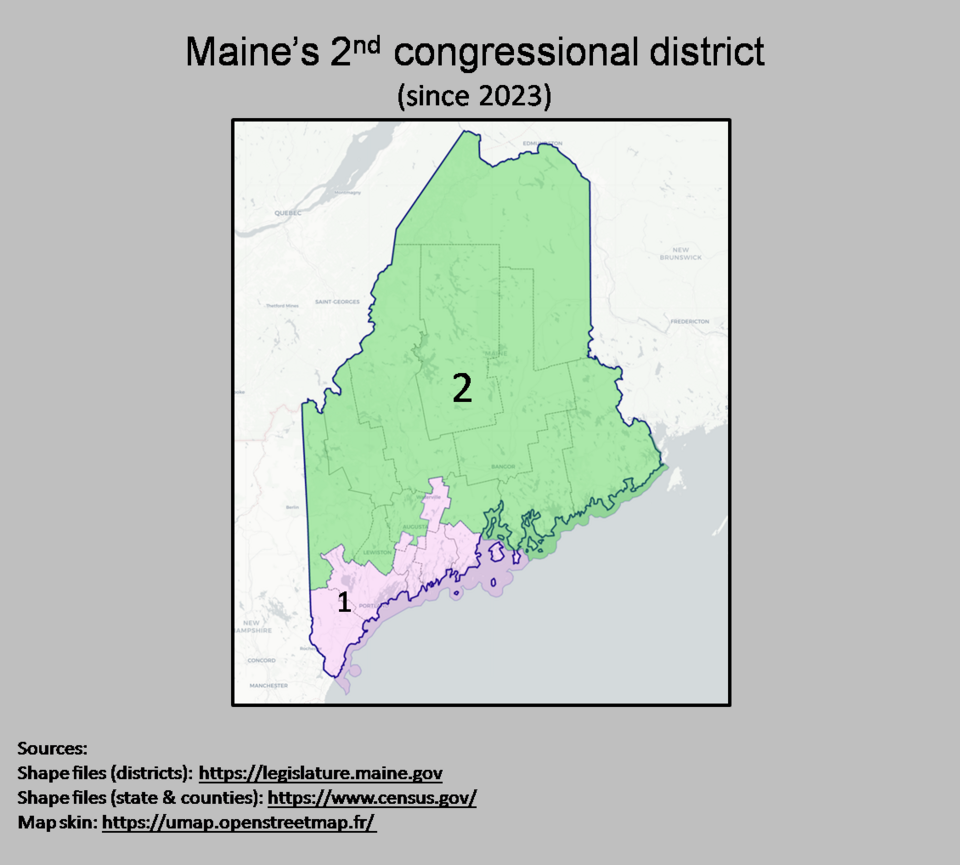
It encompasses a sprawling, heavily rural area composed of thick woodlands, rugged northern coastlines, and working-class mill towns like Lewiston and Bangor.
Politically, District 2 has developed a starkly different voting history than the reliably Democratic District 1. Though it historically supported Democrats for a quarter-century, the district underwent a significant political shift in modern elections. Republican Donald Trump successfully carried the district in 2016, 2020, and 2024, consistently securing its single electoral vote. This independent, conservative streak contrasts sharply with the southern, suburban, and coastal demographics of District 1. It establishes District 2 as a pivotal ideological counterweight.
Maine’s First Presidential Elections
Maine was admitted as a U.S. state in 1820. From 1824 to 1856, Maine voted for a mix of Democratic-Republican, National Republican, Democratic, Whig, and Republican presidential candidates.
Republican Beginnings
When the Civil War occurred, a new GOP was formed in the 1850s due to its opposition to slavery. Maine, which entered the Union as a free state under the Missouri Compromise, quickly embraced the new party. The state voted solidly for Republican nominee Abraham Lincoln in 1860 and would continue this pattern throughout the rest of the 19th century. There would be some Democratic nominees like Samuel J. Tilden, Winfield S. Hancock, and Grover Cleveland that would crack 40 percent in the state, but none in the latter half of the 19th century would carry Maine or contest it.
Early Twentieth Century
Maine started out the twentieth century continuing its successive winning streak for Republican Presidential nominees. However, the 1912 U.S. Presidential election would show a break in this pattern.
That year, a split had occurred in the Republican Party. Former President Theodore Roosevelt became at odds with his successor, William H. Taft, whom the former had handpicked as a nominee. Therefore, Roosevelt ran under the Progressive Bull Moose Party.
This, combined with a backlash to the Taft presidency, enabled Democratic nominee Woodrow Wilson to win Maine in 1912. That year, Wilson became the first Democratic nominee to win Maine and the last to do so until 1964. Four years later, Wilson would lose Maine to Republican nominee Charles Hughes.
However, the former came really close to winning Maine, as he had gained popularity among the state’s voters who had supported Teddy Roosevelt in 1912, as well as some of his agricultural policies.
When the 1920’s began, there was a nationwide backlash against the Wilson presidency due to the country having been at war. Therefore, the decade known as the Roaring Twenties saw the Republican nominee’s dominance of Maine return in the midst of three consecutive landslides for the party. Things were about to change all across the country, but that wouldn’t stop Maine from continuing to vote Republican at the presidential level.
Maine stays Republican during the Great Depression
In 1932, the United States had entered the Great Depression, and the presidency of Republican Herbert Hoover was mostly blamed for the crisis. That resulted in the Democratic nominee winning four consecutive presidential landslides.
However, Maine, along with Vermont, were the only two U.S. states to never vote for FDR in any of his landslides. In addition, Maine ended up being the only state that voted for Woodrow Wilson during one of his two landslides to never vote for FDR.
Nonetheless, the latter ended up making some headway in his first two national landslides in Maine, cracking 40 percent of the vote. In the 1940 and 1944 presidential elections, FDR ended up almost winning Maine as Wilson had nearly done so in 1916. The wartime economic boom and popularity of some of FDR’s foreign policy attracted Maine voters.
The 1948 Presidential Election saw Harry Truman pull off a narrow national victory and, although cracking the 40 percent mark in Maine, lost the state decisively to Thomas Dewey. The Republican dominance of Maine was about to return.
Back to Voting Solidly Republican
In the 1950’s, Republican Dwight D. Eisenhower, a popular World War II hero, presented policies that appealed to voters across party lines and got many northern states, such as Maine, back to voting solidly Republican at the presidential level. Eisenhower’s Vice President, Richard Nixon, ran for President in 1960 against Democrat John F. Kennedy in one of the closest races in U.S. History. Although from Massachusetts, Kennedy, despite cracking 40 percent of the vote in Maine, lost the state decisively to Nixon that year but ended up pulling off a narrow victory nationwide.
Maine Goes Democratic in the 1960’s
After the assassination of John F. Kennedy in 1963, many Americans, who were still in mourning by the time of the 1964 U.S. Presidential Election, had endeared themselves to President Lyndon Johnson. In addition, that year’s Republican nominee, Barry Goldwater, was seen as too conservative for the mainstream. His brand of Republicanism turned away many regular Republican voters, especially those in the Northeast.
In 1964, Lyndon Johnson became the first Democrat since Woodrow Wilson in 1912 to win the state of Maine. Unlike the latter, though, Johnson carried Maine very decisively.
Four years later, Johnson’s Vice-President, Hubert Humphrey, was the Democratic nominee.

Humphrey chose Democratic Senator Edmund Muskie, who was from Maine, as his running mate. This helped Humphrey win Maine decisively over the returning Nixon, who, at least, cracked the 40 percent mark in Maine, unlike Goldwater four years prior. This would be the last Democratic win in Maine until 1992.
Nonetheless, one could say it was an indicator that the type of Republicanism that Maine had previously supported was going through changes and split into different counterparts.
Back to the Republican Party
In the 1972 Presidential election, like how Barry Goldwater had been too conservative for the mainstream, Democratic nominee George McGovern was seen as too far to the left. Then President Nixon, a moderate Republican who had won Maine in 1960 but lost it in 1968, won Maine decisively in 1972. In fact, no presidential candidate of any party has come close to Nixon’s percentage of votes in Maine that year. That was also the first election that Maine’s first and second districts were counted as part of the Electoral College.
After Nixon resigned from office in 1974, his vice president, Gerald Ford, another moderate Republican, assumed the Presidency. Although Ford gained some political capital distancing himself from his predecessor, many Americans wanted to put Watergate and Vietnam behind them.
Democratic nominee Jimmy Carter, from Georgia, was a Washington outsider who promised to restore dignity to Washington, D.C. Besides his native South and a few states in the Midwest, Carter was able to score wins in Northeastern states like New York, Massachusetts, and Rhode Island, which had begun starting voting Democratic at the presidential level before much of New England. Nonetheless, he did contest northern states like New Jersey, Connecticut, and even Maine. Ford defeated Carter in Maine by less than one percentage point.
Reagan, Carter and the 1980 Election
Four years later, Carter’s presidency had disappointed many as the country was facing high unemployment, double-digit inflation, and the Iranian hostage crisis. The Republican nominee, on the other hand, Ronald Reagan, while gaining much momentum during his 1980 campaign, was seen as too conservative for some traditional Republicans at the time, especially those in the Northeast. Liberal Republican John Anderson ran as an Independent nominee that year, offering an alternative to those disappointed with Carter, who had also been challenged in the Democratic primary by the more liberal Teddy Kennedy, but hesitant about Reagan.
Not surprisingly, Reagan won Maine; however, the state was once again contested. Much of this can be attributed to the Republican base in the state, and some Democratic voters voting for Anderson, who did pretty well in Maine in the 1980 presidential election. That year, due to Anderson’s presence on the ticket, Maine would end up being one of the only states where Carter flipped counties he had lost in 1976.
Last Republican Wins
By 1984, Reagan had gained popularity across the United States as the economy, whether he was responsible for it or not, had recovered, and there was a renewed sense of hope among many Americans. Unlike in 1980, Reagan won Maine decisively in 1984, even coming close to matching Nixon’s numbers in the state in 1972. Four years later, Reagan’s vice president, George H.W. Bush, ran for the presidency. Although claiming Texas as his home state, Bush was actually originally from the Northeast, even owning a residence in Maine. While his opponent, Massachusetts governor Mike Dukakis, was able to make some headway in the Northeast, it did not prevent Bush from carrying Maine decisively in the 1988 presidential election. However, this would be the last time a Republican nominee would carry Maine at large in a presidential election and the last time one would carry any of its districts until 2016.
Maine Transforms Into Democratic State
In the 1992 U.S. Presidential election, the Republican Party was split, as Bush, who initially had high approval ratings, had been challenged by Pat Buchanan. Also, the country had seen a slight recession in 1992. Democratic nominee Bill Clinton was offering a Democratic platform that appealed to voters across different ideologies.
Also, Ross Perot ran as an Independent nominee, offering an alternative to those disappointed with Bush’s presidency but were hesitant about voting for Clinton due to his past character issues. Clinton ended up becoming the first Democrat to win Maine since 1968.
Maine would end up proving to be one of Ross Perot’s strongest states in 1992. In fact, it was one of the only states where Bush came in third.
Perhaps it was an indicator that, at the time, the state of Maine, while moving away from the national Republican Party, had not totally entered the Democratic fold yet. Nonetheless, it started a Democratic win streak for Maine at large that still persists today, although one of its districts has voted Republican in recent elections.
Bill Clinton won Maine once again in 1996, this time more decisively, though. Republican nominee Bob Dole had trouble bringing back areas of the country that had previously voted Republican to his side. Also, Ross Perot, who once again ran, was not as much a factor this go-around.

The Democratic Shift Takes Hold
The 2000 presidential election proved to be the closest election since 1960. That year, Republican nominee George W. Bush won a narrow national victory following a controversial recount in Florida. Although his father had carried Maine in 1988, George W. Bush did not. However, he did mildly contest the state in 2000 and in 2004 when he won reelection. In addition, Bush came close to winning Maine’s 2nd district. Although Maine had become a Democratic state, it showed that, depending on the political climate, some Republicans could be competitive in Maine.
Democratic Streak Continues
By 2008, much of the country had become disappointed with the Bush administration in the midst of a huge recession and backlash against wars in the Middle East. In the midst of a nationwide victory, Democratic nominee Barack Obama pulled off a decisive win over John McCain in Maine and its second district. Four years later, he would win both once again, decisively. However, while the Democratic streak would continue in the bulk of Maine, a split was about to occur.
A Split in Maine’s Electoral College Vote
In 2016, Republican Donald Trump defeated Hillary Clinton in the Electoral College despite Clinton winning the popular vote. Trump carried Maine’s 2nd District, and decisively at that, thereby becoming the first Republican nominee since George H.W. Bush in 1988 to carry any of the state’s Districts. Clinton won Maine at-large, but third-party votes narrowed her margin, giving Trump his closest result there since 1988.
Four years later, the COVID-19 pandemic had swept the country. Trump, while gaining some political capital in the Republican Party, was also facing backlash. Considering the circumstances, the 2020 U.S. Presidential election saw a record number of mail-in votes. Both Trump and Democratic nominee Joe Biden received record numbers of votes in states. Biden won Maine-at-large and improved on Hillary Clinton’s 2016 performance. However, his margin remained below Obama’s in 2008 and 2012. Trump won Maine’s 2nd District again in 2020, marking the first consecutive Republican victories there since Ronald Reagan in 1984.
Recent Elections Reinforce the Divide
In 2024, Trump returned, running against Biden’s vice president, Kamala Harris. Trump again won Maine’s 2nd District, by a smaller margin than in 2016 but a larger share than in 2020. Harris, on the other hand, won Maine-at-large. It wasn’t quite as good as Biden’s numbers in 2020 but still better than Clinton’s in 2016. Nonetheless, Maine-at-large was one of the areas that didn’t experience a massive rightward swing from 2020.
Trump’s recent support in Maine’s 2nd District could make the area competitive in future elections. Maine-at-large tends to lean Democratic, while the 2nd District tends to lean Republican.
In a tightly contested race for the White House, Maine commands national attention out of proportion to its size. Maine’s four electoral votes are a small share of the 538 total, but its unique system makes them significant. A single congressional district can award an electoral vote to a candidate who lost the statewide vote. This distinct framework fragments the state’s political influence, allowing a lone district to become a highly localized battleground. Maine’s system can influence close national elections, showing how Electoral College rules can shape presidential outcomes.
Maine’s presidential history reflects both changing voter preferences and its unique Electoral College system. By rejecting the standard winner-take-all model, Maine ensures that its internal political diversity is directly reflected on the national stage. This distinct system elevates localized district races into high-stakes contests. Maine remains a compelling example of how electoral rules can shape presidential elections.
Sources:
National Archives — What Is the Electoral College?
Maine Secretary of State — Election Results 2024
National Archives — Distribution of Electoral Votes
Maine Legislature — Title 21-A, §802: Representation
National Archives — Electoral College Results
Maine Secretary of State — Previous Election Year Results
Maine Legislature — Title 21-A, §1205-A: Congressional Districts
Editor’s Disclaimer: This article is intended to provide factual and historical information about Maine’s Electoral College system and presidential election history. Election results, electoral-vote allocations, district boundaries, and historical information are based on publicly available government records and other cited sources. Maine’s Electoral College allocation is governed by state law, with two electors selected based on the statewide presidential vote and one elector selected from each congressional district. National Archives Readers should consult official election authorities and the cited primary sources for the most current election information.
