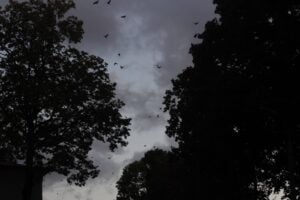
LOS ANGELES, CA — Southern California residents may notice an unusual sight during warm summer evenings: hundreds of bats suddenly appearing around sunset, circling streetlights, hovering ten/twenty feet above people walking (pedestrians), and filling the air with rapid chirping or “cawing” sounds.
While the spectacle can seem alarming, wildlife experts say it is usually a normal seasonal feeding event rather than aggressive behavior.
Why are there so many bats?
The most likely explanation is a combination of large insect hatches, warm evening temperatures, and nearby bat roosts.
Streetlights attract enormous numbers of flying insects—including moths, mosquitoes, gnats, termites, and flying ants. For insect-eating bats, those lights become a feast for them. Studies have shown that artificial lighting concentrates insects and can influence where bats choose to hunt.
Los Angeles County is home to numerous bat species, with the Mexican free-tailed bat among the most common urban residents. These bats are known for forming colonies that can range from dozens to tens of thousands of individuals, emerging around dusk to feed.
Why do they fly so close to people?
Although bats sometimes appear to dive directly at pedestrians, they are almost never targeting people.
Instead, they are chasing insects that are flying around humans, parked vehicles, trees, and illuminated sidewalks. Bats use echolocation to navigate with incredible precision, allowing them to avoid obstacles while pursuing tiny flying prey.
To someone standing beneath a streetlight, the fast, unpredictable flight paths can make it seem like bats are intentionally swooping toward them when they are actually intercepting insects only inches away.
Why does it happen between sunset and 10 p.m.?
Bat activity typically begins shortly after sunset as colonies leave their daytime roosts to feed. Many species remain highly active during the first several hours of darkness, when insect populations are often at their highest.
Warm summer nights following hot days often produce ideal feeding conditions, leading to especially noticeable concentrations of bats in parks, neighborhoods, parking lots, and commercial districts.
Are the sounds normal?
Yes.
Many bat species produce rapid chirps and social calls while flying. Although most echolocation occurs at ultrasonic frequencies beyond human hearing, some vocalizations become audible when many bats are gathered together or when individuals fly nearby.
Are bats beneficial?
Despite their spooky reputation, bats are among Southern California’s most valuable nighttime wildlife.
A single bat can consume hundreds to thousands of insects in one night, helping naturally reduce mosquito and agricultural pest populations. Large colonies collectively remove enormous quantities of insects throughout the spring and summer.
Should people be concerned?
Seeing hundreds of bats around streetlights is generally considered normal during peak summer activity.
Residents should avoid handling bats or attempting to disturb roosts. If a bat appears sick, grounded, or enters a home after contact with a person or pet, local animal control or wildlife authorities should be contacted.
Otherwise, the evening flyovers are usually a sign that Southern California’s urban ecosystem is functioning as intended—with bats providing free, natural insect control across the region.
For many Angelenos, looking up shortly after sunset may reveal one of the city’s least noticed wildlife spectacles: hundreds of bats silently patrolling the night sky in search of their next meal.
