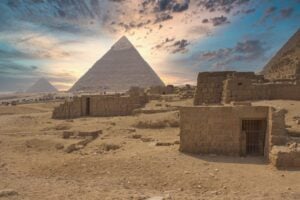
GIZA, EGYPT — More than 4,500 years ago, thousands of Egyptians participated in one of the largest construction projects in human history: building the Great Pyramids of Giza.
But beyond the enormous stone monuments that still stand today, what was everyday life like for the people who built them?
Did workers leave their families behind and travel hundreds of miles for employment? What did they eat for breakfast and dinner? Did women work, or were men expected to provide for the entire household? How young did Egyptians marry, and how much could an ordinary worker expect to earn?
Archaeological discoveries, including workers’ settlements, burial grounds, and ancient employment records, are providing answers.
According to National Geographic, the pyramid workforce was far more organized than the popular image of enslaved people hauling stones under constant punishment. Evidence indicates that many workers were compensated, fed, housed, and provided with medical treatment.
The reality was a society with specialized occupations, government-organized labor, family responsibilities, and economic opportunities—although wealth and status were distributed very unequally.
Who Actually Built the Pyramids?
The Great Pyramid of Giza was constructed during the reign of Pharaoh Khufu, approximately 2589–2566 B.C., during Egypt’s Old Kingdom.
For centuries, popular accounts suggested that enormous groups of enslaved people built the pyramids.
Modern archaeological evidence paints a different picture.
In its reporting on the Giza pyramids, National Geographic describes the workers as “paid Egyptian laborers.”
Excavations near Giza uncovered a settlement now known as Heit el-Ghurab, sometimes called the Lost City of the Pyramids. Its buildings included sleeping quarters, administrative facilities, food preparation areas, and storage spaces.
The settlement is principally associated with the later pyramids of Khafre and Menkaure, although archaeologists have also identified possible earlier remains.
Workers were organized into teams, supervised by officials, and supplied through an extensive government-supported system.
This does not mean every Egyptian laborer was free to choose their employment. Ancient Egypt also relied on compulsory labor obligations, and the precise balance between recruited, obligated, and specialist workers remains a subject of historical study.
Nevertheless, the evidence does not support the familiar image of the Giza pyramids being constructed exclusively by masses of enslaved laborers.
Did Egyptians Travel Long Distances for Work?
Yes. Some ancient Egyptians traveled considerable distances for employment, particularly when working on royal construction projects, transportation, quarrying, and trade.
The pyramid projects drew labor and resources from communities across the Nile Valley.
Some specialists lived near construction sites for extended periods. Others joined rotating work crews and eventually returned to their home villages.
National Geographic quotes archaeologist Mark Lehner describing the experience of workers living in barracks away from home:
“It really was a socializing experience.”
Lehner’s research indicates that workers rotated through the settlement, meeting people from communities beyond their own.
One of the most important discoveries supporting long-distance employment was the diary of an Egyptian official named Merer.
His records, discovered at Wadi al-Jarf near the Red Sea, document the transportation of limestone from the Tura quarries to the Great Pyramid construction site.
Merer supervised a crew of approximately 200 workers who transported materials by boat, traveled along the Nile, and spent nights at different locations.
The records describe journeys lasting several days, with crews repeatedly traveling between quarries and construction facilities.
National Geographic’s account of these ancient documents demonstrates that organized work-related travel was already a significant part of Egyptian life.
For a worker living in a rural farming community, joining a royal construction project could mean spending weeks or months away from home, depending on the assignment.
However, historians cannot establish an average commuting distance. Most farmers and local craftspeople probably worked much closer to home than specialized transport crews.
What Did Pyramid Workers Eat Every Day?
Food was central to both daily life and employment in ancient Egypt.
Bread and beer were dietary staples, but archaeological evidence suggests that some pyramid workers received a surprisingly varied diet.
National Geographic reports that workers consumed bread, meat, dates, honey, legumes, and beer. Excavations have also uncovered evidence of fish, poultry, cattle, sheep, goats, and pigs.
A typical diet could include:
- Bread: Usually made from wheat or barley, eaten regularly throughout the day.
- Beer: A common grain-based drink consumed by adults and supplied as part of labor rations.
- Vegetables and legumes: Including onions, garlic, beans, and lentils.
- Meat and fish: More readily available to some well-provisioned construction crews than to poorer rural households.
- Fruit: Dates and figs, with other produce varying by location and season.
- Honey: A valuable sweetener that could be included in provisions for certain workers.
The Ancient Egypt Research Associates organization, which has conducted extensive excavations at Giza, has investigated the bakeries and brewing facilities used to support the workforce.
Researchers even recreated ancient bread-making methods using archaeological evidence and traditional ceramic baking molds.
For an ordinary farming family, eating meat frequently may have been a luxury. But for certain workers involved in royal construction, access to meat and other provisions could be a meaningful benefit of employment.
It is important to distinguish between the documented food supplies and an exact daily menu: archaeologists cannot tell us precisely what every worker ate for breakfast, lunch, and dinner.
How Much Did Ancient Egyptian Workers Earn?
Ancient Egypt did not operate with modern salaries, hourly wages, or paper currency during the pyramid-building period.
Instead, compensation commonly came in the form of food, grain, textiles, and other valuable goods.
National Geographic explains that workers were paid in measures of grain, with compensation depending on their position in the labor hierarchy.
The diary of Merer includes administrative records tracking workers’ rations and supplies.
A general laborer might receive food provisions sufficient for basic subsistence, while supervisors, specialized craftspeople, and higher-ranking officials could receive more substantial allocations.
| Type of worker | Documented or likely compensation |
|---|---|
| General construction laborer | Food and grain rations; provisions varied by assignment |
| Skilled stoneworker or carpenter | Rations and potentially additional goods |
| Boat crew member | Food provisions; some documented crews also received textiles and special foods |
| Team supervisor | Rank-based allocations, potentially larger than those of ordinary workers |
| Senior government official | Access to institutional resources and privileges tied to office and status |
There is no reliable surviving figure for the average daily wage of all pyramid workers, and converting their compensation into modern U.S. dollars would be misleading.
However, the value of employment extended beyond food alone.
Some workers were provided with housing, medical care, and supplies. For a person from a farming community, these benefits could represent considerable economic security, although the evidence does not establish that all laborers enjoyed the same conditions.
Did Only Men Work, or Did Women Also Have Jobs?
Women contributed significantly to ancient Egypt’s economy, although their work was often different from that performed by men.
Men dominated many physically demanding state construction jobs, including quarrying, hauling stone, and transporting heavy building materials.
Women, however, participated in agriculture, food production, weaving, household management, trading, and other occupations.
According to the Egypt Exploration Society, women worked in farming, produced clothing, sold goods in markets, and sometimes managed responsibilities on behalf of their husbands.
In some circumstances, women could also hold religious, administrative, or specialized professional positions.
The economic structure of an ordinary household therefore depended on contributions from multiple family members.
A husband might work on a construction project while his wife managed farming, food preparation, children, and household resources. In another family, both adults might participate in agricultural production.
Children also contributed as they became old enough to perform useful tasks.
The idea that ancient Egyptian women universally stayed home without participating in economic activity is inaccurate. Much of their labor simply took place within households, farms, and local markets rather than the highly visible royal construction projects.
At What Age Did Egyptians Get Married and Move Out?
Marriage was an important part of family life in ancient Egypt, and people often married younger than is typical in many modern societies.
Historical estimates frequently suggest that women married during their teenage years, sometimes around ages 12–14, while men often married somewhat later, around their late teens or twenties.
A scholarly review published in Acta Paediatrica describes approximately age 20 for men and 12–14 for girls as traditional marriage-age estimates.
However, these figures should not be treated as a verified average for pyramid workers around 2500 B.C. Much of the surviving evidence concerning marriage ages comes from later periods of Egyptian history.
There is also no reliable national average for the age at which children moved out of their parents’ homes during the Old Kingdom.
Marriage could mark the establishment of a new household, but young couples might remain close to relatives or depend on extended family networks.
Ancient Egyptian households were often closely connected across generations.
The Metropolitan Museum of Art describes Egyptian families as tightly knit, with parents, children, and grandparents frequently represented together in funerary artwork. Metropolitan Museum of Art Resources
Unlike the modern expectation that young adults should become financially independent at a particular age, ancient Egyptian family arrangements were closely tied to agricultural production, inheritance, marriage, and household responsibilities.
What Jobs Were Available in Ancient Egypt?
The pyramids required much more than people capable of moving large stones.
A vast network of workers supported Egypt’s construction projects and its broader economy.
| Occupation | Primary responsibilities |
|---|---|
| Farmer | Grow grain, vegetables, and other crops |
| Stoneworker | Quarry, shape, and position building materials |
| Carpenter | Make tools, sledges, furniture, and wooden structures |
| Boat operator | Transport people, stone, food, and supplies |
| Scribe | Maintain records, inventories, and administrative accounts |
| Baker or brewer | Produce bread and beer |
| Weaver | Manufacture clothing and textiles |
| Merchant or trader | Exchange and distribute goods |
| Overseer | Supervise workers and organize production |
| Priest | Conduct religious ceremonies and temple activities |
| Physician | Treat injuries and illnesses |
| Government official | Manage resources, estates, labor, and royal projects |
Agriculture was the foundation of Egypt’s economy, but royal construction created demand for many specialized trades.
A successful pyramid-building operation required workers who could coordinate supplies, produce tools, manage food distribution, maintain boats, record inventories, and supervise large teams.
These occupations were part of a broader economic system that connected farms, villages, quarries, ports, and administrative centers.
How Did Someone Get Their Job or Become a Supervisor?
For many Egyptians, career opportunities were influenced heavily by family background.
A farmer’s child might learn agriculture from relatives, while the child of a carpenter or another craftsperson could grow up learning that trade.
Skills were frequently passed between generations through practical experience.
Education offered another route, particularly for boys whose families could obtain scribal training.
Learning to read, write, and maintain records could open opportunities in government administration, accounting, and royal institutions.
The Metropolitan Museum of Art notes that sons sometimes inherited their fathers’ offices, but individuals from less wealthy backgrounds could also rise through education and ability.
Still, ancient Egypt was a highly hierarchical society. Family connections, wealth, status, and access to training strongly influenced opportunities.
Merer’s career provides an example of a skilled administrative position within the pyramid workforce.
As an inspector, he supervised workers, coordinated transportation, and documented the movement of materials.
Above him were senior officials responsible for larger portions of the royal construction program.
National Geographic identifies Ankhhaf, a relative of Pharaoh Khufu, as a high-ranking official overseeing royal works.
Such positions demonstrate the difference between ordinary manual labor, skilled supervision, and elite government authority.
What Were Their Homes and Family Lives Like?
Most ordinary Egyptian homes were constructed from mudbrick rather than the enormous stone blocks used for royal monuments.
A typical modest household might contain living and sleeping areas, storage spaces, cooking facilities, and a courtyard.
Furniture was relatively simple compared with that of wealthy households.
Families used baskets, pottery containers, wooden stools, woven mats, and other practical household goods.
Daily life revolved around food preparation, work, child-rearing, religious practices, and maintaining the household.
Children played with toys and participated in family activities. Some boys received formal education, while many children learned practical skills through daily work.
At the pyramid workers’ settlement, however, living arrangements could be quite different.
Workers staying temporarily at Giza may have slept in shared barracks rather than private family homes.
National Geographic reports that the workers’ community also included craftspeople and others responsible for feeding, clothing, and supplying the construction workforce.
For a worker accustomed to a small agricultural village, life at Giza may have offered new social experiences alongside demanding physical labor.
Was Pyramid Construction Dangerous?
Yes. Moving and positioning massive stone blocks was physically demanding and potentially hazardous.
Archaeologists examining workers’ remains have identified evidence of serious injuries, including broken bones.
Yet some of those injuries healed successfully.
Egypt’s Ministry of Tourism and Antiquities reports that many workers buried near the Giza settlement had healed fractures, suggesting access to medical treatment.
This evidence challenges the assumption that injured workers were always abandoned or considered expendable.
However, it does not establish modern standards of workplace safety or tell us how frequently fatal accidents occurred.
How Long Did Egyptians Live?
Life expectancy in ancient Egypt was considerably lower than in the modern world, especially among poorer communities.
Some historical demographic estimates place adult lifespans among ordinary Egyptians in roughly the thirties or forties, although the exact figures vary considerably by period and population.
High infant and childhood mortality also reduced life expectancy at birth.
An individual who survived childhood could live substantially longer than the average life-expectancy figure might suggest.
Wealthier Egyptians generally had advantages in food availability, housing, and access to care.
Surviving skeletal remains and burial evidence indicate that some people reached their sixties or beyond, but these ages should not be considered typical for all workers.
Importantly, there is no sufficiently complete population record to establish a precise average lifespan specifically for the builders of the Great Pyramid.
How Pyramid Construction Helped Shape Egypt’s Economy
Perhaps the most remarkable aspect of pyramid construction was not simply the engineering required to stack millions of tons of stone.
It was the economic organization necessary to support the people doing the work.
Construction required food from agricultural regions, materials from distant quarries, transportation along the Nile, copper from Sinai, and a substantial administrative workforce.
Farmers, merchants, sailors, craftspeople, and government officials all played a role.
National Geographic explains that these massive projects encouraged the development of farms, trade networks, and supply systems that continued to serve Egyptian society after the largest pyramids were completed.
The pyramids were therefore not merely royal tombs.
They were also the products of an economy capable of coordinating thousands of people, supplying workers with provisions, and moving resources across great distances.
The Human Story Behind the Pyramids
Today, visitors from around the world travel to Egypt to see the Great Pyramids of Giza.
The monuments are celebrated for their enormous size, precise construction, and survival across thousands of years.
But the lives of the people who built them may be just as remarkable.
They were farmers, boat operators, stoneworkers, carpenters, scribes, bakers, and supervisors. They belonged to families, learned occupations, traveled for work, and received compensation through systems that existed long before modern money or employment contracts.
Some spent extended periods away from home. Others worked in communities near where they had grown up.
Their opportunities differed greatly according to social position, family connections, and occupation.
Although many questions about their private lives remain unanswered, archaeological discoveries have brought the workers themselves into clearer focus.
The pyramids represent more than the accomplishments of Egypt’s pharaohs. They are also a lasting record of the ordinary people whose labor, knowledge, and organization helped build one of history’s most extraordinary civilizations.
Sources:
- National Geographic: How Were the Pyramids of Giza Built? — Workers’ settlements, food, labor organization, and construction.
- National Geographic: This Ancient Diary Reveals How Egyptians Built the Great Pyramid — Merer’s diary, worker compensation, and travel.
- Egypt’s Ministry of Tourism and Antiquities: Workers’ Town and Cemetery — Archaeological evidence of housing, nutrition, and medical care.
- Egypt Exploration Society: Women in Ancient Egypt — Women’s economic and family responsibilities.
- The Metropolitan Museum of Art: The Daily Life of the Ancient Egyptians — Families, education, and occupations.