Amazon is becoming a more visible competitor in America’s rapidly developing autonomous transportation market as its robotaxi company, Zoox, expands a fleet of unusual driverless vehicles across several U.S. cities.
While Google‘s Waymo has become one of the most recognizable names in autonomous ride-hailing — particularly in cities including Los Angeles, San Francisco and Phoenix — Amazon is pursuing a distinctly different approach.
Instead of adding autonomous-driving equipment to a conventional passenger vehicle, Zoox has designed its robotaxi from the ground up.
The compact electric vehicle has no steering wheel or traditional pedals. Passengers sit facing one another inside a cabin designed specifically around autonomous transportation rather than a human driver.
And after years of development, those vehicles are beginning to move from experimental technology toward an actual transportation network.
How Many Zoox Robotaxis Are on the Road?
Zoox’s fleet remains considerably smaller than Waymo’s, but production and deployment are accelerating.
As of August 2026, Zoox had built a little more than 100 of its purpose-built robotaxis, according to Axios. The company has also reported that its vehicles have traveled more than 3 million autonomous miles and carried nearly 1 million riders across Las Vegas, San Francisco, Austin and Miami.
That figure should not be interpreted as more than 100 Zoox vehicles providing regular paid taxi service simultaneously. The company’s vehicles are distributed among commercial operations, rider programs, testing and development.
Earlier in 2026, a Zoox spokesperson told the Los Angeles Times that the company’s fleet numbered around 100 vehicles. Since then, Zoox has begun moving toward larger-scale production.
Its Hayward, California, production facility is eventually designed to support thousands of vehicles annually. Zoox has said it has the capability to ramp production toward 100 vehicles per week, subject to regulatory approvals and the company’s expansion needs.
The long-term ambition is considerably larger: the facility was designed with potential capacity of as many as 10,000 robotaxis per year.
Las Vegas Is Zoox’s First Major Commercial Market
Las Vegas has become the centerpiece of Zoox’s commercial strategy.
After initially offering free rides, the company received federal regulatory clearance during summer 2026 that allowed it to move toward charging passengers for rides in its purpose-built vehicles.
That is significant because the Zoox vehicle breaks with more than a century of automotive design. There is no conventional driver’s position because the vehicle was never intended to have a human driver.
Las Vegas therefore provides Amazon and Zoox with an opportunity to demonstrate whether a purpose-built autonomous vehicle can work as an everyday ride-hailing product rather than simply an experimental vehicle.
Where Is Zoox Operating?
Zoox’s footprint now extends well beyond Nevada, although the type of operation varies significantly from city to city.
Las Vegas, Nevada is its primary commercial market and the most developed example of the Zoox passenger experience.
San Francisco, California has been another major development market. Zoox has expanded its service area in the city while making rides available to select riders.
Austin, Texas, and Miami, Florida have progressed from testing locations into rider programs as Zoox prepares for broader service.
The company is also testing or developing autonomous operations in additional cities, including Los Angeles, Atlanta, Seattle, Washington, D.C., Dallas and Phoenix.
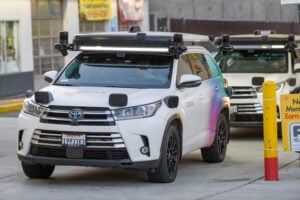
Not every Zoox vehicle seen in those markets is necessarily the company’s steering-wheel-free robotaxi. Zoox has also used modified Toyota Highlanders equipped with its sensors and autonomous-driving technology for mapping, data collection and development.
Los Angeles Is an Important Part of Zoox’s Expansion
Los Angeles could eventually become one of the most significant battlegrounds between Zoox and Waymo.
Zoox first began deploying mapping vehicles in Los Angeles in 2025, initially using manually driven Toyota Highlanders equipped with the company’s sensor technology.
The company has continued developing its Los Angeles operations, but consumers should not confuse those tests with the commercial Zoox service now operating in Las Vegas.
As of September 2026, Zoox does not yet operate a general paid robotaxi service for Los Angeles passengers.
That is expected to change.
Zoox and Uber announced a partnership in March 2026 that will make Zoox vehicles available through Uber’s ride-hailing network. The partnership begins in Las Vegas before expanding to Los Angeles by approximately mid-2027.
The arrangement is notable because it gives Amazon-backed Zoox access to an established ride-hailing platform rather than requiring every passenger to discover and download the Zoox app independently.
For Los Angeles residents, it could eventually mean opening Uber and being matched with a vehicle that has no driver — and no steering wheel.
Zoox Versus Waymo
Zoox is entering a market in which Waymo already has a substantial head start.
Waymo has deployed a much larger fleet and has accumulated significantly more autonomous miles and passenger trips. Its vehicles have also become increasingly common on Los Angeles streets.
But the two companies are approaching autonomous transportation differently.
Waymo’s current fleet primarily adapts conventional automobiles by installing the company’s autonomous-driving hardware and software. Zoox instead wants the entire vehicle — its shape, seating arrangement, doors, sensors and controls — designed around the assumption that nobody will ever sit behind a steering wheel.
That difference could become increasingly important as autonomous transportation scales.
A conventional-looking autonomous vehicle may make the transition to driverless transportation feel familiar. Zoox is effectively arguing that removing the driver creates an opportunity to rethink what the automobile itself should look like.
Amazon Has the Resources to Scale
Amazon acquired Zoox in 2020, giving the autonomous-vehicle developer the backing of one of the world’s largest technology companies.
Scaling robotaxis requires far more than developing autonomous-driving software. Companies need vehicles, manufacturing facilities, maintenance operations, charging infrastructure, remote support systems, insurance, regulatory approvals and physical locations where fleets can be cleaned and serviced.
Zoox’s strategy is particularly ambitious because the company intends to control much of that ecosystem itself.
Its California manufacturing operation represents a major piece of that strategy. Although just over 100 purpose-built vehicles is small compared with the number of conventional taxis and ride-hailing vehicles operating across the United States, the ability to eventually manufacture thousands of robotaxis annually could change the scale of the competition quickly.
The Robotaxi Race Is Becoming a Real Transportation Market
For years, autonomous taxis appeared to be technology demonstrations perpetually waiting for the future.
That future is increasingly visible on American streets.
Waymo is already transporting passengers across multiple major metropolitan areas. Zoox is carrying riders and beginning commercial operations. Tesla is developing its own robotaxi strategy, while Uber is increasingly positioning itself as the platform connecting passengers with autonomous fleets developed by other companies.
Los Angeles may become one of the clearest places to watch that competition unfold.
Waymo vehicles are already carrying passengers around the region. Zoox vehicles are being tested there today, with commercial availability through Uber planned for 2027.
The approximately 100-plus Zoox robotaxis currently built represent only the beginning if Amazon’s manufacturing plans materialize.
The larger question is no longer simply whether autonomous taxis will reach American cities.
It is which companies — and which type of driverless vehicle — passengers will ultimately choose when several of them arrive on the same streets.
