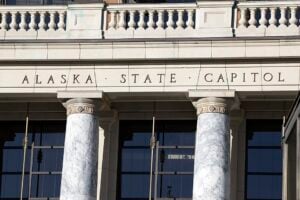
Alaska is the only U.S. state besides Hawaii that is not part of the continental United States. Like the latter state, the former is also one of the more recent states to be admitted to the nation. Both Alaska and Hawaii were admitted to the union in 1959, with the former receiving statehood first. As one of the nation’s newest states, Alaska—known as the Last Frontier—has participated in fewer presidential elections than most other states, a distinction it shares with Hawaii.
Since it became a state, Alaska has consistently voted Republican in all but one U.S. presidential election. Along with states such as Wyoming, Utah, and Idaho, Alaska has one of the nation’s longest Republican presidential voting streaks.
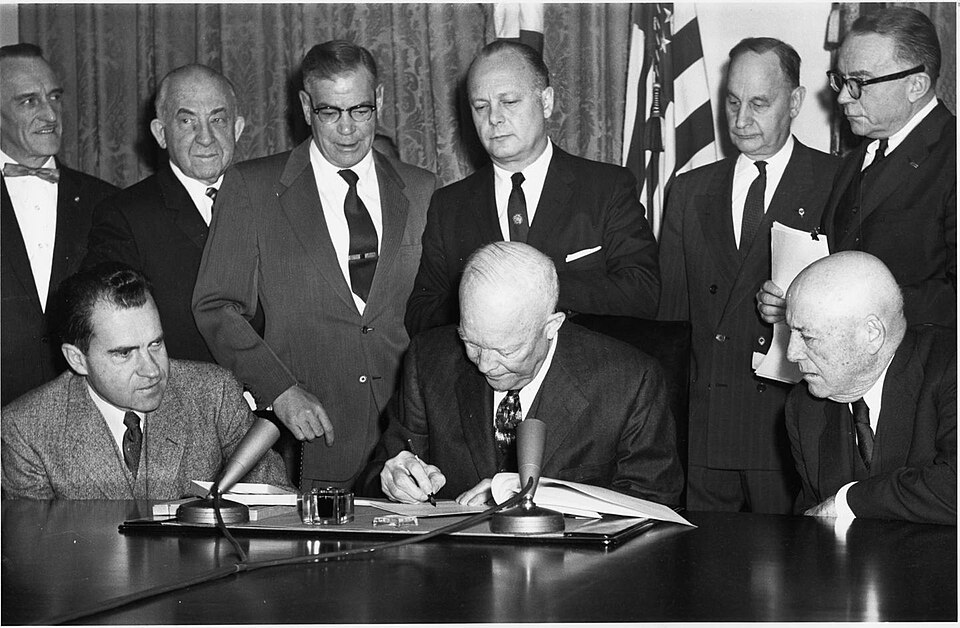
A Close Battle to Start
Held just over a year after Alaska became a state, the 1960 U.S. presidential election in Alaska was a close race, with Republican Richard Nixon narrowly defeating John F. Kennedy, the man who ultimately won the national election. The close race reflected Alaska’s strong Democratic territorial roots and Nixon’s extensive campaigning in the new state.
Johnson’s Historic Victory
Four years later, the United States was still in mourning after JFK’s assassination. Many voters got behind President Lyndon Johnson, who assumed the presidency following Kennedy’s untimely passing. In addition, the 1964 Republican nominee was Barry Goldwater, a candidate whose platform seemed too conservative for the mainstream. Therefore, the 1964 U.S. presidential election in Alaska is historic in that it marks the first and only time that a Democratic nominee, Johnson, has carried the state, and very decisively at that. It’s also the last time a Democratic presidential nominee has swept all of Alaska’s boroughs, the state’s equivalent to counties.
Another Close One
In 1968, after Lyndon Johnson dropped out of the race, Alaska’s electorate shifted back to the competitive nature that was seen in its first presidential election eight years prior. Coincidentally, the same candidate that had barely carried the state in 1960, Richard Nixon, also won Alaska by a slim margin in 1968. In the 1968 U.S. presidential election, Nixon defeated Hubert Humphrey by a margin of 2.64 percentage points. This would be the closest a Democratic presidential nominee has come to carrying Alaska since it last went Democratic four years prior. Humphrey’s performance would be the third best for a Democrat in Alaska, behind John F. Kennedy’s narrow loss in 1960, and, of course, LBJ’s landslide win in the state in 1964.
In addition, this would be the last time that a Democratic nominee would win over 40 percent of the vote in Alaska until Barack Obama in 2012, nearly 45 years later. Interestingly, Independent nominee George Wallace, whose main base of support was in the Deep South, did reasonably well in Alaska, very surprising in that it was in a state whose geographic location within the United States was farthest from the south. Wallace received about 12 percent of the vote in Alaska. His performance demonstrated that third-party and independent candidates could attract meaningful support in the state.
Alaska Becomes a Solid Republican State
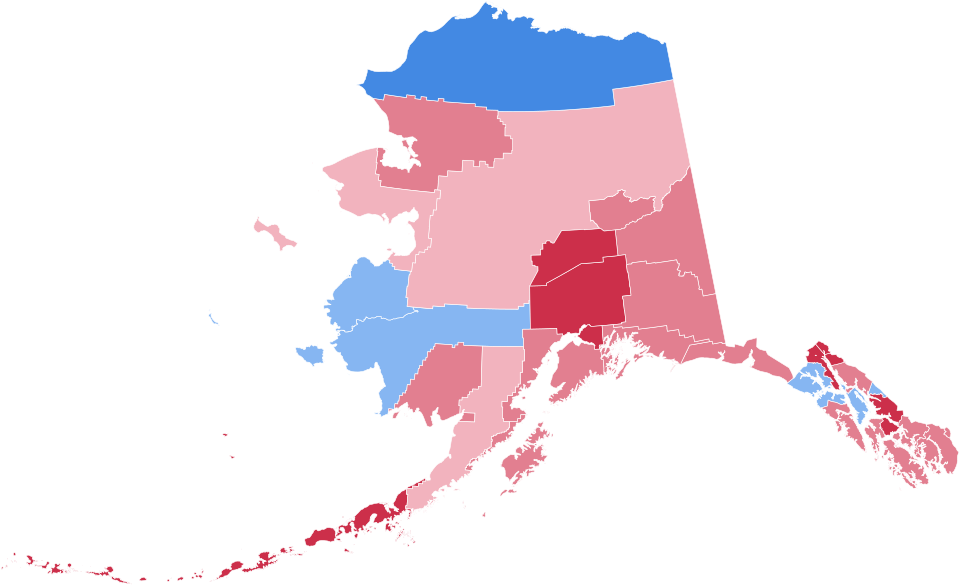
https://commons.wikimedia.org/wiki/File:Alaska_Presidential_Election_Results_1972.svg
https://creativecommons.org/licenses/by/4.0/
The 1972 U.S. presidential election, which this time featured Nixon as both an incumbent president and candidate, was the start of a series of Republican-dominated races in Alaska that still continues today, albeit recent numbers haven’t been as Republican as others. In this election, instead of a Republican nominee that was seen as too far to the right of the mainstream, it was Democratic nominee George McGovern that was perceived as too far to the left. In the midst of Nixon’s massive landslide in 1972, Alaska followed suit with most of the rest of the nation in giving the incumbent president a decisive win.
However, like how Wallace had received a substantial amount of votes for an Independent nominee four years prior, 1972 saw American Independent nominee John G. Schmitz get a little over 7 percent of the vote in Alaska. It was the start of a continuous pattern of decisive Republican wins in Alaska, with Independent/3rd party nominees receiving some of their greatest percentages nationwide.
Republican Landslides with 3rd Party Gains
Gerald Ford assumed the presidency after the resignation of Nixon following the aftermath of Watergate. While Ford attempted to distance himself from his predecessor, many Americans had become dissatisfied with American politics. The 1976 U.S. presidential election pitted Ford against Jimmy Carter, a Washington outsider promising to restore dignity to the White House. Despite Carter’s narrow win that year nationwide, Alaska proved to be one of Ford’s strongest states. Meanwhile, the Libertarian nominee that year, Roger MacBride, received a little over 5 percent of the vote in Alaska in 1976.
By 1980, the United States was overwhelmed by high unemployment, double-digit inflation, and the Iranian Hostage Crisis. Incumbent Carter was vulnerable while Republican nominee Ronald Reagan gained steam. However, while many voters were stressed about Carter, there were also many voters who viewed Reagan as too conservative. John Anderson, a socially liberal Republican, decided to run as an Independent nominee while Ed Clark was the Libertarian nominee.
Not surprisingly, Reagan won Alaska handily in 1980 in the midst of a nationwide landslide win. Carter received a little over 26 percent of the vote, which to this date is the lowest percentage of a Democratic nominee in a presidential election in Alaska. Of course, third party nominees did relatively well. However, although Anderson received a substantial amount of support for an Independent presidential nominee nationwide, in Alaska, he did not do as well as Libertarian Ed Clark, as the latter received a little over 11 percent support in the state while the former got a bit more than 7.
The Strongest Republican Win in Alaska to Date
When the 1984 U.S. presidential election was approaching, the nation’s economy had recovered, and a good many people were feeling positively about President Reagan. His opponent was Walter Mondale, who had served as Carter’s vice president. This time, there weren’t as many prominent 3rd party nominees. Due to all of these factors, 1984 not only saw Reagan win an even more convincing landslide, this time a 49-state win, but also witnessed him get the best performance of any presidential nominee in Alaska, both by percentage and margin of vote.
The Trend Continues
The 1988 U.S. presidential election saw Reagan’s vice president, George H.W. Bush, carrying on the Republican torch as he faced off against Democratic nominee Mike Dukakis. As expected based on Alaska’s voting history, 1988 was another solid win for the Republicans. However, the presence of 3rd party nominees in Alaska was visible once again. The Libertarian ticket of Ron Paul and Andre Marrou, who was actually from Alaska, garnered nearly 3 percent of the vote in Alaska that year, which, while extremely low, was not bad considering their nationwide totals.

Alaska Returns to the Single Digits
Four years later, Alaska saw a break in its presidential pattern. Regarding the national political climate, the popularity of George H.W. Bush had faded following a small recession and a dip in his conservative base as Pat Buchanan challenged him in the 1992 Republican primary. Meanwhile, Democratic nominee Bill Clinton was presenting himself as a ‘new Democrat’ who championed both liberal and conservative ideals. On the other hand, Texas Billionaire Ross Perot had gained steam as a prominent Independent presidential nominee.
Due to these factors, Bush won Alaska in 1992 by single digits. This remains the last time a Republican presidential nominee has carried Alaska by a single-digit margin. Since Perot was such a formidable presence that year, he did very well in Alaska that year, receiving 28.43 percent of the vote in the state. Alaska ended up being Perot’s strongest state after Maine. Alaska’s own Andre Marrou was the Libertarian nominee this year but trailed far behind Perot.
Back to the Norm
In 1996, President Bill Clinton was presiding over a healthy economy. This time, he was challenged by Republican Bob Dole and once again by Ross Perot, this time running under the Reform Party. With Perot’s candidacy not as much of a factor as four years prior, Alaska voted even more Republican this time around, even being the fifth strongest state for Dole to win in 1996. Clinton received an estimated 33 percent of the vote in the state, which, while very low, was not too bad for a Democratic nominee within such a solidly Republican state influenced by 3rd party nominees. Although he did not perform as well as four years earlier, Perot still got 10.9 percent of the vote while Green Party nominee Ralph Nader got a little over 3 percent.
The 2000 U.S. presidential election proved to be the closest in U.S. history since 1960. However, that didn’t stop Republican nominee George W. Bush from obtaining a landslide win in Alaska over Democratic nominee Al Gore, who only received a little more than 27 percent of the vote. This time, Green Party Nominee Ralph Nader garnered a little over 10 percent of the vote.
Although 2004 would prove to be another close race, President George W. Bush easily won Alaska over John Kerry while third-party nominees, including Ralph Nader, were not as heavily featured this go-around. The 2004 presidential election, though, would prove to be the last time that a winning nominee would receive over 60 percent of the vote.
Alaska’s own Sarah Palin

https://commons.wikimedia.org/wiki/File:Sarah_Palin_(51769866572)_(cropped).jpg https://creativecommons.org/licenses/by-sa/2.0/
Alaska legislator Andre Marrou may have been the Libertarian vice presidential and presidential nominee in 1988 and 1992, respectively, but, in 2008, Alaska Governor Sarah Palin proved to be the first vice-presidential nominee of one of the two major political parties. Senator John McCain, who was the 2008 Republican presidential nominee, chose Palin as his running mate. While Alaska was expected to vote Republican in 2008, McCain’s choice of Palin coincided with strong Republican support in Alaska. Nationally, however, the Republican ticket faced a difficult political environment. Democratic nominee Barack Obama campaigned on the slogan ‘Change,’ in a year when many Americans were distraught as a financial crisis had begun and there was backlash against Bush’s foreign wars.
In the end, McCain carried Alaska. Although his percentage and margin of victory were not as big as Bush’s had been four years prior, he did get a larger raw number of votes in Alaska in 2008. In fact, McCain’s raw number of votes, 193,841, that year is the largest of any presidential nominee in any of Alaska’s presidential elections. Not even Donald Trump, who received either the highest raw number of votes in many U.S. states in 2020 and 2024 of either a Republican nominee or nominee overall, could surpass this. However, Obama received a little over 37 percent of the vote, a sign that while Alaska would remain heavily Republican, Democrats were about to make some small gains in the Last Frontier. The 2008 election proved to be the last time the winning nominee obtained over 55 percent of the vote.
Small Democratic Gains and Return of 3rd Party Presence
The 2012 U.S. presidential election pitted Barack Obama against Mitt Romney. With Sarah Palin not on the ticket this time, the Democratic Party was able to make some gains this time as Obama became the first Democratic presidential nominee to crack 40 percent in Alaska since Hubert Humphrey in 1968.
In 2016, Donald Trump won the Electoral College, defeating Hillary Clinton, who, conversely, won the popular vote. Overall, though, both nominees were considered unpopular that year, opening the door for 3rd party nominees to make a stand. In the end, Trump won Alaska decisively, but the 3rd party presence returned as Libertarian nominee Gary Johnson received almost 6 percent of the vote in the state in 2016.
Closer Than Usual
The 2020 U.S. presidential election took place during the COVID-19 pandemic, when expanded absentee and mail voting was widely used. This resulted in high levels of mail-in voting. Trump won Alaska again, but Biden received the highest percentage of votes for a Democratic nominee since Lyndon Johnson, when he won the state in 1964. Also, Trump’s margin of victory was 10.06%, which was the closest Alaska has come to being in the single digits since 1992.
In 2024, Trump became the first U.S. President to be elected to two non-consecutive terms since Grover Cleveland. He won Alaska by 13.15 percentage points over Democratic nominee Kamala Harris, who entered the race after President Joe Biden withdrew.
This was an improvement for Trump from four years prior. However, Harris still surpassed 40 percent of the vote.
Looking Ahead
Alaska has one of the longest histories of voting Republican in presidential elections in the United States. Although coming close in 1960 and 1968, the state has only voted Democratic once in a presidential election in 1964. Despite becoming a Republican stronghold, Alaska remained a state where third-party candidates could attract modest support.
In recent elections, Democratic nominees have been making small gains in the Last Frontier. Whether these trends indicate a lasting shift in Alaska’s voting patterns remains uncertain. The 2028 election will provide another opportunity to evaluate whether recent voting trends continue.
Sources:
The Great State of Alaska – Alaska Division of Elections – Historical Election Results
The American Presidency Project (University of California, Santa Barbara) – 2024
Dave Leip’s Atlas of U.S. Presidential Elections
270toWin – Alaska Presidential Election Results
Encyclopaedia Britannica – Alaska
Federal Election Commission – Election results and voting information
Editor’s Disclaimer: This article provides a historical overview of Alaska’s voting patterns in U.S. presidential elections from 1960 through 2024. It is based on publicly available election data, official government records, and other reputable historical and academic sources. The article is intended solely for informational and educational purposes and does not endorse or oppose any political party, candidate, or viewpoint. References to historical events, election outcomes, and voting trends are presented to provide context and should not be interpreted as political advocacy or commentary on future elections. Readers are encouraged to consult official election authorities for certified results and additional information.
