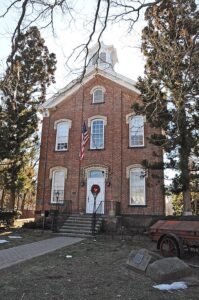
A historic Nutley school building representative of the township’s mid-20th-century public schools. It hasn't been specified if this image is the elementary school Martha Stewart attended has not been definitively identified.
Photo: Presence News
Post Views:607
Before becoming a household name, Martha Stewart was one of many students educated in Nutley’s public school system.
Martha Stewart, born Martha Helen Kostyra in 1941, grew up in Nutley after her family moved from New Jersey’s industrial corridor.
Photo by David Shankbone, via Wikimedia Commons (CC BY 3.0).
Like many local children, she attended Nutley’s public elementary schools during a period of postwar growth and educational investment.
A School Built for a Growing Community
Town planners deliberately designed Nutley’s mid-20th-century elementary schools as civic institutions, not improvised structures. Local archives show the township invested heavily in school construction as its population and expectations for public education grew in the early to mid-1900s.
Local planners built the elementary school Stewart attended during a period when schools served not only as educational institutions but also as community centers. This was reflected in the inclusion of assembly halls, multi-purpose rooms, and design elements intended to suggest permanence and civic pride.
Annual reports from the Nutley Board of Education show that the township hired professional architects to administer school building projects, reflecting a statewide move toward standardized yet respectable educational architecture. One Board of Education report from the period describes Nutley’s school buildings as designed to be durable, orderly, and adaptable to future community needs, language typical of mid-century public planning documents.
The Architect and the Design Philosophy
While records, preservation surveys, and municipal documents show that Nutley used trained architects who were good at designing public and institutional buildings, the architectural attributions for each elementary school may be different. These architects liked simple building styles like Colonial Revival or Classical, which had symmetry, natural light, and good classroom design.
State and local preservation documents show that officials intentionally kept Nutley’s school buildings simple rather than ornate. This was meant to show that schools should promote discipline and accessibility. The use of brick, large windows, and distinct entranceways contributed to this notion of schools as solid and reputable public institutions.
This way of thinking about architecture fit with the cultural values of Nutley at the time. The school buildings showed that education was a shared responsibility of the community.
A Town That Valued Education and Order
You also need to know about Nutley to know which school Stewart went to. In the 1940s and 1950s, Nutley was a township where immigrants, skilled workers, and families with young children who wanted order and opportunity lived. Records from the local historical society show that residents valued order, participation, and civic involvement. According to historical records from the Nutley Historical Society, the township’s early public schools played a central role in the community and reflected Nutley’s longstanding commitment to education.
Public schools were central to that identity. These buildings also acted as venues for town meetings, cultural events, and local celebrations, thus emphasizing their importance beyond academics. The archives of the Nutley Public Library show that local newspapers often wrote about school events. This shows how closely linked the community and education are. A Nutley Historical Society overview of the period highlights the town’s early and sustained investment in public schools. This idea is also found in other documents from the time.
Notable Alumni Beyond Martha Stewart
Stewart is Nutley’s most famous graduate around the world, but she is not the only famous person to come from the township’s public schools. Local records show many students went on to careers in the arts, public service, sports, and business.
Nutley’s schools have produced state legislators, teachers, journalists, and professional athletes with a shared educational foundation. Local newspapers have noted alumni returning to Nutley for community projects. This underscores a broader point: Nutley’s schools aimed to foster competence, discipline, and civic awareness, not celebrity.
Martha Stewart’s Early Educational Environment
Although Stewart has spoken little about elementary school, biographical accounts place her formative years in Nutley’s public education system. Stewart’s early education reflected the ideals fostered in Nutley’s classrooms.
Biographical accounts describe Stewart as a detail-minded student, reflecting the educational culture of Nutley’s schools. While no single school can explain success, Stewart’s early education reflected a culture that prized order, responsibility, and presentation.
Schools as Cultural Institutions
Nutley’s elementary schools were closely tied to the town’s cultural life, hosting concerts, holiday events, and community commemorations.
This was crucial. Education in Nutley emphasized both learning and community involvement. Many students, including Stewart, carried these lessons beyond the township.
A Lasting Legacy
Many of Nutley’s old school buildings are still standing today. They have been changed to meet the needs of modern education, but they still have their original charm. This shows that the township still values the importance of schools.
The elementary school that Martha Stewart went to is one example of this. It was built through civic planning and reflected a culture that valued education as a public good. This is not just the story of a famous graduate, but of a community that invested in its children and lasting institutions.
The history of the school is not just the history of Martha Stewart; it is also the history of Nutley.
Editor’s DisclaimerThis article is based on publicly available biographical information, local historical records, and archival materials from Nutley-area institutions. Where specific school attribution is unclear, the article focuses on the broader historical and civic context of Nutley’s public education system.
William Barber is an Editor and freelance journalist with Presence News based in Jackson, Mississippi. He regularly reports on community news, business, wellness, culture, entertainment, and human-interest stories throughout Mississippi while helping maintain the publication’s editorial standards. Before joining Presence News, William built professional experience in journalism, librarianship, copywriting, and digital publishing. As a certified copywriter, he has written hundreds of articles spanning wellness media, blogs, digital campaigns, scholarly publications, and poetry. One of his most recognized contributions to Presence News is DDPY: The Workout That’s Changing Lives, which became one of the publication’s most-viewed articles. Through his reporting, William has gained recognition within his local community for covering businesses, nonprofit organizations, entrepreneurs, artists, and community leaders making a positive impact. As an Editor, he has publishing authority at Presence News and works closely with contributors to ensure articles are accurate, informative, and aligned with the organization’s commitment to original, people-first journalism. One of William’s long-term goals is to relocate to New York City, where he hopes to provide regular on-the-ground coverage of local news, business, culture, and community events for Presence News. Story ideas, press releases, and editorial inquiries can be sent to william@presencenews.org More by William Barber