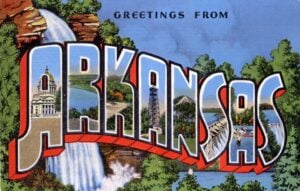
Arkansas became the 25th U.S. state when it was admitted to the Union in 1836. That very year, Arkansas participated in its first U.S. presidential election. For years, the state remained one of the most Democratic states, both in the South and the nation. In fact, between 1836 and 1972, Republican presidential candidates won Arkansas’s popular vote in only two elections, 1868 and 1872, during Reconstruction. However, Arkansas’s electoral votes were counted in 1868 but not in 1872 because the state could not certify its election results. Even when many southern states started voting Republican, Arkansas remained very Democratic at both the state and federal level. However, today, Arkansas is among the nation’s most reliably Republican states in presidential elections. This article examines Arkansas’s shift from Democratic to Republican dominance and its presidential voting patterns across the South.
Early Presidential Elections
In its first presidential election in 1836, Arkansas strongly supported Democrat Martin Van Buren. Van Buren was the sitting vice president under President Andrew Jackson. Arkansas voters viewed Van Buren as a continuation of Jacksonian policies, popular in the frontier state. Conversely, the newly formed Whig Party was too fragmented and disorganized to have an appeal to Arkansas voters. Van Buren would win Arkansas decisively once again in 1840 in his reelection bid. This started a long succession of Democratic wins in the state.
Arkansas’s Democratic Stronghold and the Growing Sectional Divide
For the next two and a half decades, Arkansas remained strongly in the Democratic fold. This was evidenced by Democratic nominee James K. Polk’s strong win in the state in 1844. Four years later, Lewis Cass, the 1848 Democratic nominee, was able to pull off a double-digit win in Arkansas. However, Whig nominee Zachary Taylor gained support through his Southern roots and Mexican-American War victories. In the next election, Democrat Franklin Pierce easily defeated Whig nominee Winfield Scott in Arkansas.
Throughout the 1840s and 1850s, national debates over slavery’s westward expansion and states’ rights increasingly defined Arkansas politics. As a Southern slaveholding state, Arkansas aligned closely with pro-slavery Democratic platforms, while the Whig Party collapsed over sectional divides.
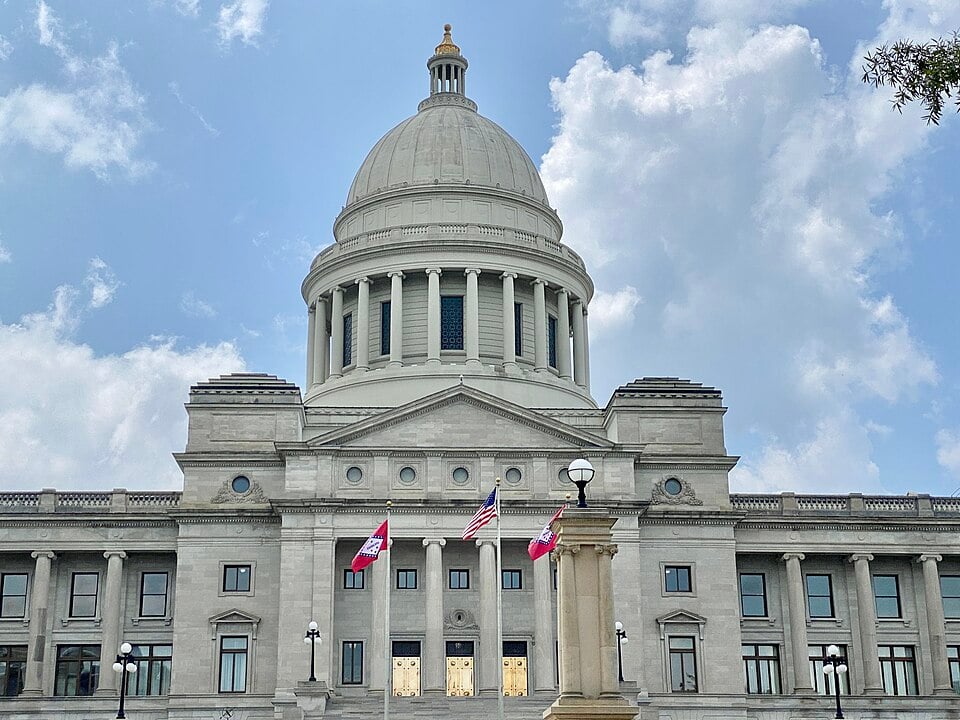
By the time of the 1860 U.S. presidential election, the Democratic Party was fractured. This resulted in a Southern Democratic nominee, John C. Breckinridge, and a Northern Democratic nominee, Stephen A. Douglas. In Arkansas, where Republican Abraham Lincoln did not appear on the ballot, Breckinridge defeated Douglas and Constitutional Unionist nominee John Bell. Following the election, Arkansas moved toward secession and formally left the Union on May 6, 1861.
Civil War and Reconstruction: 1864-1876
After the attack on Fort Sumter, Arkansas seceded on May 6, 1861, and joined the Confederacy. Arkansas did not participate in the 1864 presidential election because it remained part of the Confederacy during the Civil War.
Postwar Reconstruction saw Republican leadership briefly take control of Arkansas. After being readmitted as a state in 1868, Arkansas backed Republican Ulysses S. Grant in that year’s presidential election. Four years later, Grant again won Arkansas’s popular vote, defeating Democratic and Liberal Republican nominee Horace Greeley by a much smaller margin of approximately 4.4 percentage points. However, Arkansas’s six electoral votes were not submitted for counting because the state was unable to certify its election results. Afterward, internal Republican divisions in the state resulted in the armed Brooks-Baxter War of 1874, a political conflict that contributed to the end of Reconstruction-era Republican rule in Arkansas. The conflict helped bring Reconstruction-era Republican rule to an end, while a new state constitution was adopted in 1874 and Democrats subsequently regained political control of Arkansas. The 1868 election marked the last time a Republican presidential candidate received Arkansas’s counted electoral votes until 1972, while Grant’s 1872 victory marked the party’s final Republican popular-vote win in the state during Reconstruction.
Democratic Dominance: 1880-1948
By the late 19th century, Arkansas had joined the Solid South as one of the nation’s most Democratic states. Arkansas backed Democrat Grover Cleveland in all three of his presidential races: 1884, 1888, and 1892.
Arkansas backed Democrat Woodrow Wilson in 1912 and 1916, supporting his progressive reforms and antiwar stance. During the 1920s, much of the South bucked the national trend, supporting Democratic nominees despite three consecutive Republican landslides. Arkansas was one of these states, even voting for Democratic Al Smith in 1928, a year that saw Republican Herbert Hoover carry a few states in the South in the midst of opposition to Smith’s Catholicism. Throughout the 1920s, Republican presidential nominees Warren Harding, Calvin Coolidge, and Herbert Hoover found pockets of support in historically Unionist areas of the Ozark region, where Republican political traditions had persisted since the Civil War.
The New Deal Era
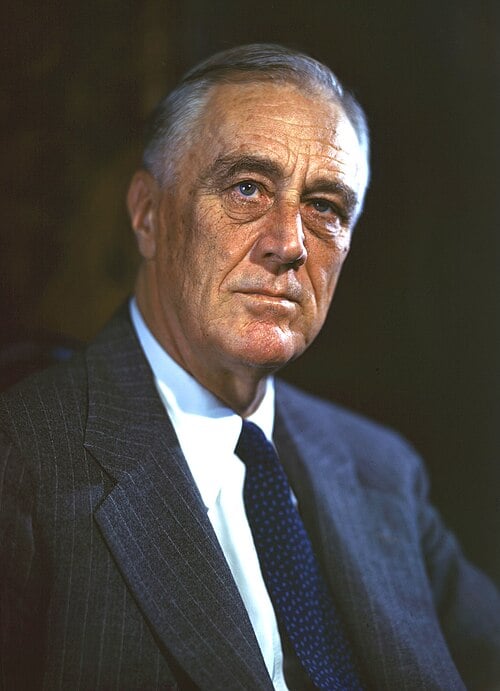
By 1932, Republican gains made during the previous decade had largely disappeared as the Great Depression reshaped the nation’s political landscape. Democratic nominee Franklin D. Roosevelt would dominate the South, and Arkansas, for that matter, in all four of his consecutive landslides. Roosevelt’s New Deal programs appealed to Arkansas and other Southern states by addressing agricultural challenges, unemployment, and the economic hardships of the Great Depression.
The 1948 U.S. presidential election marked the first major break in Democratic dominance across the Solid South since 1928, as several Deep South states supported States’ Rights Democratic candidate Strom Thurmond, whose campaign opposed the Democratic Party’s civil rights platform. Arkansas, however, remained with the national Democratic ticket, voting decisively for President Harry Truman. Although Democrats would continue to dominate Arkansas in the next several presidential elections, divisions within the party’s political coalition were beginning to emerge.
Changing Political Alignments: 1952-1968
The 1950s saw the rise of Republican nominee Dwight D. Eisenhower, a World War II hero who could appeal across party and ideological lines. His popularity extended beyond traditional Republican strongholds, attracting voters in several Southern states. In addition, there was a nationwide backlash against the Truman presidency following the Korean War. In the 1952 and 1956 presidential elections, Arkansas voted for Democratic nominee Adlai Stevenson. Although Stevenson carried Arkansas in both elections, Eisenhower performed relatively well for a Republican nominee, receiving more than 40 percent of the statewide vote in each contest.
The Rise of Southern Political Shifts
The 1960 U.S. presidential election proved to be one of the closest in U.S. history, with Democratic nominee John F. Kennedy squeaking out a win over Republican nominee Richard Nixon, the sitting vice president. As in the 1928 election involving Al Smith, Kennedy’s Catholicism raised concerns among some Southern Protestant voters. Nonetheless, Kennedy still won Arkansas by a comfortable margin, although it was still in the single digits.
The assassination of John F. Kennedy in November 1963 left the nation in mourning, while many Americans continued supporting President Lyndon B. Johnson, who had assumed office following Kennedy’s death. In addition, the 1964 Republican nominee, Barry Goldwater, was viewed by many voters as too conservative, particularly because of his positions on federal economic programs and the role of the federal government. Goldwater carried several Deep South states, benefiting in part from opposition to the Civil Rights Act of 1964, which Johnson had signed into law. Arkansas, however, supported Johnson decisively.
Arkansas’s Changing Political Alignment from Kennedy to Wallace
In 1968, Arkansas became the only state that had supported Lyndon B. Johnson in 1964 to cast its presidential votes for third-party candidate George Wallace, the former governor of Alabama, who ran under the American Independent Party. Wallace campaigned on a segregationist platform that directly opposed the goals of the Civil Rights Movement. Wallace’s victory in Arkansas, despite Goldwater’s defeat there four years earlier, reflected the appeal of Wallace’s populist campaign and his segregationist message among segments of the state’s electorate. Nevertheless, Arkansas was the weakest-performing state among the five states Wallace carried in 1968, where he received approximately 38.9 percent of the vote. Although Democratic nominee Hubert Humphrey carried several states nationally, Nixon attracted considerable support in parts of northeastern Arkansas, where Republican voting traditions had developed earlier than in other sections of the state.
Arkansas Returns to the Republican Column in 1972
In 1972, Arkansas voted Republican for the first time since 1872, when it supported Richard Nixon over Democratic nominee George McGovern. Although Grant won the state’s popular vote in 1872, Arkansas’s electoral votes were not counted because the state could not certify its election results. In that year’s presidential election, Democratic nominee George McGovern was widely viewed as too liberal by many mainstream voters, much as Barry Goldwater had been viewed as too conservative in 1964. Arkansas joined the rest of the nation in 1972 in voting for Nixon decisively. However, Democratic dominance in the state was far from over.
Carter’s Big 1976 Win and Competitiveness in 1980
After President Richard Nixon resigned in August 1974 amid the Watergate scandal, much of the nation sought to move beyond the political turmoil surrounding Watergate and the Vietnam War. Gerald Ford, who assumed the presidency following Nixon’s resignation, initially benefited from his reputation for honesty and his efforts to restore public confidence in the federal government. However, Ford’s decision to pardon Nixon in September 1974 generated considerable controversy and weakened his standing among voters who wanted greater accountability following Watergate.
Democratic Jimmy Carter, a former Governor of Georgia, was running as a Washington outsider. Although several Southern states had begun voting Republican in presidential elections, Democrats continued to maintain considerable influence in state and local politics throughout much of the region.
Carter built a Southern electoral coalition that included African American voters and white Southerners who were attracted to his regional background and outsider image. In the 1976 presidential election, Carter narrowly defeated Gerald Ford nationally while carrying nearly every Southern state, losing only Virginia and Oklahoma among the states commonly included in that regional comparison.
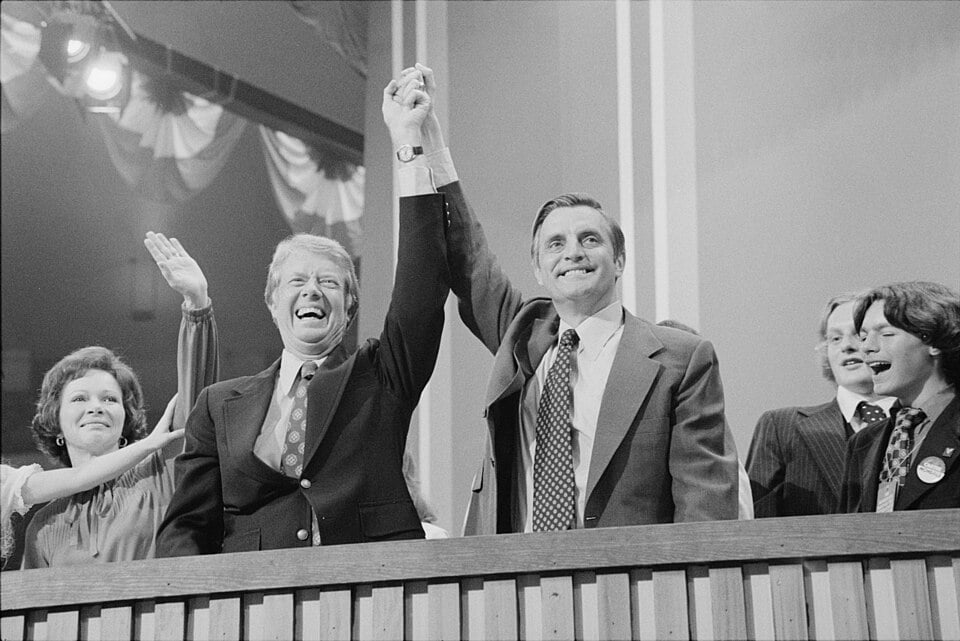
Arkansas was Carter’s second-strongest state in 1976, behind only his home state of Georgia, as he received approximately 65 percent of Arkansas’s popular vote. The 1976 election marked the last time a Democratic presidential nominee received at least 60 percent of Arkansas’s statewide popular vote.
The 1980 Election: Reagan’s Narrow Victory in Arkansas
By the time of the 1980 U.S. presidential election, Carter’s administration was facing significant economic and foreign policy challenges. Although Carter achieved some legislative and diplomatic successes, his presidency faced high unemployment, inflation, and the Iranian hostage crisis. Despite Carter’s declining national popularity, he continued to receive support from portions of the Southern electorate, although his regional backing had weakened compared with 1976.
In the end, Republican nominee Ronald Reagan won a national landslide. However, many Southern states remained competitive, with Reagan carrying a number of them by either very narrow margins or within the single digits. Arkansas was among the closest contests in the region, with Reagan defeating Carter by approximately 0.6 percentage points.
Interestingly, future President Bill Clinton was Governor of Arkansas at the time and campaigned for Carter. Unrest involving Cuban refugees temporarily housed at Fort Chaffee in western Arkansas also became a political issue during the 1980 campaign, particularly in the state’s gubernatorial race.
Republicans Gain Ground in Arkansas
By the end of Ronald Reagan’s first term in office, the economy had recovered, and there was a sense of optimism across much of the country. Regardless of the extent to which his administration contributed to the economic recovery, Reagan maintained considerable popularity and secured an even larger electoral victory in 1984. With Carter no longer on the Democratic ticket, Reagan decisively carried the South in 1984, including Arkansas.
With the economy still relatively healthy, Bush maintained much of Reagan’s political support and secured another decisive Republican victory in the 1988 presidential election. Bush carried the South, and Arkansas, for that matter, decisively that year. Nevertheless, Democratic nominee Michael Dukakis improved on the Democratic Party’s performance in Arkansas compared with 1984, demonstrating that Republicans had not completely eliminated Democratic competitiveness in the state.
Bill Clinton and the Presidential Elections of 1992-2004
Bill Clinton built his political career in Arkansas, where he served as state attorney general from 1977 to 1979 before becoming governor in 1979, a position he held from 1979 to 1981 and again from 1983 to 1992.
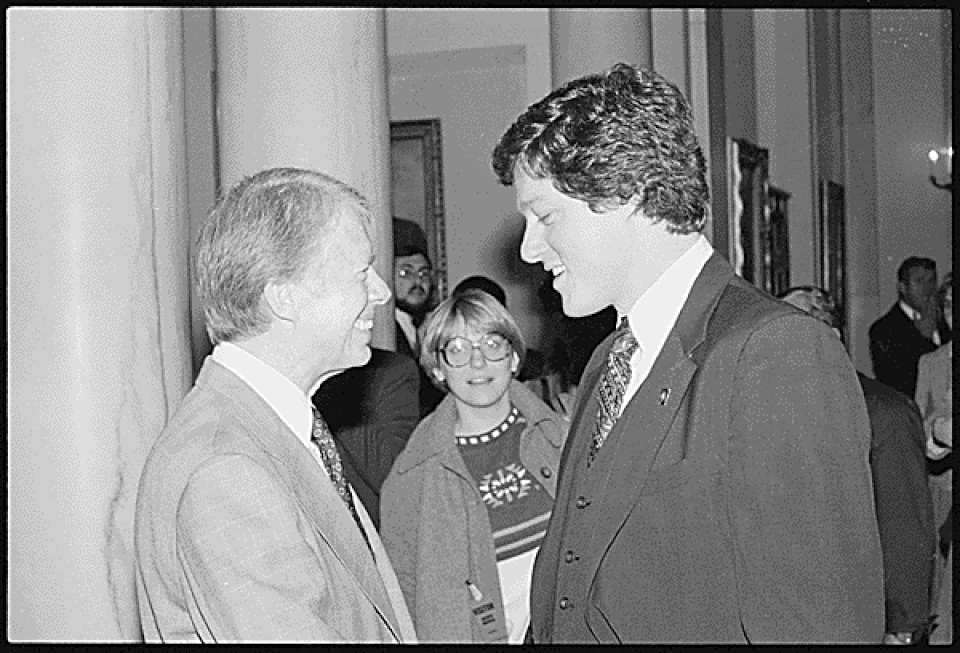
After losing reelection in 1980, Clinton returned to the governor’s office following his 1982 election victory. During his second tenure, he pursued education and economic reforms that strengthened his political profile and helped prepare him for his 1992 presidential campaign. Clinton later became associated with the New Democrat movement.
Clinton’s Home-State Advantage and Arkansas’s Republican Shift
In 1992, Clinton carried his home state of Arkansas with approximately 53.2 percent of the popular vote, defeating Republican George H.W. Bush, who received 35.5 percent, and independent candidate Ross Perot, who received 10.4 percent. Clinton secured all six of the state’s electoral votes. Clinton carried Arkansas again in 1996, receiving approximately 53.7 percent of the vote against Republican nominee Bob Dole.
Clinton’s previous experience as Arkansas governor gave him strong name recognition and established political connections in the state. His familiarity with Arkansas voters and his record in state government likely contributed to his strong electoral performances in 1992 and 1996.
In 2000, Republican George W. Bush won Arkansas with 51.31% to Democrat Al Gore’s 45.86%, securing all six electoral votes. Bush won Arkansas more comfortably in 2000 than Reagan did in his narrow 1980 victory over Carter. Bush’s victory reflected Arkansas’s broader rightward political shift, which became increasingly apparent after Clinton left the presidential ticket.
Modern Presidential Elections 2004-2024
Bush’s 2004 Arkansas victory further cemented the state’s Republican shift.

John Kerry remains the last Democrat to win over 40 percent of Arkansas’s vote and lose by a single-digit margin, through 2024.
Arkansas Strengthens Its Republican Alignment
The 2008 race saw Arkansas solidify itself as a Republican stronghold. That year, the state voted for Republican nominee John McCain over Democratic nominee Barack Obama, who won an electoral landslide. Arkansas shifted further Republican in 2008, widening the GOP’s victory margin over 2004. Four years later, Mitt Romney defeated Obama decisively in Arkansas, despite Obama’s national reelection victory. Obama fell short of 40 percent in both elections but outperformed Democratic nominees in Arkansas in 2016, 2020, and 2024.
The Democratic Party’s Continued Struggles in Arkansas, 2016–2024
Hillary Clinton became the Democratic presidential nominee in 2016, winning the national popular vote but losing the Electoral College to Republican Donald Trump. Despite her Arkansas ties, Hillary Clinton lost decisively to Trump as the state shifted further right.
The 2020 U.S. presidential election took place amid the COVID-19 pandemic, which significantly influenced the national political landscape. The pandemic, economic uncertainty, and public debate over the federal government’s response became central issues in the presidential campaign between incumbent President Donald Trump and Democratic nominee Joe Biden. Democrat Joe Biden won the national popular vote but secured a narrow Electoral College victory. Arkansas was among the few states that shifted further toward Republicans in 2020. Although Biden slightly improved on Hillary Clinton’s statewide vote percentage from 2016, Trump expanded his margin of victory, further demonstrating the state’s growing Republican alignment.
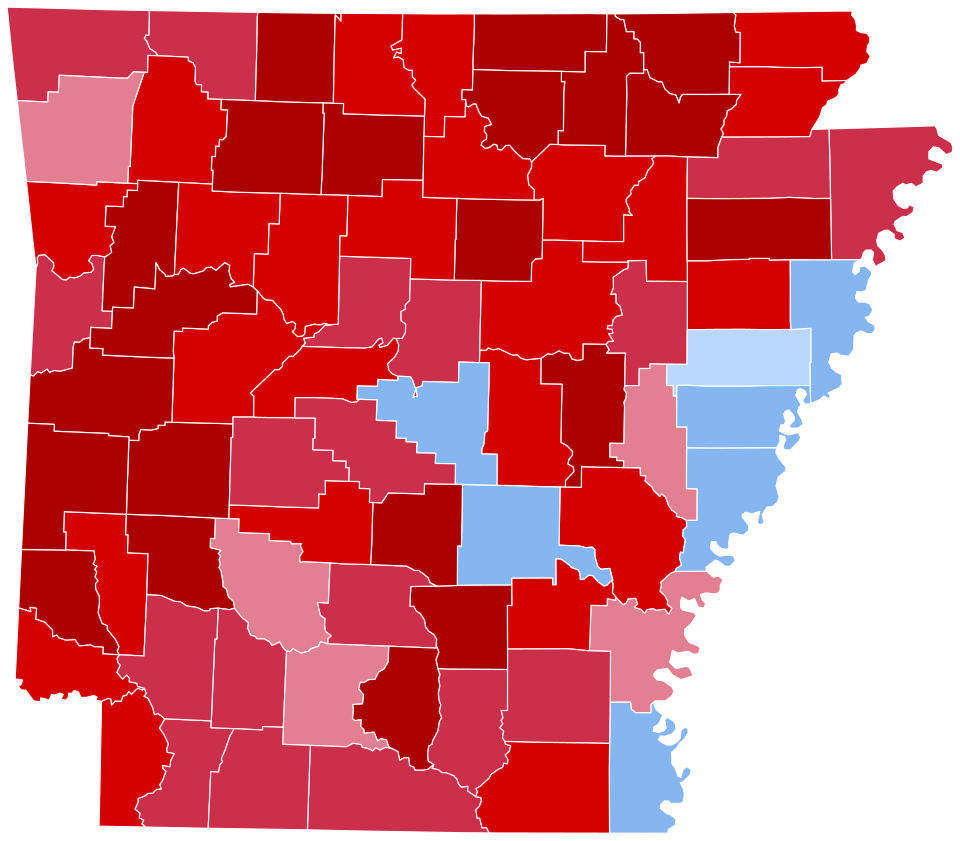
In 2024, Kamala Harris became the Democratic presidential nominee after President Joe Biden withdrew from the race. Meanwhile, Donald Trump secured the Republican nomination for a third consecutive presidential election. Trump defeated Harris in both the national popular vote and the Electoral College, winning 312 electoral votes to Harris’s 226 and becoming the first president since Grover Cleveland to serve two nonconsecutive terms. In Arkansas, Trump won decisively with approximately 64.2 percent of the vote, compared with Harris’s 33.6 percent, further reinforcing the state’s strong Republican alignment.
Conclusion
From statehood in 1836 through 2024, Arkansas’s presidential voting history reflects a dramatic party reversal. For over a century, Arkansas favored Democratic presidential candidates, with brief Republican victories during Reconstruction and a notable third-party victory for George Wallace in 1968.
The Civil Rights era and Southern realignment weakened Democratic dominance as party positions on race and social issues shifted. Despite Republican gains, Arkansas native Bill Clinton carried the state in 1992 and 1996, the only Democratic victories since Jimmy Carter in 1976. Arkansas’s narrowest presidential contest in the modern Republican era occurred in 1980, when Ronald Reagan defeated Jimmy Carter by approximately 0.6 percentage points. Although the state remained relatively competitive in 2000 and 2004, Republican nominees gradually expanded their margins in subsequent elections. The 2000 and 2004 elections were the last presidential contests in which Arkansas voted by single-digit margins and Democratic nominees received more than 40 percent of the statewide vote.
Since 2000, Arkansas has voted Republican in every presidential election, including wide margins for Donald Trump through 2024. Over nearly two centuries, Arkansas moved from a solidly Democratic state to a reliably Republican one. With the next presidential election scheduled for 2028, recent voting patterns suggest that Arkansas will remain a Republican stronghold. Nevertheless, future election results are never guaranteed, and changing political conditions could influence the state’s presidential voting patterns.
Sources:
National Archives – Electoral College Historical Results
Arkansas Secretary of State – Historical Report of the Secretary of State
Encyclopedia of Arkansas – Bill Clinton
University of Arkansas – Arkansas’s Divided Democracy The Making of the Constitution of 1874
Library of Congress – Presidential Election Statistics
Editor’s Disclaimer: This article examines Arkansas’s presidential election history from 1836 through 2024 using historical election records and publicly available research. Election results, political affiliations, and historical interpretations are presented for informational and educational purposes. The article is intended as a nonpartisan historical overview and does not endorse any political party, candidate, or ideology.
