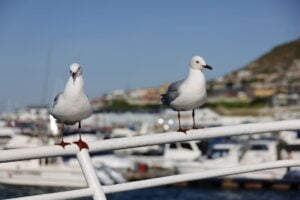
Seagulls are on beaches, in parking lots, around restaurants and sometimes hundreds of miles from the ocean. They have become remarkably good at navigating environments built by humans—and research suggests they may be paying closer attention to us than many people realize.
Leave a sandwich unattended at the beach and it may not stay unattended for long.
Seagulls have become so closely associated with beaches, boardwalks and outdoor restaurants that their presence can seem almost inevitable. They circle above crowded shorelines, patrol parking lots for discarded food and occasionally make a daring attempt to grab lunch directly from someone’s hand.
But one of the most interesting things about the familiar “seagull” is that there isn’t actually a single species of bird called a seagull.
Gulls are a family of birds containing numerous species, and many of them are not limited to the sea at all. Depending on the species and location, gulls can be found around oceans, lakes, rivers, reservoirs, agricultural fields, landfills, shopping centers and cities.
The Ring-billed Gull, for example, is frequently found inland. The Cornell Lab of Ornithology says the species occurs around urban and suburban environments as well as reservoirs, lakes, ponds, streams, landfills, parking lots and shopping malls.
That adaptability helps explain something people across America have probably wondered at one point or another:
Why are gulls seemingly everywhere?
Gulls Don’t Need the Ocean
Calling every gull a “seagull” creates the impression that these birds belong exclusively along the coast.
They don’t.
Some gull species spend substantial amounts of time inland, particularly around freshwater and human development.
Ring-billed Gulls are especially common around inland environments. Their diet can include fish, insects, earthworms, rodents, grain and garbage, according to the Cornell Lab of Ornithology.
That variety is important.
An animal that depends on one highly specific food source can struggle when that resource disappears. Gulls, by comparison, can be remarkably flexible about what constitutes dinner.
A beach may provide marine organisms and other natural food.
A farm may provide insects and grain.
A lake may provide fish.
A city can provide something else entirely: humans.
Humans Have Created an Enormous Gull Buffet
Modern cities unintentionally provide many of the things an adaptable bird needs.
Restaurants generate food waste. People leave scraps behind at parks and beaches. Garbage accumulates in dumpsters. Landfills can contain huge quantities of edible material.
And sometimes people intentionally feed the birds.
Research published by the U.S. Geological Survey illustrates how strongly gulls can become associated with human food sources.
Researchers monitoring eight parking lots in central Massachusetts spent more than 1,200 hours observing gulls and human-gull feeding interactions. Ring-billed Gulls accounted for 98% of the gulls recorded during more than 4,000 counts.
Parking lots might seem like strange bird habitat, but they offer gulls several advantages.
Food is one of them.
The physical environment is another.
Large parking lots resemble some of the open landscapes gulls naturally use. They provide broad sightlines and relatively unobstructed areas where birds can stand, watch their surroundings and quickly take flight.
That helps explain why a flock of gulls may be standing outside a supermarket even when the nearest ocean is nowhere in sight.
Landfills Changed the Equation
Few human environments offer a scavenger a food source quite like a landfill.
Research involving California Gulls in the San Francisco Bay area found that landfills played a major role in the birds’ movements.
Scientists tracked 108 California Gulls, recording more than 7,000 locations and more than one million detections using automated systems positioned at breeding colonies and landfills.
Gull attendance at the landfills was greatest during the hours when garbage was being delivered.
The finding demonstrates how closely wildlife can adjust its daily behavior around human activity.
For a gull, a garbage truck arriving at a landfill can effectively represent another feeding opportunity.
Humans did not intentionally create cities and waste facilities as wildlife habitat.
Gulls simply learned how to use them.
They May Be Watching Us More Closely Than We Think
Finding human food isn’t necessarily a matter of randomly wandering around until a french fry appears.
Research suggests gulls can use human behavior itself as information.
In a University of Exeter experiment involving urban herring gulls, researchers presented birds with two identical food items. The gulls watched a person handle one of the items before placing it back down.
Among the gulls that pecked at one of the food items, 79% chose the food they had watched the human handle.
Researchers repeated the experiment using similarly shaped non-food objects. The same preference did not appear.
The findings suggest gulls weren’t simply attracted to anything a person touched. Instead, human handling appeared to provide information specifically about potential food.
In other words, a gull watching people eat may be doing more than waiting for something to fall.
It may be learning where the easiest meal is likely to appear.
Why Do Seagulls Steal Food?
Food stealing is one of the behaviors that has given gulls their reputation for being aggressive around humans.
Yet research suggests the stereotypical french-fry thief may represent only a minority of gulls.
Another University of Exeter experiment examined whether herring gulls changed their behavior depending on whether a nearby person looked directly at them.
Only about 26% of the gulls targeted in the experiment ultimately touched the food.
Those that did approach generally took longer when the person was looking directly at them.
Researchers concluded that food-snatching behavior may therefore be driven by a relatively small number of particularly bold individuals rather than being something every gull routinely does.
That distinction matters.
A tourist may remember the one gull that swooped down and stole part of a sandwich while barely noticing the dozens of other gulls that kept their distance.
Eye Contact Can Actually Matter
The research also produced an unexpectedly practical lesson for anyone trying to protect lunch at the beach.
Watch the gull.
Experiments found that herring gulls were more hesitant to approach food when a person was looking directly at them.
In one study, gulls took an average of approximately 21 seconds longer to approach food while being watched compared with when the person looked away.
Researchers have also found that gulls respond to the direction of a person’s gaze when people approach them.
More recent research published in 2025 found that human voices can affect their behavior as well. In an experiment involving 61 gulls across nine seaside towns, nearly half of the gulls exposed to a shouting human voice flew away within a minute. A normal speaking voice also increased vigilance and reduced interaction with the food compared with a neutral bird sound.
That doesn’t mean beachgoers should spend lunch screaming at wildlife.
It does show that gulls aren’t simply oblivious scavengers.
They are paying attention.
Cities Can Be Surprisingly Good Gull Habitat
Food isn’t the only reason gulls live around humans.
Buildings can also provide nesting opportunities.
Roofs and other elevated structures can offer relatively protected locations away from many ground-level predators. Open urban spaces provide places to rest, while rivers, lakes, coastlines and reservoirs can provide additional natural food nearby.
Combine those features with enormous amounts of human-generated food and an adaptable animal suddenly has many reasons to stay.
Researchers studying urban herring gulls have described them as particularly successful at exploiting landscapes shaped by humans.
That ability is part of a much larger ecological phenomenon.
As cities expand, some wildlife species decline because they cannot tolerate the changes humans make to their habitat.
Others adapt.
Gulls are exceptionally visible examples of animals learning to exploit the opportunities created by human civilization.
Feeding Gulls Can Reinforce the Behavior People Complain About
Throwing a few french fries toward a gull may seem harmless.
But intentionally or unintentionally feeding gulls can strengthen the association between people and food.
University of Exeter researchers have specifically warned that improperly discarded food can reinforce those associations.
If approaching picnic tables, restaurant patios or people carrying food repeatedly produces a reward, there is little evolutionary reason for an opportunistic animal to ignore the opportunity.
That creates an unusual cycle.
People provide food.
Gulls learn that people provide food.
Gulls begin approaching people looking for food.
People then complain that gulls are constantly approaching them.
Reducing accessible food waste and avoiding intentional feeding can help break that relationship.
Are Gulls Actually Aggressive?
They can be defensive, particularly around nests and chicks, and individual birds can become unusually bold around food.
But describing all gulls as aggressive oversimplifies their behavior.
Research showing that many gulls refuse to approach humans at all suggests the notorious food-stealing gull isn’t necessarily representative of the entire population.
Like people, individual animals can differ considerably in temperament and willingness to take risks.
Some gulls keep their distance.
Others have apparently discovered that stealing a french fry can be worth the gamble.
Their Success Is Really a Story About Adaptation
The gull standing on top of a light pole outside a shopping center may seem completely out of place.
Ecologically, it may make perfect sense.
Below it are open spaces.
Nearby are dumpsters.
People are carrying food.
Buildings provide elevated resting and nesting locations.
And the bird possesses a flexible diet and the behavioral ability to recognize opportunities.
Gulls did not need humans to survive before cities existed, and they still rely on natural habitats and food sources. But certain gull populations have become extraordinarily good at incorporating human environments into their lives.
Perhaps that is why the familiar “seagull” seems to follow people almost everywhere.
The birds haven’t necessarily abandoned nature.
They have simply learned that humans are now part of it.
Source:
