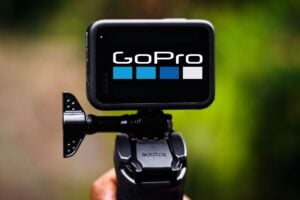
GoPro’s smallest interchangeable-lens cinema camera skips autofocus and even the lens itself, but combines an unusually compact body, professional video features and aggressive pricing with a creator-driven marketing campaign designed to show filmmakers what it can actually do.
UNITED STATES — September 9, 2026 — GoPro built its reputation by putting cameras in places traditional cameras could not easily go. Now, the company is attempting to bring that philosophy into professional filmmaking with the MISSION 1 PRO ILS, an ultra-compact interchangeable-lens cinema camera aimed at independent filmmakers, content creators and production crews.
The camera became globally available Sept. 2 after being announced in August, and GoPro describes the MISSION 1 PRO ILS as the world’s smallest and most rugged cinema camera. The body weighs just 6.95 ounces, or 197 grams, yet records as high as 8K at 60 frames per second. (GoPro Investor Relations)
Perhaps just as interesting as the camera, however, is how GoPro introduced it to filmmakers.
Rather than relying solely on polished advertisements telling potential buyers what the camera could do, GoPro put the MISSION 1 PRO ILS into the hands of creators and reviewers before launch. That allowed real-world footage from different filmmakers, lenses, environments and shooting styles to become part of the product’s introduction. (GoPro)
The result has been a launch in which the footage itself is effectively the advertisement.
A $699 Cinema Camera Body
The MISSION 1 PRO ILS carries a $699.99 MSRP, while existing GoPro subscribers can purchase the body for $599.99. That puts the entry price well below many traditional professional cinema-camera systems.
There is an important distinction, however: that price does not include a lens.
The ILS — short for interchangeable-lens system — uses a Micro Four Thirds mount, allowing filmmakers to select compatible manual lenses for different applications. GoPro also says adapters can allow filmmakers to use vintage lenses, PL-mount cinema lenses and other specialty glass.
That approach makes the $699 body price attractive, particularly for filmmakers who already own compatible glass, but the complete cost of a usable package will depend heavily on the lens and accessories selected.
There Is No Autofocus
One of the biggest differences between the MISSION 1 PRO ILS and many modern mirrorless cameras is also one of its most deliberate limitations: there is no autofocus.
The camera’s Micro Four Thirds mount lacks the electronic contacts necessary to operate electronic autofocus lenses. Compatible lenses therefore rely on manual focus and manual aperture control. That means filmmakers accustomed to sophisticated subject detection and continuous autofocus systems will have to work differently. (Digital Camera World)
For traditional cinema production, though, manual focus isn’t necessarily unusual. Dedicated cinema lenses and professional productions have long relied on manual focus, sometimes controlled by a camera assistant or follow-focus system.
GoPro has also attempted to compensate for the tiny camera body with its free MISSION Monitor app, which connects the camera to an iPhone or iPad and provides tools including focus peaking, focus assist, zebra patterns, LUT previews and shot overlays.
The result is a curious combination: the camera itself is remarkably small, but its operating philosophy is closer to a cinema camera than a point-and-shoot consumer GoPro.
A 50-Megapixel 1-Inch Sensor Inside a 197-Gram Body
At the center of the MISSION 1 PRO ILS is a 50-megapixel 1-inch sensor paired with GoPro’s GP3 processor.
Video recording reaches 8K60 and 4K240, while Open Gate recording is available up to 8K30 and 4K120. The camera also supports 10-bit color, GP-Log2, HLG HDR, bit rates up to 240Mbps and timecode synchronization for multicamera production.
Those specifications become more interesting when considered alongside the camera’s size.
A 197-gram cinema camera can be positioned where a conventional cinema body may be impractical. GoPro specifically points to applications such as mounting the camera inside a vehicle with considerably smaller rigging.
That could ultimately prove to be one of the MISSION 1 PRO ILS’s strongest advantages.
It does not necessarily have to replace a larger cinema camera.
It can become the camera that gets the shot the larger camera cannot.
No Built-In Flash — Because This Is Primarily a Cinema Tool
Anyone approaching the MISSION 1 PRO ILS as a traditional still-photography camera may find the design unusually stripped down.
There is no built-in flash, autofocus is absent and a lens must be purchased separately. Those omissions make more sense when the camera is considered primarily as a filmmaking platform rather than a conventional consumer mirrorless camera.
GoPro’s priorities are instead centered around high-resolution video, high frame rates, stabilization, professional color workflows, compact mounting and interchangeable optics.
That makes the MISSION 1 PRO ILS a relatively specialized camera — but specialization may be precisely the point.
GoPro Turned Filmmakers Into Part of the Launch
The hardware may be impressive, but GoPro’s marketing around the camera deserves attention of its own.
Ahead of launch, the company says it distributed MISSION 1 PRO ILS cameras to creators and reviewers to demonstrate how far filmmakers could push the interchangeable-lens platform.
That created something more convincing than a traditional specification sheet: footage.
Creators could pair the camera with different lenses and show audiences what the system looked like in actual production environments. GoPro could then amplify individual examples through its own enormous social-media ecosystem.
One example promoted by GoPro showed a damselfly captured in ultra-slow motion using a 50mm macro lens. Another demonstrated the camera with a 600mm telephoto lens pointed toward the moon — exactly the kind of imagery many consumers would not historically associate with a GoPro. (Smash Balloon)
For independent filmmakers scrolling through social platforms, the marketing proposition becomes immediately understandable.
Instead of GoPro saying, “Our camera produces cinematic footage,” filmmakers are seeing the footage first.
Then they discover what camera captured it.
That distinction matters.
A Social-First Camera Launch
Camera manufacturers have traditionally depended heavily on launch events, professional reviews, trade publications, spec sheets and YouTube reviewers.
GoPro appears to be combining that traditional strategy with something increasingly powerful: distributed creator marketing.
When multiple filmmakers publish visually impressive footage around the same launch period, each piece of content can reach a different audience. Those clips can then be shared again by GoPro, creating another layer of distribution.
The approach is particularly well suited to a camera because the product generates its own marketing material.
Every filmmaker testing a MISSION 1 PRO ILS potentially creates another demonstration of what the product can do.
And every visually striking shot gives another filmmaker a reason to ask the most important question GoPro wants them asking:
What camera was that shot on?
The Limitations Are Real
The aggressive price and compact body shouldn’t obscure the compromises.
There is no autofocus, compatible electronic lenses are limited by the lack of electronic contacts, and filmmakers using heavier lenses may need additional lens support. Digital Camera World notes that GoPro recommends external support for lenses weighing more than 250 grams. (Digital Camera World)
The 1-inch sensor is also considerably smaller than the full-frame sensors found in many popular professional and prosumer cinema cameras.
And while the body costs $699.99, the real cost increases once filmmakers add a lens, monitoring device, cage, audio equipment, batteries, media and whatever additional rigging their production requires.
So the MISSION 1 PRO ILS isn’t suddenly a $700 replacement for every $5,000 or $10,000 cinema-camera setup.
It doesn’t need to be.
GoPro May Have Found a New Place on Film Sets
The more compelling argument for the MISSION 1 PRO ILS is not that it replaces larger Sony, Canon, RED, Blackmagic or ARRI systems.
It is that a filmmaker can now add a tiny interchangeable-lens 8K camera to a production without spending several thousand dollars on the camera body alone.
A documentary filmmaker could carry one in a small bag. A production could mount one inside a vehicle. A music-video director could position several around a set. A cinematographer could use one for unusual angles or risky placements where putting a much more expensive camera would be difficult.
And independent filmmakers working with limited budgets suddenly have access to 8K recording, Log video, Open Gate capture, high frame rates and interchangeable cinema-oriented lenses from a body priced at $699.99.
GoPro may have knocked the hardware proposition out of the park.
But it may have done something equally important with the launch.
By getting the camera into filmmakers’ hands before widespread availability and allowing the resulting footage to travel across social media, GoPro made the filmmakers themselves part of the product demonstration.
For a company whose cameras became famous because of the footage people created with them, that strategy feels remarkably appropriate.
The MISSION 1 PRO ILS isn’t being marketed simply as another camera to look at.
GoPro is marketing it by showing people what filmmakers can do with it.
