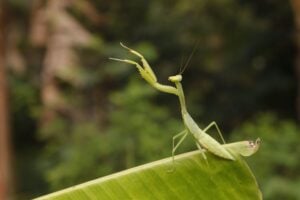
A praying mantis may spend much of its life standing almost perfectly still, but behind that motionless appearance is a highly specialized predator equipped with remarkable vision, fast forelegs and a life cycle filled with competition, danger and survival.
Imagine emerging into the world as a tiny insect surrounded by dozens—or potentially hundreds—of siblings.
There are no parents waiting to feed you.
There is no nest where you will spend your childhood.
Almost immediately, you are on your own.
You need to find food, avoid becoming food yourself and grow large enough to reproduce before your relatively short life comes to an end.
Welcome to life as a praying mantis.
With triangular heads, enormous eyes and front legs that appear to be folded together in prayer, mantises are among the most recognizable insects in the world.
But their peaceful-looking pose is misleading.
Those folded legs are weapons.
And much of a mantis’s life revolves around one fundamental activity: hunting.
Life Begins Inside a Foamy Egg Case
Before a young mantis ever sees the outside world, it develops inside a protective egg case known as an ootheca.
A female produces a foamy secretion around her eggs that eventually hardens into a protective structure. Depending on the species, an ootheca can contain dozens or even hundreds of eggs.
In areas with cold winters, the eggs of some species remain protected inside the case throughout winter before hatching when conditions become warmer.
When the young emerge, they are called nymphs.
They already resemble tiny versions of the adults they will eventually become, although they lack fully developed wings.
And they don’t receive much of a childhood.
The young disperse and begin searching for food.
Sometimes, that food can even be another young mantis.
From the Beginning, You Are a Predator
A praying mantis doesn’t have teeth, claws or a venomous sting to bring down prey.
Instead, it possesses an extraordinary pair of front legs.
Known as raptorial forelegs, these specialized limbs are equipped with spines that help a mantis seize and hold its prey.
When resting, those legs fold against the body, producing the familiar posture that gave the praying mantis its name.
When prey gets close enough, however, the peaceful pose disappears.
A mantis can suddenly extend its forelegs, capture its target and pull the victim toward its mouth.
The strike can happen in milliseconds.
Mantises primarily prey on other insects and other small animals. Depending on the species and size of the mantis, prey can include flies, moths, crickets, grasshoppers and other insects.
Large mantises have even been documented attacking small vertebrates.
Life as a mantis therefore involves an unusual amount of waiting.
Rather than constantly chasing food, a mantis may remain nearly motionless, blending into vegetation while waiting for something edible to move within striking distance.
Then everything happens very quickly.
Your Eyes Are One of Your Greatest Weapons
If you were a praying mantis, the world would also look very different.
The two enormous compound eyes on either side of a mantis’s triangular head provide it with an extensive view of its surroundings.
Even more remarkable is its ability to judge depth.
Researchers at Newcastle University demonstrated that praying mantises use stereoscopic, or 3D, vision while hunting.
Scientists famously demonstrated the ability by fitting mantises with miniature colored 3D glasses and showing them images of prey.
When an image appeared to be positioned within catching distance, the mantises attempted to strike it.
Further research showed that mantis stereoscopic vision works differently from human vision. Rather than constructing the detailed three-dimensional world humans experience, the mantis system appears particularly suited to answering a question that is enormously important to a predator:
Is that moving object close enough for me to catch?
You Can Look Around Without Moving Your Entire Body
The mantis has another useful hunting adaptation: an unusually mobile head.
A mantis can rotate its head dramatically from side to side, allowing it to visually track activity around it without repositioning its entire body.
That matters when your hunting strategy depends on remaining inconspicuous.
Many mantises are also remarkably well camouflaged.
Green and brown species can disappear among leaves, stems and dried vegetation.
Other species take camouflage much further.
Some resemble dead leaves, while species such as the orchid mantis possess shapes and colors that can make them look surprisingly flower-like.
Camouflage serves two purposes.
It can prevent prey from noticing the approaching predator.
But it can also prevent predators from noticing the mantis.
Because being an effective hunter doesn’t mean you’re safe.
While You’re Hunting, Something Else May Be Hunting You
Life as a mantis is not spent comfortably at the top of the food chain.
Birds, reptiles, amphibians, spiders and other predators can potentially turn a mantis into a meal.
A mantis therefore lives in a world where it can switch from predator to prey very quickly.
Remaining motionless and blending into the environment can help.
Some mantises also use defensive displays when threatened, making themselves appear larger by raising their wings and forelegs.
But there are no guarantees.
Surviving long enough to become an adult requires repeatedly finding food while avoiding animals that are trying to do exactly the same thing to you.
Growing Means Crawling Out of Your Own Skeleton
There is another problem with being an insect.
Your skeleton is on the outside.
A mantis’s hard exoskeleton cannot simply expand indefinitely as the animal grows.
Instead, a young mantis must periodically molt, shedding its old exoskeleton and emerging with a new, larger one.
Nymphs undergo multiple molts on their journey toward adulthood.
For a short period after molting, the mantis’s new exterior is softer and more vulnerable while it hardens.
Eventually, after its final molt, the mantis reaches adulthood.
Depending on the species, an adult may possess fully developed wings and the ability to fly.
Now another biological priority becomes increasingly important.
Finding a mate.
Dating Can Be Dangerous When You’re a Mantis
Few aspects of mantis biology have attracted as much attention as their mating behavior.
The popular story is dramatic: a female praying mantis mates with a male and then eats him—sometimes beginning with his head.
But the familiar claim that female mantises always eat their mates is a myth.
The behavior varies by species and circumstances, and researchers have found that many mating encounters end without the male becoming dinner.
For a male approaching a potentially hungry female, however, the danger can be very real.
Females are generally larger, and a male is approaching an animal whose nervous system is exceptionally good at identifying appropriately sized moving objects as potential prey.
From an evolutionary perspective, mating successfully is worth taking that risk.
For an individual male mantis, it can make courtship one of the most dangerous moments of his life.
The Female Creates the Next Generation
After mating, a female can eventually produce an ootheca containing the next generation.
She attaches the foamy egg mass to vegetation or another suitable surface, where it hardens around the eggs.
In temperate environments, the adults of many familiar mantis species die as colder weather arrives.
The adults may be gone, but their offspring remain.
Protected within the ootheca, the next generation waits.
When conditions are right, tiny mantises emerge and the entire cycle begins again.
They disperse.
They hunt.
They molt.
They hide.
They grow.
And the survivors eventually reproduce.
So What Would Being a Praying Mantis Actually Be Like?
If we could somehow experience the world as a mantis does, life might feel like an endless game of distance, movement and patience.
Something moves.
Is it food?
Is it within reach?
Is it dangerous?
Should you remain perfectly still?
Should you strike?
For an animal that can appear almost meditative while sitting on a plant, the mantis lives a surprisingly intense existence.
It begins life without parental care, must hunt almost immediately, repeatedly sheds its external skeleton as it grows, spends its days simultaneously hunting and hiding from predators and eventually has to survive the potentially dangerous business of reproduction.
And yet the mantis is exceptionally well equipped for that existence.
Its camouflage helps it disappear.
Its mobile head allows it to watch the world around it.
Its unusual 3D vision helps determine when prey has entered striking distance.
And those seemingly peaceful folded forelegs can transform into a formidable trapping mechanism in milliseconds.
The praying mantis may look like it is praying.
In reality, it is probably waiting.
And somewhere nearby, another insect may be about to discover what it has been waiting for.
Source: https://www.nationalgeographic.com/animals/invertebrates/facts/praying-mantis
