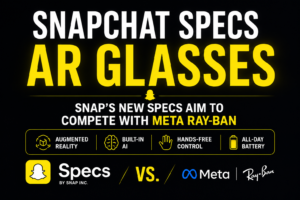
Snap Inc., the parent company behind Snapchat, has officially unveiled its long-awaited augmented reality (AR) smart glasses called Specs, marking one of the company’s most ambitious technology launches to date.
Announced at the Augmented World Expo (AWE) in Long Beach, California, the new wearable device represents Snap’s vision for a future where computing is integrated directly into everyday life rather than centered around smartphones.
Who Owns Specs?
Specs are developed by Specs Inc., a wholly owned subsidiary of Snap Inc. The subsidiary was established in early 2026 to focus exclusively on the development and commercialization of the company’s augmented reality hardware.
Snap Inc. was founded in 2011 by Evan Spiegel, Bobby Murphy, and Reggie Brown and is best known for creating Snapchat. While Specs Inc. operates independently, ownership remains under Snap Inc., with CEO Evan Spiegel continuing to champion the company’s long-term AR strategy.
The move allows the company to attract strategic partners, develop new technologies, and potentially secure outside investment while maintaining Snap’s overall control of the platform.
What Are Specs?
Specs are standalone augmented reality glasses designed to overlay digital information onto the physical world through transparent lenses.
Unlike traditional smartphones that require users to look down at a screen, Specs are intended to place information directly into a person’s field of view.
The device includes:
- See-through augmented reality displays
- Voice and hand-gesture controls
- Built-in artificial intelligence capabilities
- Dual Snapdragon-powered processors
- Integrated cameras and sensors
- Support for prescription lenses
- Up to four hours of battery life
- Charging case extending usage to approximately 20 hours
The glasses operate using Snap’s proprietary operating system, known as Snap OS, which enables users to interact with digital content through voice commands, hand tracking, and spatial computing experiences.
A New Computing Platform
Snap executives describe Specs as more than a wearable gadget.
CEO Evan Spiegel has repeatedly positioned the device as a step toward what the company believes will become the next major computing platform.
“The smartphone put our lives in our pockets. Specs put computing into the world, where life actually happens,” Spiegel said during the launch presentation.
The company envisions users navigating cities, measuring objects, receiving real-time information, collaborating on projects, and interacting with AI-powered tools without pulling out a phone.
The Mission Behind Specs
For more than a decade, Snap has invested billions of dollars into augmented reality technology.
The company’s stated mission is to make computing more natural and human-centered by blending digital experiences into everyday environments.
According to Snap, AR glasses have the potential to reduce screen dependency and allow users to remain more engaged with the people and places around them.
Instead of isolating users behind a device, Specs are designed to enhance real-world interactions through contextual information and AI assistance.
The company’s long-term goal is to create a computing platform that feels less intrusive than smartphones while remaining powerful enough to perform many of the same tasks.
Competing in a Growing Market
The launch places Snap in direct competition with major technology companies investing heavily in wearable computing.
Competitors include Meta’s smart glasses initiatives, Google’s Android XR ecosystem, and Apple’s Vision Pro platform.
However, Snap is attempting to differentiate itself through lightweight, standalone AR glasses rather than headset-style devices.
At a launch price of approximately $2,195, Specs are initially targeted toward early adopters, developers, creators, and technology enthusiasts.
Industry analysts note that widespread consumer adoption will likely depend on future improvements in battery life, comfort, software ecosystems, and affordability.
Looking Ahead
The launch of Specs represents one of Snap’s largest bets since the creation of Snapchat itself.
Whether augmented reality glasses become the successor to smartphones remains uncertain, but Snap is positioning itself at the forefront of the emerging wearable computing industry.
For now, the company is asking consumers to imagine a future where digital experiences exist not on a screen in their hands, but directly within the world around them.
As the race toward spatial computing accelerates, Specs may offer an early glimpse into what that future could look like.
Sources used for factual details regarding ownership, launch, pricing, features, and company strategy. (Snap Newsroom)
