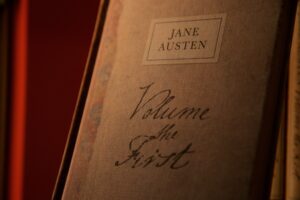
NEW YORK – “It is a truth universally acknowledged, that a single man in possession of a good fortune, must be in want of a wife.” Thus begins Jane Austen’s most well-known and best-selling novel Pride and Prejudice. A stroll throughout boutique book shops and major retail book stores will reveal at least a notebook or mug with these words emblazoned upon it.
Today, those words ring true with the same good-natured banter as when they were first penned – the moment that Jane’s pen scratched across the surface of the page. Even in our busy world with AI technology and self-parking cars, people are drawn to English country living, candlelight ballrooms, and an orderly society. The friendship and love between sisters, cousins, and close-knit families beckon to us. Even with their familiar dysfunction. Perhaps that is what we are all looking for: connection and community.
This year marks Jane’s 250th birthday and millions are celebrating across the globe. It is as if time itself is pausing for us to lift the veil of time and take a closer look at why Austen, and her novels, matter more than ever.
Well-Situated
After the passing of the Rev. George Austen in December 1805, Jane found herself unsupported in Bath. She also had an older sister, Cassandra, and mother (also named Cassandra) to consider. As was the custom, the three Austen women naturally turned to their brothers/sons for aid. The situation reminds us of the plight of the four Dashwood women in Sense and Sensibility.
Jane began work on a novel in Bath entitled The Watsons – the tale of an impoverished clergyman with four unmarried daughters. Although the writing seemed to go quickly, The Watsons remained unfinished. She began the novel before her father died. This leaves us to wonder why she never returned to the manuscript. However, the infant work laid the foundations for future plots and story-lines.
According to a literary critic, Kathryn Sutherland, The Watsons is “a study in the harsh economic realities of dependent women’s lives”
All of the Austen brothers, Edward, James, Henry, and Francis (Frank), pledged to aid their mother and unmarried sisters. They offered a place under their respective roof with their own families. From 1805-1809, Jane traveled across southern England, seeing new sights and gaining experience.
Future Life
Before Jane had left Bath, in 1802, she received a proposal of marriage from a respectable man named Reginald Bigg-Wither, who lived in a spacious manor house near Basingstoke, in Hampshire. Jane and Cassandra befriended his sisters and spent a portion of the Christmas holidays with the family. He was heir to several local estates, placing him firmly in the eligible category. For a retired parson’s daughter, Jane could do worse than accept such an offer.
Yet, according to Austen’s writings, Bigg-Wither was not very intelligent or handsome. His place in the world promised comfort and security for Jane, her aging parents, and sister. At first, she accepted but then, the next morning, declined his offer. Jane and Cassandra returned to Bath – who knows what thoughts passed in Jane’s mind on their journey home.
Time marched on, as it does for everyone. In 1809, the Austen women finally settled in Chawton, a picturesque village in their beloved Hampshire, under the care of Edward Austen. Here, in the peace of the countryside, Austen entered the most fruitful period of her life at 34 years of age.
Material A Change
“We know so little about Jane’s life, and that little is so difficult to interpret accurately, that we can’t afford to dismiss what’s revealed in her fiction. At least it speaks, and at least it was written by her,” Helena Kelly wrote in The Literary Hub. Jane speaks the clearest in her novels, and it is there where we find her.
Sense and Sensibility completed the full publication process, entering the printed world in 1811. She first began the story under another title 16 years prior. Now the story of Elinor and Marianne found its voice and quickly became a favorite among ladies, and even men, in the upper classes.
Today, critics and biographers point out the narrow view Austen provides of the Regency Era. There are no scenes where the male characters interact without a woman present. She deals with her own social circle, with only a passing nod to those higher or lower. In contrast, she never mentions Napoleon or the impact of the French Revolution, threatening the entire social order and peace of Europe. Some accuse Austen of excusing Willoughby for his scandalous behavior while banishing Maria Bertram, of Mansfield Park, from her family’s good graces forever.
John Willoughby may not have been shunned by society, yet he is far from happy, as he bitterly confesses to Elinor near the end of Sense and Sensibility. He must bear the loss of Marianne. He knows he “lost” her to his rival, Colonel Brandon. Austen deals with Maria according to the teachings of the Anglican Church. She accepts reality while demonstrating how Maria could have avoided her fall.
Let Other Pens
“She never expected to be read the way we read her, gulped down as escapist historical fiction, fodder for romantic fantasies. Yes, she wanted to be enjoyed; she wanted people to feel as strongly about her characters as she did herself. But for Jane a story about love and marriage wasn’t ever a light and frothy confection,” Kelly explained.
Through September, The Morgan Library and Museum, in NYC, is hosting an exhibition on the writings of Austen. “Bringing together the Morgan’s expansive collection of Austen works, particularly her letters, alongside many exquisite loans, A Lively Mind is a rare opportunity to experience Austen’s many facets at once. From her family life to her authorship and her legacy,” said director Colin B. Bailey in press release, April 15.
Coming to stages across the country, a musical version of Pride and Prejudice will premier in October of 2025. Austen’s Pride showcases the wit, banter, and romance of the classic novel. According to The Seattle Times, the script uses a “generous portion of (Austen’s) sparkling dialogue verbatim.” It “captures the lilt of Austen’s language and her cunning social observations.” What would Jane think of all of this attention?
After a long illness, Jane starts to rest in 1817. She was just 41 years old. In her own quiet way, she left English literature – and all literature – changed forever. She wrote what she knew and her subject is the human heart, its endearing foibles, quirks, follies, and dark secrets.
“Jane wasn’t a genius—inspiring, unthinking; she is an artist. She compared herself to a miniature painter; in her work every stroke of the brush, every word, every character name and every line of poetry quoted, every location, matters.” ~ Helena Kelly.
Editor’s Disclaimer:
The following article was written by contributor Rachel as part of Presence News’ arts and literature section. The views and interpretations expressed are those of the author and do not necessarily reflect the official stance of Presence News. Content may include literary analysis, personal reflection, and historical perspective.