
By Rachel Flammia | Presence News
As autumn leaves begin to turn and fall, a night spent at home takes on a new charm. When daylight fades earlier than before, we are drawn to the comforts of home — a cozy place to gather, talk, and dig out those board games forgotten in the blaze of summer.
Electronic devices allow users to play games anywhere they please. But tabletop games insist that we stop and stay in one place — sometimes for hours at a time. Popular trends reveal the top four tabletop games of 2025 and why they remain classics.
In this article, Presence News investigates the resurgence of board games in popular culture and why unplugging matters now more than ever.

The Human Connection
It’s the sound of shuffling cards. Dice clink against a game board. Friends and family share a chuckle or sigh of frustration as victory is thwarted. Even the smell of paper, cardboard, and pencils mingle to create something beyond tablets and mobile phones.
You cannot manufacture this phenomenon — it’s live interaction.
There was a time when such gatherings were common, if not normal. One can play games on an electronic device, but can you experience a virtual connection? Without the human touch, game time is only as deep as the width of the screen.
Why are so many people rummaging through their closets to find forgotten decks of cards and board games? Let’s take a deeper look at this turning tide and discover the allure of paper, plastic pieces, and rules.
Vintage Pleasures
The growing “vintage” and “retro” aesthetic continues to enthrall many across the globe. Wherever modernity reaches its height, a counter-cultural movement arises. From cottagecore and grandmacore to dark and light academia, the longing to create a more authentic and digital-free life persists.
It’s a steady pulse — a heartbeat in the midst of notifications and concerns about algorithms. Blogger Krish Maran describes the connection between the vintage ideal and demographics:
“Life can be chaotic, stressful, and unpredictable. But through the power of aesthetics, Gen Z has learned to find beauty in the small things,”
— Krish Maran, Medium (March 2025)
From journaling to Edison bulbs, the search for meaning and authenticity continues. Gen Z could well be called the new Romantics. The Romantic Movement, in early 19th-century Europe, was itself a reaction against industrialization, urban sprawl, and consumerism.
The New Deal: Nostalgia and Play
So what do nostalgic Millennials and Gen Z have to do with tabletop games? In an effort to bring back the “good old days,” many are finding alternative forms of entertainment.
Instead of bingeing the latest Netflix show or scrolling endlessly on a phone, why not play a game?
Four titles stand out — still wildly popular, and still well-loved. These games not only provide hours of screen-free fun but also teach lessons about life and one another.
Monopoly
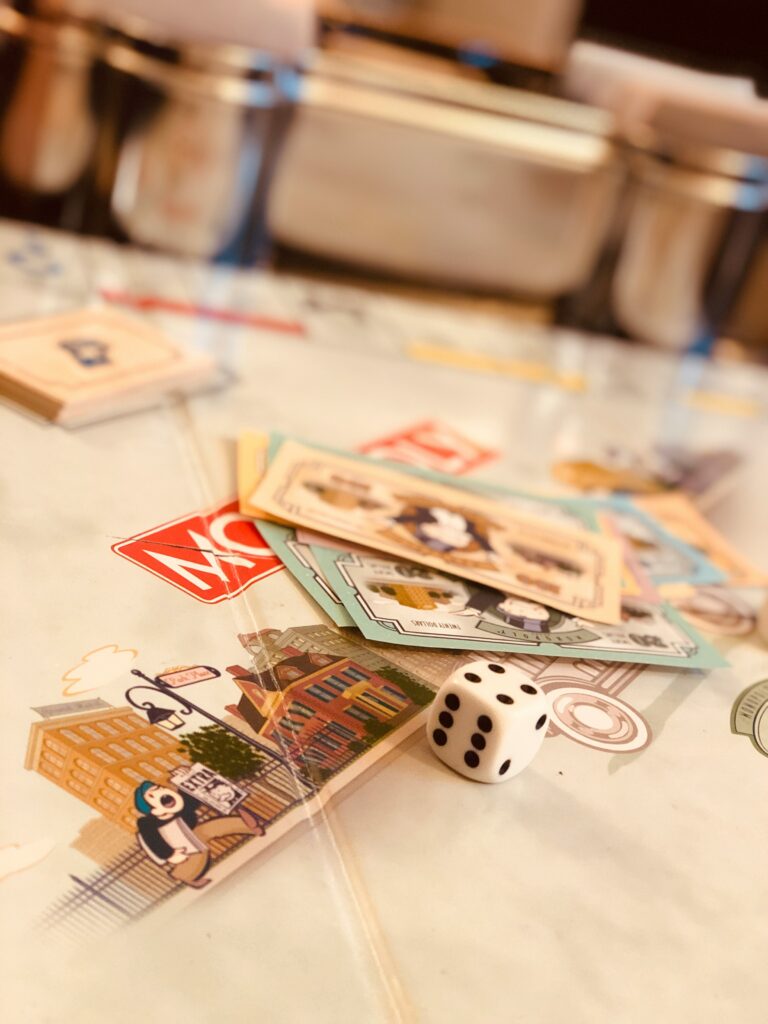
Coming in at number one, this game of buying properties and avoiding bankruptcy is a true American classic. Monopoly entered the public sphere in the early 1900s as a warning against the rise of capitalism.
Inventor Elizabeth J. Magie Phillips created the idea in 1903 after observing the growing divide between bankers, businessmen, and the working class.
As America marched toward greater wealth and global influence, Monopoly offered insight into economic inequality. Charging rent as a landlord mirrored the discrepancies among the slums of New York, New Jersey, and Chicago.
Today, Monopoly shines in a more positive light and includes countless themed and digital versions, but the original remains an enduring symbol of ambition, strategy, and luck.
Chess
Played since the Middle Ages, Chess is a game of quiet skill and quick thinking. According to Chess.com, the game offers “a very clear metric for results (ratings)… giving us an especially strong feedback loop for determining the objective quality of our decisions.”

In a world lived behind screens, real-time decisions can be daunting. There is no “undo” button in life — and chess teaches that well.
The pieces themselves reflect the hierarchy of medieval Europe, requiring players to understand their position to make the best move possible.
From polished wood to glass sets, serious players often display their boards as symbols of intellect and tradition. Would any library be complete without one?
The Game of LIFE
“All jokes aside — I play this every day.”
First appearing in the 1860s, The Game of LIFE was designed to teach a moral lesson about choices and success.
Navigating marriage, home-buying, and career paths, players simulate real financial and personal decisions. The modern version — redesigned by Stephen Withers and Reuben Klamer in the 1960s — captured the spirit of an evolving American dream.
Players aim to reach “Millionaire Acres” or risk retiring at “Poor Farm.” While some editions dropped this feature, the lesson remains: life’s journey is filled with unexpected turns.
Today, LIFE thrives both on traditional boards and home gaming systems, bridging generations through play.
Clue (Cluedo)
Originally called Cluedo, this murder mystery classic was born in 1940s England. Musician Anthony Pratt, inspired by parlor games he’d observed before World War II, adapted the idea during long nights of air raids and blackout drills.

His daughter, Marcia Davies, recalled in a 2009 interview that Pratt was “an avid reader” of crime fiction — especially Agatha Christie.
Patented and sold to Parker Brothers in 1947, Clue brought suspense, logic, and storytelling to the family table. Six suspects, six weapons, and endless intrigue later, the game has inspired films, books, and digital adaptations alike.
Gather Together
Spending time with family and friends is worthwhile — strengthening our spirits and increasing resilience.
Life’s challenges can be met without embracing mindless consumerism. Sometimes, all it takes to reconnect is a deck of cards, a roll of the dice, and the anticipation of your next move.
Sources
- YouTube – Classic Board Games & Nostalgia
- Lemon8 – Glam and Glasses Feature on Vintage Aesthetic
- Instagram – Chess Reel Feature
- Reddit – Clue Game Discussion Thread
- YouTube – Clue Movie Trailer
Editor’s Note: This article was written by Rachel Flammia for Presence News. All opinions expressed are those of the author.
