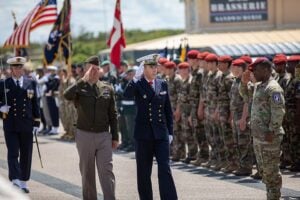
The 82nd anniversary of D-Day is being observed on June 6 by museums, memorials, veterans organizations, and military institutions across the United States and Europe. They honor the courage, sacrifice, and cooperation that helped secure the Allied victory in World War II.
The Normandy Invasion and Operation Overlord
More than 150,000 Allied troops crossed the English Channel and landed in Normandy, France, on D-Day as part of Operation Overlord, the largest amphibious invasion in military history. The goal of this operation was to begin the liberation of Western Europe from the Nazi occupation. Additionally, the operation involved nearly 150,000 American, British, Canadian, and other Allied troops attacking Germany’s fortified defenses in Normandy.
The invasion took place along five designated landing beaches—Utah, Omaha, Gold, Juno, and Sword. To secure the flanks, many paratroopers parachuted into the area behind the westernmost and easternmost enemy lines so they could take over important targets and interfere with German communication. The Allies had a difficult time establishing a foothold in France against stiff resistance and heavy losses. However, they were able to do so successfully and create sufficient momentum that Nazi Germany was eventually defeated in less than a year.
According to the National Archives, D-Day remains one of the defining moments of World War II. The agency preserves records, photographs, and firsthand accounts that help document the scale and significance of the invasion. Many historians agree that the D-Day invasion was a critical event in the overall success of the Allies. It was key to their campaign to take back Europe from the Nazis.
Commemorating D-Day’s Legacy
As the number of surviving World War II veterans continues to decline, commemorations of D-Day have taken on added significance. As part of a nationwide event marking the anniversary of D-Day, many American organizations are capturing personal accounts. In addition, they are educating our future generations about the sacrifices of WWII.
Museums and Memorials Mark the Anniversary
The National WWII Museum (formerly known as the National D-Day Museum) in New Orleans is holding events on June 6, including educational activities and a public commemoration ceremony honoring those who participated in the Normandy campaign.
Additionally, the museum is presenting the Dr. Hal Baumgarten D-Day Commemoration, named in memory of D-Day veteran Dr. Harold “Hal” Baumgarten. The annual event remembers those who participated in the Normandy landings and supports the museum’s mission to educate future generations about World War II and its lasting impact.
According to Axios New Orleans, the museum highlights New Orleans’ important contribution to the Normandy invasion through the development and production of Higgins Boats. These boats were designed by Andrew Higgins and built by thousands of workers in New Orleans. Higgins Boats were used to carry Allied troops ashore during the D-Day landings and played a critical role in the success of the Normandy invasion.
The Higgins Boats became one of the most identifiable symbols of D-Day. More than 25,000 workers helped manufacture the vessels during the war, demonstrating how American industry supported the Allied war effort far from the front lines.
The Higgins Boat’s Role in D-Day
In Normandy, remembrance services are being held to honor those who fought in World War II. According to the U.S. Army, service members will participate in more than 120 events and ceremonies across Normandy. These commemorations will pay tribute to the service members who participated in the D-Day landings and subsequent operations during World War II.
The American Battle Monuments Commission honors U.S. service members who died in World War II. It does so by maintaining the American Cemetery at Normandy and other military memorials worldwide. The American Cemetery at Normandy serves as a lasting reminder of the lives lost during World War II.
Why D-Day Still Matters Today
D-Day remains significant because it demonstrated how Allied nations worked together to overcome a common threat during World War II.
The anniversary also provides an opportunity to reflect on the historical impact of the Allied campaign in Europe.
Many families maintain personal connections to D-Day through relatives who served during World War II. Museums, archives, and memorial organizations continue to preserve these stories for future generations.
Nearly 82 years later, D-Day remains a powerful reminder of the sacrifices made to defend freedom during one of history’s largest military operations. The anniversary continues to serve as an opportunity to remember those who took part in the invasion and to reflect on its lasting historical significance.
Sources:
The National WWII Museum — “Home”
The United States Army — “Airborne Ceremony at Sainte-Mère-Église Marks 82nd Anniversary of D-Day”
American Battle Monuments Commission — “Home”
Axios New Orleans — “How New Orleans helped win D-Day”
National Archives — “Records Relating to D-Day”
Editor’s Disclaimer: This article is intended for informational and educational purposes. It is based on publicly available information from government agencies, museums, historical institutions, and news organizations. Historical events, dates, and figures have been presented using sources deemed reliable at the time of publication. Readers are encouraged to consult the cited sources for additional context and research. Presence News does not endorse any external organizations referenced in this article and is not responsible for changes to third-party content after publication.
