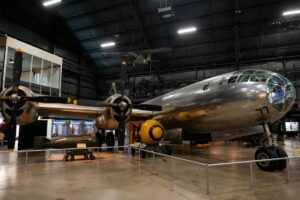
The metal skin of the B-29 hummed beneath my boots as I climbed the ladder into the fuselage. Dawn hadn’t arrived yet—just that watery blue edge of morning that never quite feels real. Everyone else on the airfield moved like silhouettes, swallowed by the enormity of the mission, the war, and the sky itself.
We had practiced this climb hundreds of times. Today, it felt heavier.
I ducked into the forward cabin and took my position. The air smelled like cold aluminum, fuel, and something quieter—anticipation, maybe. No one spoke much. Conversation had become a luxury in the last twenty-four hours. We all understood our roles too well.
Starting the airplane
The engines began warming, four giant Wright R-3350s growling like chained animals. Their vibrations crawled up my spine. Even after all these months, that sound still carried both comfort and dread: comfort, because it reminded us we were protected by one of the most advanced aircraft ever built; dread, because every mission took men up but didn’t always bring them home.
“Ready,” the pilot said. His voice echoed in the headset, steady but unmistakably human.
The runway lights blurred beneath us as we climbed, the island shrinking into a dot. Every minute the world became quieter, the Pacific stretching in all directions like a secret.
Our orders had been reviewed, rehearsed, and drilled into us—but no one could rehearse the feeling of actually carrying a weapon capable of rewriting history. The bomb bay remained sealed behind me, silent, as if holding its breath.
Waiting
Hours passed. The sun rose at our altitude long before it touched the ground below. Clouds rolled beneath the B-29 like endless fields of white. We flew, and flew, and flew, each of us alone with our thoughts.
I remember looking down at my hands, wondering how history would remember them. Would anyone ever know the names inside this aircraft? Or would the world only speak of the day, the bomb, the aftermath?
Then came the moment.
The pilot’s voice crackled: “Approaching target.”
The cabin tightened—not physically, but emotionally, spiritually. We were suspended in a space between duty and destiny. My heart hammered so loudly I thought the intercom would pick it up.
The bay doors opened. Cold air surged in. The plane felt lighter, but my chest felt heavier.
A second passed. And another. And another.
“Bomb away.”
Only two words, but they changed every world—ours above the clouds, and the one far below.
We turned. No one looked back. That was an unspoken rule. But the sky behind us glowed—a light too bright to be natural, too silent to be forgotten. Even without seeing it, we felt its enormity.
The radio stayed quiet the entire way home. Nobody needed to speak. Every man on board carried his own storm of emotion: relief, sorrow, confusion, and the sharp awareness that we were now tied to history forever.
When we landed, ground crews approached with wide eyes, already sensing that something irreversible had happened. We climbed down in silence. The engines ticked as they cooled, no longer roaring, just breathing.
The world would never be the same.
Neither would we.
And now, decades later, the aircraft rests inside the National Air & Space Center in Virginia—polished, preserved, unmoving. Visitors walk beneath its wings and read its name, its specifications, its role. They see a machine.
But we knew it as something else.
A vessel of fate.
A witness to the unthinkable.
A reminder of the weight a single mission can put on a human soul.
When you stand before it, remember the crew that once climbed its ladders before sunrise, uncertain whether they’d return—ordinary men tasked with an extraordinary moment that reshaped the world.
Disclaimer: This article contains a fictionalized narrative inspired by real historical events. While the B-29 Superfortress and the 1945 mission are historically accurate, the first-person story and character perspectives in this piece are imaginative recreations for storytelling purposes only.
