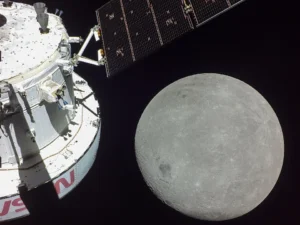
NOVEMBER 21, 2022 - NASA’s Orion spacecraft approaches the far side of the Moon during its Artemis I mission, captured by a camera mounted on one of its solar arrays as it prepared for a lunar flyby.
Photo: Presence News
Post Views:458
For a few brief but critical minutes, the four astronauts aboard Artemis II will experience something no human has felt in more than half a century: total isolation from Earth. As their Orion spacecraft slips behind the far side of the Moon, every signal—every voice transmission, every stream of data—will vanish, marking the mission’s lunar communications blackout.
It’s not a malfunction, but a planned and unavoidable part of the mission.
A Silence Built Into the Mission
Artemis II, scheduled as NASA’s first crewed lunar mission since the Apollo era, is designed as a free-return trajectory—a sweeping path that loops astronauts around the Moon and brings them safely back to Earth without requiring engine burns to return home.
The roughly 10-day mission will begin with system tests in Earth orbit before Orion heads toward the Moon, looping around it and returning to Earth along a carefully planned free-return path.
According to NASA, the mission’s primary goal is to test life-support systems, navigation, and crew operations in deep space before future landing missions.
But embedded in that trajectory is a moment of unavoidable silence.
When Orion passes behind the Moon, the entire bulk of the lunar body blocks radio signals between the spacecraft and Earth. This phenomenon, sometimes referred to as a lunar communications blackout, is not new. Apollo missions experienced it as well. What’s different now is the context: Artemis II represents a return not just to the Moon, but to deep space operations in a vastly more connected and data-driven era.
Today, constant communication is the norm. On the International Space Station, astronauts are rarely out of contact. Even satellites orbiting Earth maintain near-continuous links. Artemis II breaks that expectation.
For several minutes, the crew will be completely on their own.
The Psychological Edge of Deep Space
That silence is more than a technical detail—it’s a psychological threshold.
In low Earth orbit, astronauts can look down and see cities, coastlines, and continents in recognizable detail. They are physically distant, but emotionally tethered. On Artemis II, that connection shifts. Earth becomes smaller, more abstract. And during the blackout, it disappears entirely—not visually, but communicatively.
This moment may be one of the most emotionally intense parts of the mission.
While NASA has not framed the blackout as a primary risk, it is a known and carefully planned aspect of deep space travel. The agency emphasizes that Orion is designed to operate autonomously during these periods. As NASA explains, the Orion spacecraft is “built to take humans farther than they’ve ever gone before,” highlighting its ability to function independently when needed.
That independence is critical. During the blackout, astronauts must rely entirely on onboard systems and their training. There is no real-time guidance from Earth. No immediate troubleshooting support. Every decision, if one is required, must be made within the spacecraft.
Technology Designed for Isolation
Compared to Apollo-era spacecraft, Orion represents a major technological advancement. Many countries, such as the European Space Agency, helped develop Orion. Orion incorporates advanced flight control, automated navigation systems, and modern life-support technology.
According to the European Space Agency, the Orion spacecraft’s service module will supply the spacecraft with electricity, propulsion, thermal control, air and water, underscoring its role as the backbone of the mission. This allows Orion to sustain astronauts even when communication is temporarily lost.
Automation is very important to the operation of spacecraft. Most of the actual flight will be controlled by onboard systems. Even though astronauts have been trained to take over manual control if required, the spacecraft will be capableof maintaining its trajectory, monitoring onboard systems, and controlling the spacecraft during critical stages of flight.
Still, automation does not eliminate uncertainty—it changes its nature.
Rather than relying on constant input from mission control, astronauts must trust the systems—and themselves.
A Throwback to Apollo, With Higher Stakes
The idea of a communications blackout may sound like a relic of the 1960s, but it remains an unavoidable reality of lunar missions. During Apollo 8, the first crewed mission to orbit the Moon, astronauts experienced similar periods of silence. At the time, those blackouts became moments of suspense back on Earth, as families and engineers waited for signals to return.
Artemis II will echo that experience, but in a very different media environment.
In the Apollo era, delays and gaps in communication were expected. Today, they feel almost unnatural. We are accustomed to instant updates, live streams, and continuous connectivity. The absence of information—even for a few minutes—can feel significant.
As Space.com notes, Artemis II will “test critical systems including life support, navigation, and communications,” as NASA prepares for future missions beyond the Moon. That includes how both astronauts and audiences handle moments of uncertainty.
Why the Silence Matters
The communications blackout is not just a technical footnote. It is a preview of the realities of future space exploration.
As NASA looks beyond the Moon toward missions to Mars, communication delays will stretch from minutes to potentially tens of minutes each way. Real-time conversation with Earth will no longer be possible. Crews will need to operate with far greater autonomy, making decisions without immediate input from mission control.
Artemis II offers a small but meaningful glimpse into that future. It’s a reminder that space exploration is not just about reaching new destinations. It’s about adapting to new conditions, including the absence of something we often take for granted: connection.
The Moment Contact Returns
Orion will emerge from behind the Moon, and communication with Earth will be restored. Voices will return, data will begin flowing again, and mission control will reconnect with the crew.
But for those few minutes of silence, Artemis II will offer a rare glimpse into the true nature of deep space exploration—where distance is real, independence is essential, and humanity is, for a moment, truly on its own.
Editor’s Disclaimer:This article is based on publicly available information from NASA and its international partners regarding the Artemis II mission. Mission details, timelines, and technical specifications may change as the program develops.
William Barber is an Editor and freelance journalist with Presence News based in Jackson, Mississippi. He regularly reports on community news, business, wellness, culture, entertainment, and human-interest stories throughout Mississippi while helping maintain the publication’s editorial standards. Before joining Presence News, William built professional experience in journalism, librarianship, copywriting, and digital publishing. As a certified copywriter, he has written hundreds of articles spanning wellness media, blogs, digital campaigns, scholarly publications, and poetry. One of his most recognized contributions to Presence News is DDPY: The Workout That’s Changing Lives, which became one of the publication’s most-viewed articles. Through his reporting, William has gained recognition within his local community for covering businesses, nonprofit organizations, entrepreneurs, artists, and community leaders making a positive impact. As an Editor, he has publishing authority at Presence News and works closely with contributors to ensure articles are accurate, informative, and aligned with the organization’s commitment to original, people-first journalism. One of William’s long-term goals is to relocate to New York City, where he hopes to provide regular on-the-ground coverage of local news, business, culture, and community events for Presence News. Story ideas, press releases, and editorial inquiries can be sent to william@presencenews.org More by William Barber