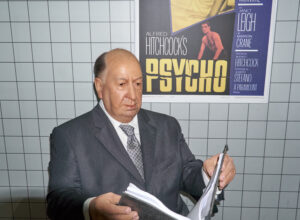
The ‘Horror’ of Hitchcock
Known worldwide as The Master of Suspense, Alfred Hitchcock built a six-decade career crafting unforgettable thrillers. Yet his genius went far beyond tension and mystery. Beneath his careful pacing and psychological nuance lay a mastery of horror—subtle, chilling, and deeply human.
Two of Hitchcock’s most iconic works, Psycho (1960) and The Birds (1963), not only terrified audiences in their own eras but also set the tone for decades of horror cinema to come.
Psycho (1960)
Isolation, Escape, and Chainsaws
In Psycho, Hitchcock traps both character and viewer inside the eerie stillness of the Bates Motel.
Marion Crane (Janet Leigh) steals a sum of money and flees into the night—only to stumble upon isolation itself. Hitchcock’s innovative use of lighting, camera framing, and Bernard Herrmann’s unforgettable score builds a mood of dread that later films would emulate.
That same isolation and terror echo through later classics. In The Texas Chainsaw Massacre (1974), a group of young travelers ventures into a desolate rural area, only to confront horror lurking behind closed doors. Both films transform isolation into a weapon.
Wait—She’s Not the Final Girl?
Hitchcock’s decision to kill off Marion Crane halfway through Psycho shocked audiences and redefined storytelling. The “false protagonist” trope—introducing a main character only to eliminate them early—became a horror hallmark for decades.
Films that carried forward this Hitchcockian twist include:
- Halloween (1978) – Focus shifts between Laurie Strode (Jamie Lee Curtis) and her friends before horror strikes.
- Friday the 13th (1980) – Annie (Robbi Morgan) seems central—until her unexpected demise.
- A Nightmare on Elm Street (1984) – Tina (Amanda Wyss) experiences the first nightmare and dies early on.
- Scream (1996) – Drew Barrymore’s Casey Becker meets her end before the opening credits finish.
Hitchcock turned narrative structure into suspense itself—and horror storytellers never looked back.
The Birds (1963)
Man vs. the Unexplained
With The Birds, Hitchcock left human villains behind and turned the natural world into the antagonist. A small coastal town faces a relentless, unexplained assault from flocks of birds—an image of nature rebelling against humanity.
This theme resurfaced in Final Destination (2000), where characters are hunted by fate itself—another invisible, unstoppable force.
Nature’s Fury
Isolation again drives Hitchcock’s terror. In The Birds, trapped characters fight for survival inside homes and cars as nature closes in.
That same claustrophobic tension echoes decades later in Crawl (2019), where humans face monstrous alligators amid floodwaters. Both films pit fragile human order against unrelenting natural chaos.
Remembering Hitchcock
Whether it’s Night of the Living Dead (1968), Scream (1996), or Barbarian (2022), each owes a creative debt to Hitchcock’s blend of psychology, pacing, and visual storytelling.
This Halloween—or any dark, stormy night—remember the man who proved that true horror lies not only in monsters, but in the tension between fear and fascination.
Sources
- Psycho (1960), dir. Alfred Hitchcock
- The Birds (1963), dir. Alfred Hitchcock
- The Texas Chainsaw Massacre (1974), dir. Tobe Hooper
- Halloween (1978), dir. John Carpenter
- Friday the 13th (1980), dir. Sean S. Cunningham
- A Nightmare on Elm Street (1984), dir. Wes Craven
- Scream (1996), dir. Wes Craven
- Final Destination (2000), dir. James Wong
- Crawl (2019), dir. Alexandre Aja
