
Alabama, located centrally in the Deep South, has undergone an extraordinary political realignment. Alabama election history reveals how the state transformed from one of the nation’s most reliable Democratic strongholds into a Republican presidential bastion. Many of the factors behind Alabama’s transformation have been present in other southern states as well: civil rights developments; changing demographics; and changing partisan coalitions.
From Democratic Stronghold to Southern Dissatisfaction
Following Reconstruction, Alabama became part of what was known as the “Solid South,” a region that voted overwhelmingly Democratic for decades. From the late nineteenth century through much of the twentieth century, Democratic candidates dominated Alabama politics at both the state and national levels.
One notable exception occurred in 1928 when Democratic nominee Al Smith faced resistance in parts of the South because of his Catholic faith. Although Smith still carried Alabama, Republican Herbert Hoover performed better than Republicans traditionally had in the region. Any political impact from that election was soon overshadowed by the Great Depression and the rise of Franklin D. Roosevelt.
During the 1930s and 1940s, Roosevelt carried Alabama comfortably in each of his four presidential victories. Many Southern states supported FDR’s New Deal initiatives, which helped to enhance the Democratic Party’s influence. However, there were rifts in the Southern Democratic Party and at the national level among Democrats, particularly as they pertained to civil rights issues.
Those tensions became evident in 1948. After President Harry Truman ordered the integration of the U.S. Armed Forces, many Southern Democrats opposed the direction of the national party. Alabama joined several Deep South states in supporting the States’ Rights Democratic Party, commonly known as the Dixiecrats, led by South Carolina Governor Strom Thurmond. While Alabama remained Democratic at the local level, the election signaled growing divisions within the party.
Civil Rights and Political Realignment
A major turning point in Alabama election history occurred during the 1960s as civil rights legislation reshaped political alliances across the South.
Alabama continued to support Democratic presidential nominees Adlai Stevenson in both 1952 and 1956. However, Republican Dwight D. Eisenhower improved Republican performance across much of the South, signaling the beginning of cracks in the region’s longstanding Democratic loyalty.
The real turning point came during the 1960s. In 1960, Democratic nominee John F. Kennedy carried part of Alabama’s electoral vote, while unpledged electors received support elsewhere in the state. Kennedy’s Catholic faith generated skepticism among some Southern voters, though larger political changes were still to come.
Following the death of President John F. Kennedy (JFK), President Lyndon Baines Johnson made an aggressive effort to implement civil rights legislation and push for the passage of the Civil Rights Act of 1964. The passage of the Civil Rights Act created an enormous change in the political landscape of America and propelled forward the political realignment that had been taking place in the Southern United States.
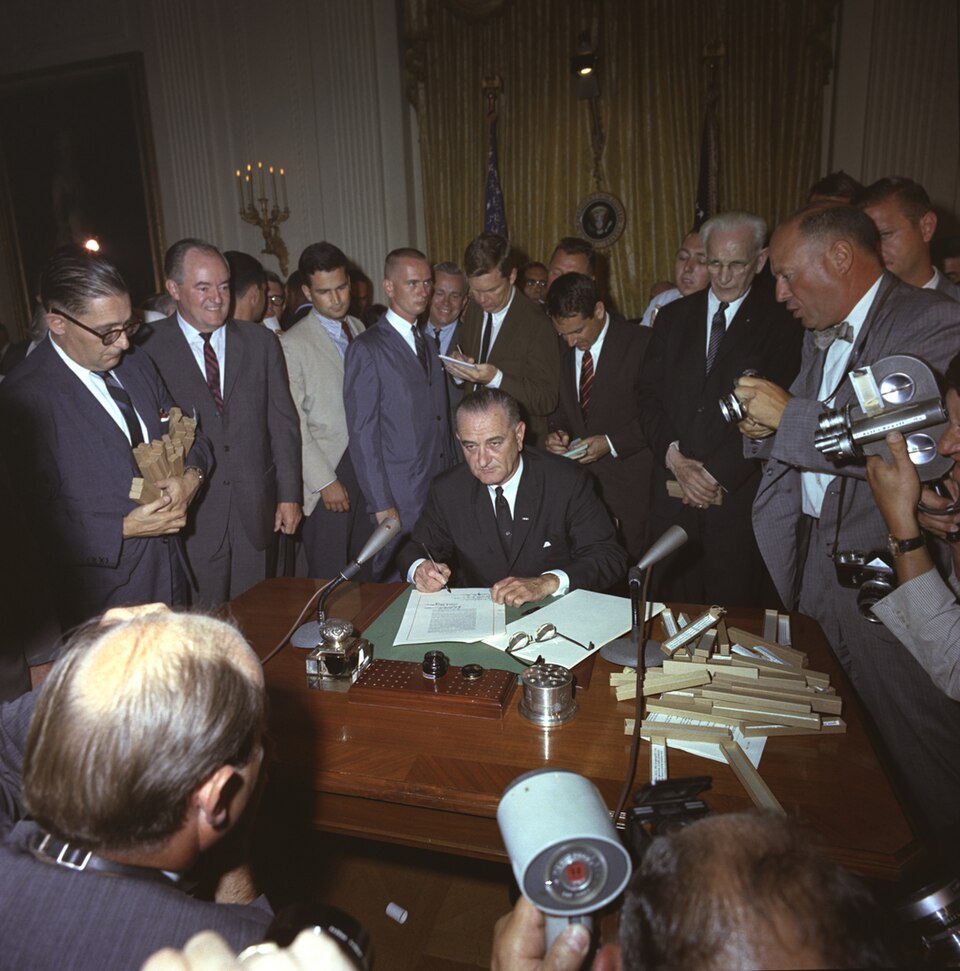
https://commons.wikimedia.org/wiki/File:Civil_Rights_Act_signing_LBJ.jpg https://creativecommons.org/publicdomain/mark/1.0/
Goldwater and the Republican Breakthrough
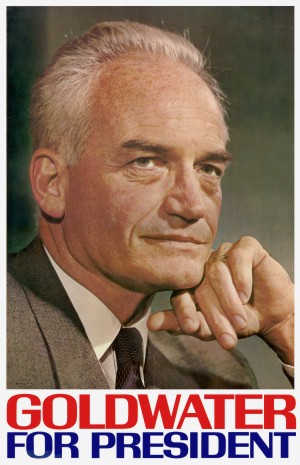
In a three-way race for president in 1964, Barry Goldwater won the State of Alabama as the Republican nominee. Barry Goldwater opposed the Civil Rights Act, arguing that portions of the legislation exceeded the federal government’s constitutional authority. Goldwater’s victory marked the first time since Reconstruction that Alabama voted Republican in a presidential election, signaling a major shift in the state’s political alignment.
This change did not happen overnight. In 1968, Alabamians had the opportunity to support native son George Wallace, who had previously served as the Governor of Alabama. Wallace received strong support from many Alabama voters due to his status as a native son and a populist and segregationist political platform.
By 1972, Republican President Richard Nixon won Alabama as part of a national landslide. Historians have frequently cited Nixon’s appeal to white Southern voters through what became known as the ‘Southern Strategy’ as one factor in the South’s continuing political realignment. Even so, Democrats still maintained significant influence throughout Alabama at the state and local levels.
Jimmy Carter and the Last Democratic Victory
The 1976 election remains one of the most significant moments in Alabama election history, marking the last time a Democratic presidential nominee carried the state.
In the aftermath of Watergate and President Nixon’s resignation, many voters sought a political alternative that emphasized honesty and trust in government. Jimmy Carter, the former governor of neighboring Georgia, ran on a message of restoring honesty and integrity to government.
Carter’s southern heritage played a crucial role in his ability to unite voters from a wide variety of backgrounds. The Democratic Party nationally struggled in the South, but Carter was able to build a broad coalition of voters that included not only traditional southern Democrats but also significant amounts of support among African Americans who were starting to become a large and important part of the Democratic Party after the civil rights movement.
Carter emphasized what he called a “New South,” one that looked toward economic development and reconciliation rather than the racial divisions of the past. His message resonated across much of the region.
In Alabama, Carter won decisively. The state joined much of the South in supporting the Georgia Democrat, making 1976 the last presidential election in which Alabama voted for a Democratic nominee. Carter’s victory also marked the last time a Democrat carried many Alabama counties that would later become reliably Republican.

https://commons.wikimedia.org/wiki/File:Jimmy_Carter_Campaign.gif
https://creativecommons.org/publicdomain/mark/1.0/
His success reflected a unique combination of regional identity, dissatisfaction with the Republican administration, and Carter’s ability to bridge divisions within the Democratic coalition.
The Last Competitive Election
By 1980, however, Carter faced serious challenges. The country was facing high inflation, slow economic growth, energy shortages, and the Iran hostage crisis. Ronald Reagan campaigned on policies focusing on tax reductions, economic growth, and a smaller federal government.
Although Reagan won a national landslide, Alabama remained surprisingly competitive. Reagan carried the state by just 1.3 percentage points, making 1980 the last presidential election in which Alabama was truly contested between the two major parties.
The close result demonstrated that the South’s transition toward the Republican Party was still incomplete. Carter remained popular among many Southern Democrats, and his regional roots helped him maintain support despite his broader national difficulties.
Nonetheless, Reagan’s win signified an important turning point. Republicans were gaining ground throughout the South, and Alabama was becoming an increasingly important part of the Republican coalition.
The Reagan Era and Republican Growth
Reagan’s popularity soared during his first term as the economy improved and inflation declined. In 1984, Alabama voted overwhelmingly for Reagan as he defeated former Vice President Walter Mondale in one of the largest landslides in American history.
The election also reflected broader changes occurring within Alabama politics. As Republican candidates gained ground across the United States in state and local elections, they also gained traction in presidential races. The shift of traditional Democratic voters to the Republican Party continued with the success of Republican Vice President George H. W. Bush over Democrat Michael Dukakis in 1988. This further aligned the state with the Republican Party after voting for George H. W. Bush in 1988.
Clinton’s Southern Appeal
Democrats had another chance to win in the South with the election of 1992. Bill Clinton, governor of Arkansas, was a southern candidate who was able to gain the support of moderate-to-conservative voters.
Bill Clinton won several Southern states in both the 1992 and 1996 elections. However, his candidacy was not successful in Alabama, although he was able to provide competitive performances based on current standards.
The 1996 election remains significant because it was the most recent presidential election in which Alabama was decided by a single-digit margin. It was also the last election in which many Alabama counties voted Democratic at the presidential level.
While Clinton slowed the Republican trend in parts of the South, he could not reverse the broader political transformation underway in Alabama.
Alabama in the Twenty-First Century
By the beginning of the twenty-first century, Alabama election history had entered a new phase as the state became firmly Republican in presidential contests.
In 2000, Republican nominee George W. Bush defeated Vice President Al Gore by a wide margin. Gore became the last Democratic presidential nominee to receive at least 40 percent of Alabama’s vote. Since then, Democratic candidates have consistently struggled to remain competitive statewide.
Every Republican nominee has won Alabama by a comfortable margin since 2004. The state has now gained a reputation for being one of the strongest Republican presidential bases.
While some of the more recent nominees, such as Barack Obama, were able to do better than others, they were unable to duplicate the success of President Carter or the relatively close competition with Clinton. Many of the counties that had voted Democratic in the past, when voting for president, have changed to predominantly Republican.
Today, Alabama’s voting patterns reflect a political realignment that has unfolded over several generations. The state moved from being one of the Democratic Party’s most reliable supporters to becoming one of the Republican Party’s strongest bases of support.
Conclusion
Alabama election history tells the story of one of the most dramatic political transformations in the United States. From the Democratic dominance of the Solid South to the civil rights era, from Jimmy Carter’s historic victory in 1976 to decades of Republican success, Alabama has undergone one of the most significant electoral shifts in American politics. Nearly fifty years after Carter’s victory, Alabama remains firmly Republican at the presidential level, illustrating how profoundly the state’s political landscape has changed.
Sources:
270toWin — “Historical U.S. Presidential Elections 1789–2024”
Encyclopaedia Britannica — “United States Presidential Election”
National Archives – Electoral College Results (1789–Present)
American Psephology — “The 1960 Presidential Election in Alabama”
Encyclopaedia Britannica — “Dixiecrat”
BallotWire — “1964 U.S. Presidential Election Results”
Encyclopaedia Britannica — “George Wallace”
Miller Center — “Jimmy Carter: Campaigns and Elections”
Editor’s Disclaimer: This article is part of Presence News’ ongoing series examining the presidential election history of individual U.S. states. The article is intended for informational and educational purposes and is based on publicly available historical election data and reference materials. Historical events, voting patterns, and political developments are presented within their historical context and should not be interpreted as an endorsement of any political party, candidate, or viewpoint.
