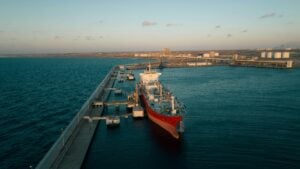
A Critical Trade Artery
The Red Sea is a commercial superhighway that connects European and Asian markets. Trade routes in this region have played a crucial role in the movement of goods and resources between continents for centuries. According to various maritime and trade analyses, the Red Sea carries a significant share of global container shipping, though estimates vary by source and year.
Various industry and government estimates indicate that roughly $1 trillion in trade passes through the Red Sea annually. Government and industry estimates suggest that approximately 9–12% of globally traded seaborne oil and around 8% of liquefied natural gas (LNG) shipments transit the Red Sea.
At the southern end of the Red Sea, the Bab El-Mandeb Strait serves as a chokepoint that is only dozens of kilometers across. This means that a massive portion of the world’s shipping is contingent on a single point. Any sizable disruption would mean rerouting shipping around the Cape of Good Hope.
Circumnavigating the entirety of continental Africa adds between 10 and 20 days to the journey. It also adds roughly 3,000-4,000 nautical miles to the journey. This, in turn, causes insurance, fuel, labor, port fees, and equipment rental costs to dramatically increase. As a result, these cost incursions pass surcharges onto global consumers. This inflates prices and strains supply chains.
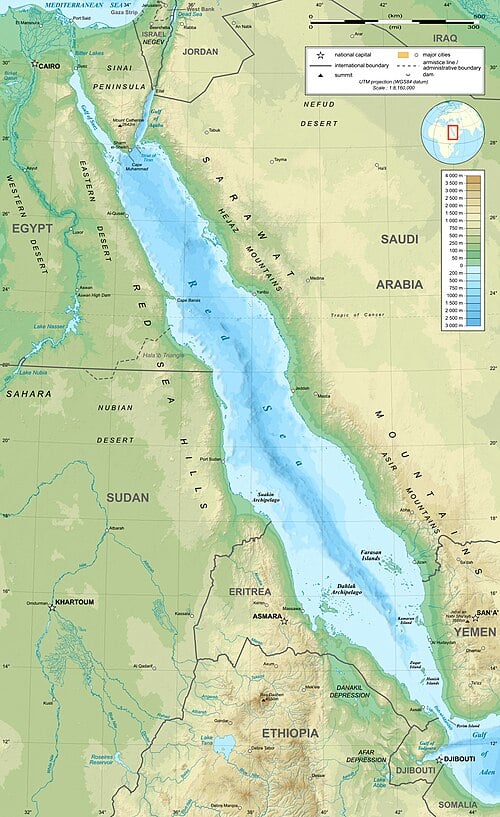
Map by Eric Gaba (Sting), via Wikimedia Commons. Licensed under Creative Commons Attribution-ShareAlike 4.0 International (CC BY-SA 4.0).
https://commons.wikimedia.org/wiki/File:Red_Sea_topographic_map-en.jpg https://creativecommons.org/licenses/by-sa/4.0/
Militarization in the Red Sea
Any disruption or potential closure of the Strait of Hormuz in the Persian Gulf increases the strategic importance of both the Bab el-Mandeb Strait and the Suez Canal. Regional tensions involving Iran have also raised concerns that Iranian-aligned proxy groups could become more active throughout the region.
The Houthi rebels in Yemen have continued to disrupt Red Sea trade. This has increased pressure on governments, shipping companies, and regional partners to seek alternative routes and long-term solutions. These developments have drawn increased international attention to Somaliland, a self-governing region that declared independence from Somalia in 1991 but remains largely unrecognized internationally.
Strategic Competition in the Horn of Africa
The invaluable nature of the Bab El-Mendeb Strait’s importance has not been lost on regional or global powers. Military investment and security cooperation have increased across the Horn of Africa and among Persian Gulf states. Investments into foreign military bases, large naval deployments, private military and maritime security companies (PMC/PMSC), and domestic militaries have been made by multiple states. Along with Somaliland, there is another region worth mentioning. Puntland remains an autonomous region within Somalia, though political disagreements with the federal government in Mogadishu have at times raised questions about the future relationship between the two administrations.
Risks of Escalation
- Recognition of Somaliland triggering regional backlash
If recognition of Somaliland begins to gain traction, it could trigger a chain reaction of diplomatic and political responses across the region. Several diplomatic relationships among regional actors are already strained. Such a shift could increase diplomatic tensions among regional actors and potentially contribute to broader instability. Some security analysts argue that prolonged regional instability could create opportunities for armed non-state actors, including Al-Shabaab and the Houthis, to expand their influence.
This can further destabilize the already fragile trade chokepoints in the Red Sea.
- Proxy warfare spilling into Somalia
Competition among foreign powers for regional influence has increased the strategic importance of both Somaliland and Puntland. Some observers argue that these dynamics have contributed to further political fragmentation within Somalia. Somalia’s strategic coastline and potential natural resources have made the country an important arena for regional competition and investment. If proxy warfare spilled into Somalia, it could devastate the already fragile unity of the federal government in Mogadishu.
Maritime and Security Threats
- Piracy resurgence linked to instability
Increased instability could raise the risk of renewed piracy and maritime crime in the region. Greater political fragmentation could weaken governance and create conditions in which criminal networks are able to expand their operations. Weak enforcement capacity could make it more difficult to contain maritime crime. Such conditions could also create opportunities for militant organizations such as Al-Shabaab to exploit weakened governance and security structures, potentially complicating regional counterterrorism and maritime security efforts.
Al-Shabaab has historically sought to undermine security cooperation and weaken local security institutions.
Such developments could complicate efforts by foreign governments seeking deeper engagement with Somaliland. It could also affect regional security arrangements and economic agreements involving Somaliland, Puntland, Ethiopia, and the United Arab Emirates.
- Ethiopian–Somali tensions reigniting
Growing tensions involving Somaliland and Puntland could contribute to wider regional instability in the Horn of Africa. Somaliland’s diplomatic initiatives have become a source of regional controversy and debate. Some observers have expressed concern that regional tensions could complicate existing security challenges elsewhere in the Horn of Africa, including Ethiopia. The controversial Ethiopia-Somaliland Memorandum of Understanding (MoU) would grant Ethiopia access to a portion of Somaliland’s coastline, while Somaliland has indicated that it hopes the agreement could eventually lead to formal recognition by Ethiopia.
The agreement drew criticism from Egypt, Eritrea, and Somalia’s federal government and contributed to increased security cooperation and military activity in the region.
Conclusion
The odds of Somalia becoming the center of a conventional interstate war are unlikely. However, it could become a focal point for overlapping proxy conflicts, maritime competition, and geopolitical positioning if current regional tensions continue to intensify. The complex web of diplomacy and geopolitical competition in the Horn of Africa and the Persian Gulf is likely to continue shaping the strategic calculations of regional powers. Understanding these developments requires considering the interconnected political, economic, and security factors shaping the region. Viewed in this broader context, Somaliland’s growing strategic relevance helps illustrate both the opportunities and risks emerging across the Horn of Africa.
Sources:
Atlantic Council — “Turkey signed two major deals with Somalia. Will it be able to implement them?”
GIS Reports — “Rising tensions in the Horn of Africa”
Martin Plaut — “The Geopolitical Ripple Effects of Somaliland’s Recognition”
Policy Center for the New South — “Somali Piracy: A Simple Flare-Up or a Rising Threat?”
Atlantic Council — “A lifeline under threat: Why the Suez Canal’s security matters for the world”
CNBC — “The Strait of Hormuz crisis explained: What it means for global shipping””
DocShipper — “Red Sea Crisis Update: Route Alternatives & Cost Impacts on Global Shipping”
Instico Logistics — “How Transportation Fuel Surcharges Affect Shipping
Editor’s Disclaimer: This article is an analysis of geopolitical, economic, and security developments affecting the Red Sea and Horn of Africa regions. It is based on publicly available reporting, research publications, government information, and industry analyses available at the time of writing. References to potential future developments, regional tensions, security risks, and diplomatic outcomes are analytical assessments rather than predictions of events. Geopolitical situations can evolve rapidly, and readers are encouraged to consult multiple sources for the most current information.

More from Presence News:
.