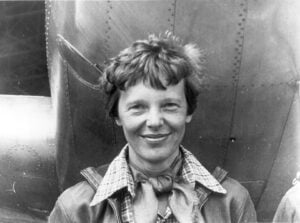
This week marks the anniversary of one of the most important achievements in aviation history.
On May 20–21, 1932, Amelia Earhart became the first woman and second person to fly solo nonstop across the Atlantic. Nearly a century later, her accomplishment remains a defining moment in both aviation and women’s history.
Earhart’s love of flying began years earlier after her first airplane ride in California. Reflecting on the experience later, she said, “As soon as I left the ground, I knew I myself had to fly.”
A Record-Breaking Flight Across the Atlantic
Earhart departed from Harbor Grace, Newfoundland, in her red Lockheed Vega aircraft on May 20, 1932. Her original goal was to land in Paris, following the route Lindbergh had taken five years earlier. Earhart faced many challenges while flying this long-distance flight, including bad weather, mechanical problems, and fatigue. The Smithsonian National Air and Space Museum reports that Earhart faced severe winds, ice, and mechanical issues during her nearly 15-hour flight.
After overcoming many different challenges, Earhart landed safely on a farm field in Londonderry, Northern Ireland, on May 21.
When asked by a local farm worker if she had flown far, Earhart famously replied, “From America.”
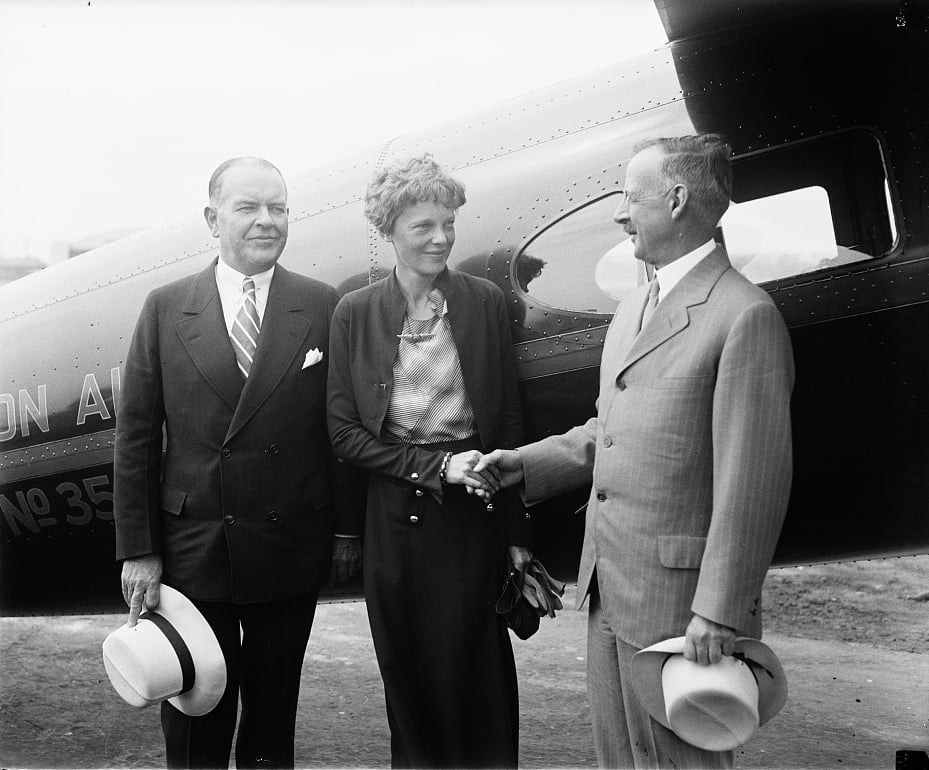
Harris & Ewing Collection / Library of Congress via Wikimedia Commons
https://commons.wikimedia.org/wiki/File:Amelia_Earhart_center2.jpg
https://creativecommons.org/publicdomain/mark/1.0
The moment immediately secured her place in history and transformed her into one of the world’s most recognizable public figures.
Dangerous Conditions in Early Aviation
An International Celebrity Overnight
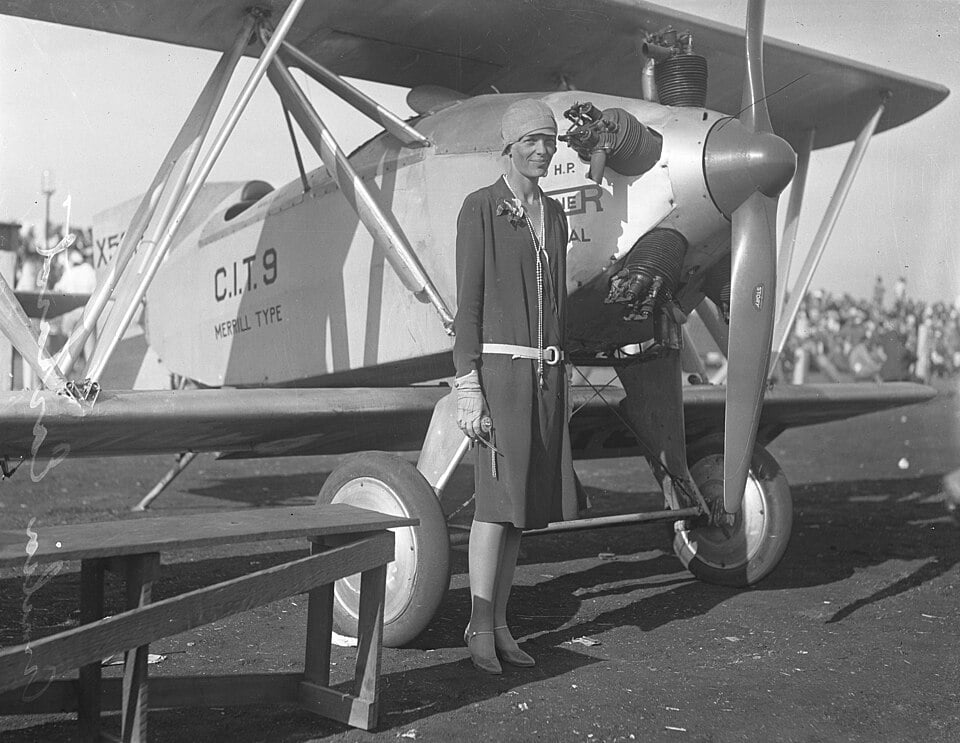
Los Angeles Daily News via Wikimedia Commons
https://commons.wikimedia.org/wiki/File:Amelia_Earhart,_circa_1928.jpg
https://creativecommons.org/licenses/by/4.0
Earhart’s difficult flight earned her worldwide honors, including the Distinguished Flying Cross, and made her an international celebrity overnight.
Nonetheless, Earhart frequently resisted being viewed as a mere symbol or idol.
Instead, she used her fame to promote aviation and encourage women to pursue careers once limited to men.
Earhart once remarked, “Women must try to do things as men have tried.”
Her influence extended far beyond the cockpit. Earhart traveled nationwide, gave speeches, and published books and articles promoting opportunities for women in science and engineering.
The Library of Congress preserved a speech in which Earhart said women must embrace new inventions to seize opportunities in a changing world. She truly believed that all people should have access to progress and be given equal access to it.
Why Earhart’s Legacy Still Matters
Modern historians continue to view Earhart’s 1932 flight as a breakthrough moment in cultural as well as aviation history. The Smithsonian Air and Space Museum retrospective notes that her accomplishment challenged public assumptions about what women were capable of achieving. As the article explains, “By 1932, Earhart still craved acceptance as a serious pilot.” At a time when female pilots were often viewed as novelties rather than serious aviators, Earhart proved that skill, courage, and determination mattered more than gender.
Earhart’s legacy continues to be an integral part of American history. While the story of her disappearance while attempting to fly around the world in 1937 continues to capture attention, her biggest legacy may be all of the opportunities she created for young girls who came after her. Women now serve in commercial aviation, military aviation, aerospace engineering, and space exploration in numbers far greater than during Earhart’s era.
Remembering a Lasting Symbol of Courage
For over 90 years, the iconic photograph of Amelia Earhart leaving for her solo flight across the Atlantic in her Lockheed Vega has inspired many people throughout the globe. While her flight was a new record for distance and time, it represented her courage to face fear, uncertainty, and the restrictions society imposes on individuals.
We must remember, as we mark the anniversary of Earhart’s flight, that the statistics alone do not define any person or achievement. Reaching milestones can be just as important as achieving a world record.
Sources:
Library of Congress — “The Sky’s the Limit: Amelia Earhart and the National Woman’s Party”
Smithsonian National Air and Space Museum — “Amelia Earhart”
Federal Aviation Administration — “Amelia Earhart” (PDF)
Smithsonian National Air and Space Museum — “Women and Flight”
Editor’s Disclaimer: This article is intended for historical and educational purposes. Historical quotations and references have been sourced from publicly available archives and institutional materials, including the Smithsonian National Air and Space Museum, the FAA, and the Library of Congress. Readers are encouraged to consult original archival sources for additional historical context.
