
Fans of the Star Wars franchise come together around the world to celebrate May 4th as Star Wars Day. Nearly five decades have passed since the release of Star Wars: Episode IV – A New Hope. The iconic phrase ‘May the Force be with you’ has evolved from a simple pun into a global cultural event. The celebration reflects the franchise’s lasting impact on the film industry nearly 50 years later. It also highlights its influence on global culture, storytelling, and its dedicated fan community.
Revolutionizing the Film Industry
When A New Hope premiered in 1977, few could have predicted its lasting impact.
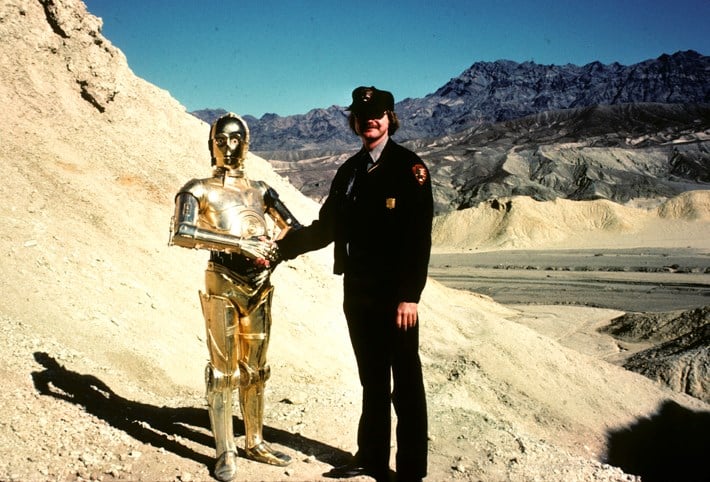
File Photo: Behind-the-scenes filming in Death Valley during the production of a Star Wars film, circa 1976. Author unknown. Courtesy of the U.S. National Park Service, via Wikimedia Commons (public domain). https://commons.wikimedia.org/wiki/File:Star_Wars_-_A_New_Hope,_filming_in_Death_Valley.jpg
https://commons.wikimedia.org/wiki/Commons:Licensing
As the Smithsonian National Air and Space Museum notes, “First, in the late 1970s, Star Wars revived the marketplace for space science fiction as a genre.” This resurgence helped fundamentally change how films were made and marketed. The film introduced groundbreaking special effects, helping usher in a new era of blockbuster filmmaking. This new style combined storytelling, spectacle, and mass appeal in ways previously unimagined. As a result, the film’s success helped establish the modern studio model for blockbuster filmmaking. Today, studios rely heavily on franchises rather than standalone films as primary revenue drivers.
The Rise of Merchandising and Franchise Power
Beyond the screen, Star Wars also transformed the entertainment business. Smithsonian Magazine has documented the franchise’s pioneering large-scale merchandising strategy. The franchise transformed how films generate revenue through merchandising, including toys, collectibles, and other related products. After leaving the theater, fans can continue engaging with the universe through toys, collectibles, and other merchandise. This merchandising model is now standard across major film franchises, from superhero blockbusters to animated features. Much of this approach originated from George Lucas’ vision and business strategy. Yet the legacy of Star Wars extends far beyond economics and technology.
Expanding the Universe Through Storytelling
Academics often cite the franchise as a cornerstone of modern ‘transmedia storytelling,’ where narratives unfold across films, television, books, and games. Star Wars is no longer just a single narrative; it has evolved into a vast universe told from multiple perspectives.

https://commons.wikimedia.org/wiki/File:Vinylmation_-_Star_Wars_-2_(7857294564).jpg
https://creativecommons.org/licenses/by/2.0/
This approach enhances fan engagement while establishing a framework for storytelling across platforms. As a result, many interconnected cinematic universes today trace their roots back to the foundation established by Star Wars.
A New Era: Streaming and Modern Star Wars
The franchise has evolved with the times in all aspects of its history. Advancements in television and streaming distribution have created new opportunities for narrative development. One key example is the success of the television series The Mandalorian. The series was designed to attract new audiences to the Star Wars franchise.
Recent coverage highlights the series’ role in revitalizing the franchise by blending classic themes with new storytelling. This demonstrates the franchise’s ability to evolve with changing audience expectations. The show reinforces that Star Wars remains both relevant and culturally significant. This is especially notable within today’s competitive streaming landscape, including platforms like Disney+.
Iconic Characters and Lasting Influence
At the heart of this enduring appeal are the characters who have come to define the saga. Among them, few are as iconic as Carrie Fisher’s portrayal of Princess Leia.
She was not just a supporting character, but a leader and warrior who represented rare on-screen female strength at the time. Carrie Fisher’s performance as Leia helped reshape how female characters could be portrayed in film. This helped redefine how female characters were portrayed in mainstream film at the time.
Carrie Fisher’s impact extended far beyond her role as Leia. Her sharp wit, candor, and outspokenness endeared her to so many people, fans from the Star Wars community, as well as the general public. Her legacy will forever continue to inspire future generations after her passing.
A recent People article highlighted how her daughter, Billie Lourd, honored Fisher on Star Wars Day by sharing the films with her own children. Reflecting on her mother’s impact, Lourd said, “She was a brilliant magical human and I want them to know that.” This underscores how Star Wars is not just a series of films, but a shared cultural experience passed down through generations.
A Legacy That Spans Generations
One of the most remarkable aspects of Star Wars’ legacy is its ability to connect generations.

https://commons.wikimedia.org/wiki/File:Cosplay_of_Leia_Organa_Solo_at_Brussels_Comic_Con_2019_(33600504718).jpg
https://creativecommons.org/licenses/by-sa/2.0/
If someone saw the original films as a child, they can now share them with their children and grandchildren. This shared experience makes each generation part of an ongoing story rooted in exploration and nostalgia. Beyond the original films’ themes of hope, redemption, and the struggle between good and evil, the story continues to resonate across generations. Each new generation continues to experience the films in its own way.
The Meaning of Star Wars Day
“May the 4th” reflects upon how this connection remains throughout the generations. What started as a fun play off of an iconic phrase has now evolved into an international event. This event celebrates storytelling, creativity, and community. On this date, fans revisit their favorite moments, share the films with new viewers, and celebrate the franchise together. Moreover, they reflect on how the Star Wars franchise has been a major factor in shaping their lives.
A Timeless Story of Hope and Connection
Ultimately, the legacy of Star Wars lies in its ability to evolve while remaining true to its core themes. From its origins to its current success in streaming, the franchise has helped define storytelling on a global scale. Countless filmmakers have been influenced by the franchise, inspiring new generations of fans. It presents a universe that feels both timeless and continually evolving.
As we again celebrate May 4, we are doing so not just to reminisce but to recognize the continued impact of the story about uniting people from all cultures and generations. In a time of global change, the Star Wars franchise remains a constant. It continues to convey themes of hope in difficult times, embodied in the enduring power of the Force.
Sources:
Smithsonian National Air and Space Museum — “How Star Wars Revolutionized Entertainment”
Amsterdam University Press — “Star Wars and the History of Transmedia Storytelling”
Smithsonian Magazine — “Star Wars: A Merchandising Empire”
Screen Rant — “The Mandalorian’s Impact on Star Wars: 6 Years Later”
Images used in this article are sourced from publicly available platforms under their respective licenses, including public domain and Creative Commons. Proper attribution has been provided where required. Any fan-created content, including cosplay, is used to illustrate the cultural impact of the franchise and does not imply official endorsement.
