
For years, the electric vehicle revolution has been framed as a high-end transformation. Sleek designs, cutting-edge tech, and price tags pushing well beyond $40,000 defined the market. The Chevrolet Bolt 2027 signals a shift in the electric vehicle market, as automakers increasingly focus on affordability after years of prioritizing higher-end models.
General Motors is reviving the Bolt for the 2027 model year, with production expected to begin in 2026. The move is being pitched as a technological upgrade—faster charging, improved range, and modern features—but its most important detail is simpler: price. The new Bolt is expected to start around $30,000, which could make it one of the most affordable electric vehicles in the United States. In fact, industry analysts view the latest version as a critical step toward making EV ownership accessible to a wider group of drivers. According to reports from The Wall Street Journal and Car and Driver, the revived Bolt is expected to return with updated technology and a starting price near the $30,000 range.
That price point is not just a selling point—it signals a broader shift in EV strategy.
A Reset for EV Strategy
When the original Bolt launched, it stood out as a practical, relatively affordable EV option. As General Motors noted in its announcement, “From its introduction in model year 2017, Bolt was a game-changer – the first long-range, mass-produced EV available at a truly affordable MSRP.” That identity—affordable, accessible, and practical—is now central to its return. The assumption was that consumers would follow—trading up for premium EVs as quickly as they once adopted smartphones, but that transition has been slower than expected.
Recent data suggests EV demand has cooled relative to industry expectations. Business Insider reported that EV sales have recently declined relative to expectations, citing Cox Automotive data, though such figures may reflect short-term fluctuations rather than long-term demand trends.
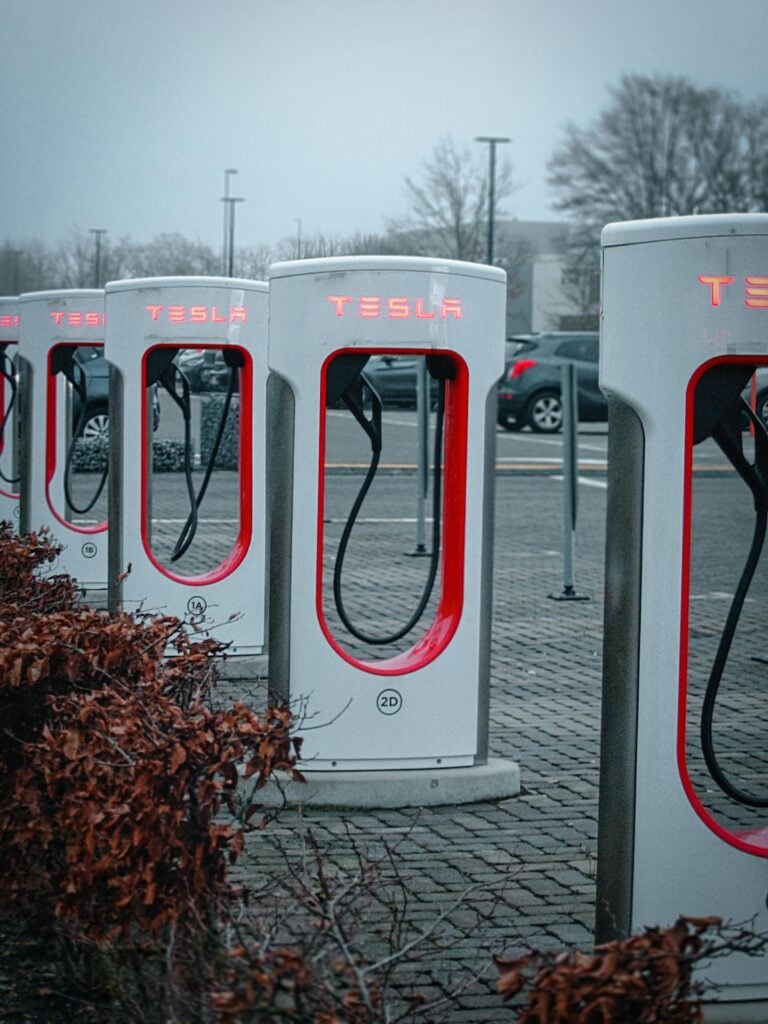
Photo by Tom Swinnen via Pexels
https://www.pexels.com/photo/tesla-charging-stations-in-urban-setting-30361373/
https://www.pexels.com/license/
Even GM has acknowledged the shift, investing hundreds of millions back into gas-powered vehicle production while recalibrating its EV plans.
Against that backdrop, the return of the Bolt looks less like nostalgia and more like strategy. More details about the Chevrolet Bolt 2027 are expected as production approaches.
What’s Actually New
The 2027 Bolt goes beyond its earlier version and features several significant upgrades.
According to General Motors, the vehicle should charge faster than previous models—potentially around 25–26 minutes from 10% to 80%—and could deliver approximately 23 miles of range after just five minutes of charging.
Additionally, the Bolt is likely to include a native NACS charging port, allowing access to a broader charging network.
Range is expected to land around 255 miles—enough to cover typical daily driving needs—and the vehicle is expected to include updated interior tech and connectivity features. Notably, the new model is expected to offer updated features while maintaining a focus on affordability.
Affordability appears to be a central focus of General Motors’ strategy for the new model.

File Photo: Close-up of an electric vehicle connected to a charging station, illustrating the role of charging infrastructure in EV adoption.
Photo by Kindel Media via Pexels
https://www.pexels.com/photo/road-industry-cable-charging-9800002/
https://www.pexels.com/license/
The $30K Question
Many analysts view a sub-$30,000 electric vehicle as a key threshold for broader EV adoption. While the Bolt may start below that threshold, additional fees and higher trims can push the final cost above $30,000, making affordability more complex in practice. It is even more complicated if the consumer cannot qualify for the federal incentives to help offset the cost of their EV.
That tension matters. It highlights the gap between headline affordability and real-world cost, a gap that has slowed broader EV adoption.
Still, compared to many electric vehicles on the market, the Bolt undercuts competitors by thousands of dollars. That alone positions it as a key player in the next phase of EV growth. Furthermore, the Bolt could become the benchmark for affordable electric vehicles as the market evolves.
A Course Correction
The bigger story isn’t just about one car. It’s about a shift in direction.
Automakers spent much of the past decade chasing premium margins in the EV space. High-end models helped offset the costs of new technology and uncertain demand. But that strategy left a gap in the market—one that affordable models like the Bolt are now stepping in to fill.
In fact, GM expects lower-cost vehicles like the Bolt and the Equinox EV to make up a significant portion of its electric vehicle sales moving forward.
That’s a notable change. It suggests the industry may be rethinking the assumption that consumers will pay more for electric vehicles, recognizing that price remains a critical factor.
What This Means Going Forward
The return of the Bolt represents a kind of reality check for the EV industry. The transition to electric vehicles is still underway, but it’s not unfolding exactly as expected. Consumers are interested, but they remain cautious—especially about cost. In summary, the new Bolt reflects a broader shift toward affordability in the EV market.
Affordable EVs may not be as flashy as their luxury counterparts, but they may ultimately be more important. If the goal is widespread adoption, vehicles like the Bolt could do more to move the market than any high-end flagship.
In that sense, the Bolt’s comeback isn’t just a product launch. It’s a correction.
As the Chevrolet Bolt 2027 approaches production, its emphasis on affordability may help define the next phase of EV adoption.
Sources:
The Wall Street Journal — “GM Launches 2027 Chevrolet Bolt”
Business Insider — “GM to Invest $340 million in gas cars as EV” demand plummets”
Car and Driver — “The Chevy Bolt Returns with a Sub-$30K Price and 255-Mile Range”
General Motors — “It’s back: Introducing the 2027 Chevrolet Bolt”
Editor’s Disclaimer: Information in this article reflects current reporting, manufacturer statements, and industry analysis at the time of publication. Specifications, pricing estimates, and timelines for the Chevrolet Bolt 2027 have not been fully confirmed and may change. While efforts have been made to ensure accuracy, no guarantees are made regarding completeness or future developments. Readers should verify details with official sources, including General Motors, before making decisions.
