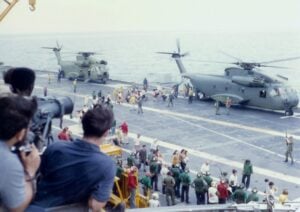
The image of helicopters flying above Saigon on April 30, 1975—carrying evacuees from rooftops and embassy grounds—has come to symbolize the final day of the Vietnam War. These helicopters were transporting the last American citizens and thousands of South Vietnamese out of a chaotic city that was falling apart. At the same time, thousands of South Vietnamese gathered below, hoping for a final chance to escape. Today, this moment is widely recognized as marking the anniversary of the Fall of Saigon and its enduring legacy.
Saigon was renamed Ho Chi Minh City after its fall. This change marked the formal end of the Vietnam War after nearly 20 years of conflict that cost millions of lives.
On April 30, 1975, the end of the Vietnam War closed a chapter of Cold War–era history and marked a symbolic turning point in Cold War–era perceptions of U.S. power. In the years that followed, it contributed to political caution in U.S. foreign policy, widespread human displacement, and enduring questions about America’s role in global affairs.
A War’s Final Hours
North Vietnamese forces had advanced rapidly by late April 1975. The defense of South Vietnam was now in complete disarray. As U.S. officials concluded that the situation would deteriorate further, they initiated Operation Frequent Wind to evacuate remaining Americans from Saigon.
According to analysis from the Lieber Institute at West Point, the operation began on April 29 as “an effort to evacuate U.S. citizens and certain vulnerable…Vietnamese personnel by helicopter.”
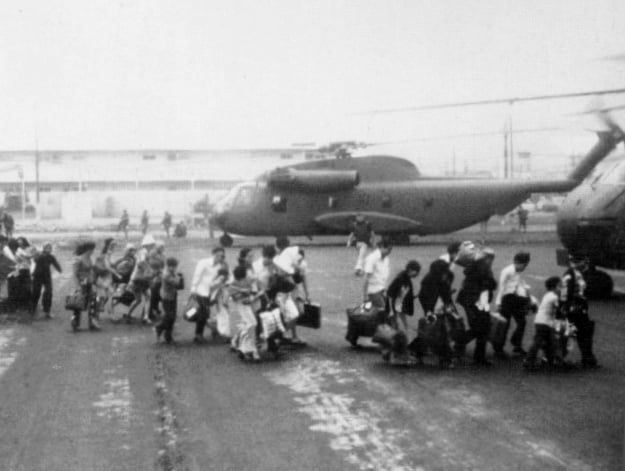
Photo: U.S. Marine Corps, via Wikimedia Commons (public domain)
https://commons.wikimedia.org/wiki/File:Evacuation_from_LZ39.jpg
https://commons.wikimedia.org/wiki/Commons:Licensing
Helicopters ferried evacuees from Saigon to U.S. Navy ships waiting offshore. In total, more than 7,000 people were evacuated—one of the largest helicopter evacuations ever conducted.
But the evacuation was not orderly. It was chaotic, urgent, and deeply human.
For those on the ground, the experience was visceral. One U.S. Navy officer later recalled “cursing my luck,” in an account published by the U.S. Naval Institute.
That memory—raw, immediate, and personal—captures what statistics cannot.
Chaos, Courage, and Limits
The evacuation revealed both the capabilities and limits of American power. Within hours, thousands were evacuated through coordinated air and maritime operations. The operation relied on years of logistical planning and military coordination.
Although the operation succeeded in evacuating thousands, it also exposed the limits of American power. Tens of thousands of South Vietnamese who had supported the United States were left behind. Many faced imprisonment, re-education camps, or exile.
Accounts preserved by the U.S. State Department emphasize the courage of diplomats, service members, and refugees caught in those final hours. The fall of Saigon, one account notes, effectively ended the war while forcing “American diplomats and refugees” into a desperate race for evacuation.
The images from those days—helicopters on rooftops, crowds pressing against embassy gates—have endured precisely because they reflect this dual reality. There was success in execution but failure in outcome.
The Human Aftermath
For many Vietnamese, April 30 marked not just the end of a war but the beginning of mass displacement.
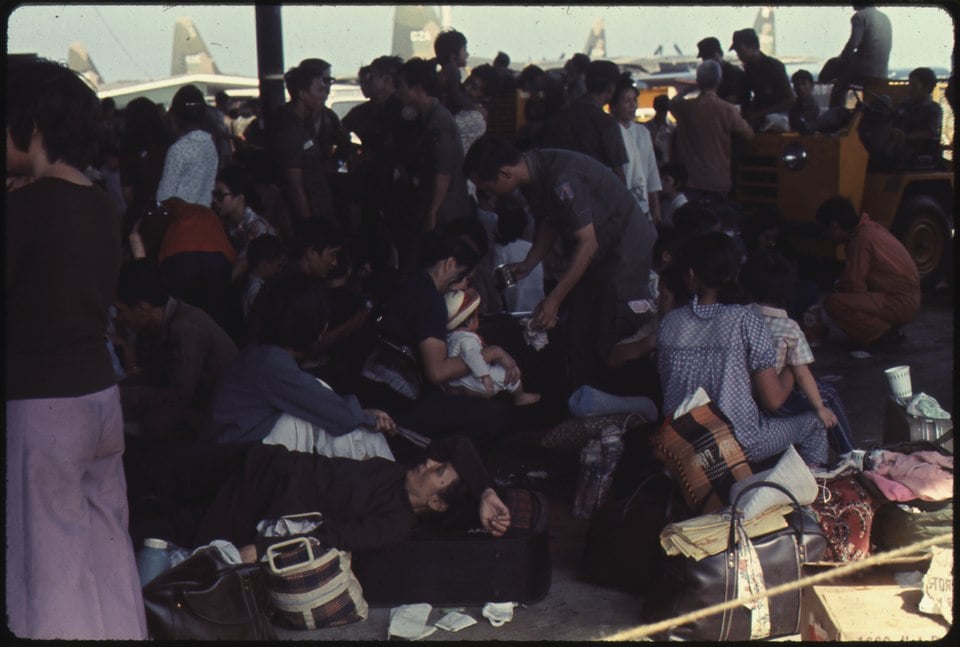
Photo: National Archives and Records Administration (NARA), via Wikimedia Commons (public domain)
https://commons.wikimedia.org/wiki/File:The_air_evacuation_of_siege-stricken_Vietnamese_from_Saigon_to_the_U.S._was_conducted_after_the_Babylift_operation…._-_NARA_-_542335.tif
https://commons.wikimedia.org/wiki/Commons:Licensing
In the weeks and months that followed, hundreds of thousands fled the country by sea or air. This marked the beginning of a global Vietnamese diaspora. Families were separated, and many rebuilt their lives in different parts of the world.
Earlier in April, Operation Babylift evacuated more than 3,000 Vietnamese children, while broader evacuation efforts in April 1975 brought thousands more to safety.
As the emotional fallout of this event continues to resonate, oral histories and veteran testimony continue to highlight these experiences. Accounts from veteran communities reflect the anxiety and desperation during the last days leading up to an evacuation. Many hoped for some form of escape from the life they once knew.
An eyewitness relates how the evacuation event occurred when everything happened at once; rapid, high-stakes decisions were made that changed lives forever.
A Turning Point in American Policy
Beyond its human impact, the fall of Saigon reshaped U.S. foreign policy in lasting ways.
The war was deeply divisive among the American public; the end of the conflict further fueled an existing distrust of military involvement. As a result of this experience, public scrutiny of how political leaders use military force increased significantly after Vietnam. This was especially true regarding U.S. involvement in other countries.
The legacy of Vietnam—often called the ‘Vietnam Syndrome’—shaped U.S. policy throughout the late Cold War and beyond. The impact also reached into the early decades of the 21st century.
Even today, analysts continue to draw lessons from 1975. In a Lieber Institute for Law and Land Warfare article, R. Scott Adams describes the Fall of Saigon as marking “the complete withdrawal of U.S. Forces from Saigon,” a moment that continues to shape debates about strategy, withdrawal, and responsibility.
Those lessons have resurfaced repeatedly, from conflicts in the Middle East to discussions about the limits of nation-building.
Memory and Meaning, 50 Years Later
Fifty years on, April 30 remains a date of divided memory.
Reunification Day, as it is known in Vietnam, is a celebration of victory and national unity. In the United States, it is often remembered as a moment of defeat and a time of reflection for both the Vietnamese refugee community and their descendants, who can reflect on their losses, sense of resilience, and ability to survive.
As a result, these contrasting interpretations of the same event make the fall of Saigon such an important milestone in history. It resists a single interpretation.
That observation reflects not only the military reality of the time but also a broader truth: the war’s meaning extended far beyond the battlefield.
The End—and the Beginning
The helicopters that lifted off from Saigon in April 1975 marked the end of direct American involvement in Vietnam. They also marked the beginning of a new era—one defined by reflection, caution, and debate about the role of the United States in the world.
The fall of Saigon was not merely the end of a war.
It reshaped how future wars would be understood, remembered, and—perhaps most importantly—questioned.
And decades later, those questions remain.
Sources:
U.S. Naval Institute — “Bravery in the Chaos: Operation Frequent Wind, April 1975”
PBS American Experience — “First Days Story Project-Operation Frequent Wind”
American Legion — “THE FALL OF SAIGON: ‘I WILL NEVER FORGET APRIL 1975’”
Veterans Breakfast Club — “Operation Frequent Wind”
Editor’s Disclaimer: This article is an anniversary analysis marking the events of April 30, 1975, commonly known as the Fall of Saigon. It draws on a range of historical sources, firsthand accounts, and modern interpretations to provide context and perspective.
While every effort has been made to ensure accuracy, this piece is not intended to serve as a comprehensive history of the Vietnam War. Some details have been condensed or synthesized for clarity and readability.
The article includes perspectives from U.S. officials, veterans, and historians, as well as references to Vietnamese experiences. However, it cannot fully represent the wide range of viewpoints surrounding these events, particularly those of individuals and communities directly affected.
All quoted material has been sourced from publicly available publications listed by the author. Interpretations and analysis presented in this piece are those of the writer and do not necessarily reflect the views of the publication.
Readers are encouraged to consult additional sources and perspectives to gain a more comprehensive understanding of this complex and deeply consequential moment in history.
