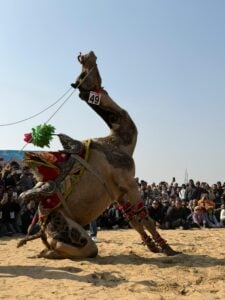
In recent years, media reports have documented cases in which officials at camel beauty competitions in parts of the Gulf region removed animals after inspections revealed the use of Botox and other cosmetic enhancements. These incidents—often described in media coverage as camel beauty contest ‘Botox scandals’—have drawn international attention.
These incidents have drawn attention to the surprising extent of cosmetic procedures in animal competitions. Media reports describe multiple incidents across different events and countries in the region, rather than a single isolated case. At one reported camel beauty festival in the region, with some reports referencing events in Oman, veterinarians removed multiple animals. According to a 2026 article in People by Charlotte Phillipp, “the disqualified camels had received a mix of injectables, including hyaluronic acid injections to their lips, dermal fillers and silicone around their nose, Botox to soften their faces, silicone wax to inflate their humps, and more,” to enhance their appearance.
Local news coverage captured the controversy:

The apparent goal of these enhancements was to gain a competitive advantage. Camel beauty contests, while unusual to outsiders, are serious events across parts of the Middle East. Prestigious breeding, long-standing traditions, and monetary incentives are all part of this culture; in this way, cosmetic procedures move beyond novelty and become a competitive strategy—highlighting the types of pressures that can emerge in competitive environments.
A strange scandal, but not an isolated one
These incidents did not occur in a vacuum. Similar controversies have been reported in the region. As reported by contributor Tanya Akim in Forbes, “Oman’s recent pageant scandal isn’t the first time that camels have come into the crosshairs of cheating by use of aesthetic enhancements designed for humans.”
Controversies have also been reported in Saudi Arabia, according to multiple media reports.
Reporting from The Jerusalem Post notes that veterinarians have warned that cosmetic procedures on camels can cause serious harm, while competition organizers enforce strict rules to preserve the integrity of judging.
These repeated incidents suggest the issue may be more widespread, based on available reporting, than a single isolated case; as the value of winning continues to escalate, so does the motivation for the manipulation of those results. Cosmetic enhancement—once associated primarily with the human beauty industry—is now extending to camels.
The cultural weight of camel beauty
To understand why this matters, it helps to understand what camel beauty contests represent.
These competitions are deeply rooted in regional culture, far from being mere novelty events.
In many contemporary festivals, judging criteria have become increasingly specific, with categories for judging differing types of camels based on their head type/size, lip fullness, neck length, and hump symmetry. While these traits may seem arbitrary to outsiders, they are part of a formalized aesthetic system. This system is generally understood to be shaped by traditional breeding practices and regional pride associated with those areas.
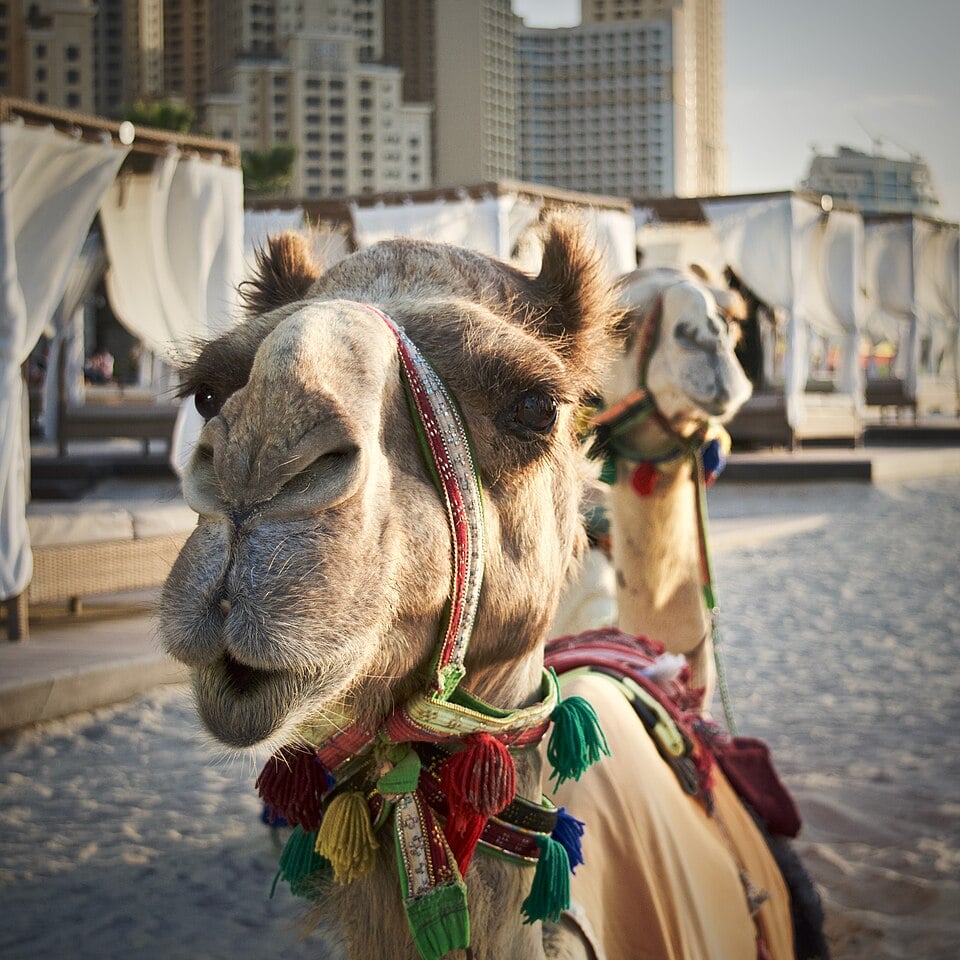
Photo by Rifat Yakan / Wikimedia Commons
https://commons.wikimedia.org/wiki/File:Camel_beauty_2.jpg
https://creativecommons.org/licenses/by-sa/4.0/
As these competitions grow in size and visibility, traditions surrounding animals in traditional events evolve naturally; as a result, participation has grown, and commercial elements increasingly shape these events. The prize money offered at competitions can be substantial, making it possible for an animal to dramatically increase in value based on winning a competition; therefore, there can be significant pressure on breeders to produce the “perfect” camel, much like that placed on participants in the human beauty industry.
When enhancement crosses a line
Cosmetic intervention in animals has raised ethical concerns among critics and animal welfare advocates. In addition to grooming and selective breeding, animal competitions have been around for years. However, the introduction of injected substances such as fillers or Botox has been described as pushing these practices into more controversial and invasive territory.
Animal welfare advocates have been particularly critical of such practices, citing potential physical harm and stress to the animals. In the Oman case, one critic described the practice as “hideously cruel,” pointing to the physical risks posed by such procedures.
Critics argue that artificial enhancement undermines the premise of judging animals based on natural traits, transforming what was once a reflection of breeding skill into something closer to cosmetic fabrication.
The issue is not entirely new. A similar scandal occurred in Saudi Arabia in 2021, when numerous camels were disqualified from competition due to the use of Botox. As reported by The Guardian, many camels had alterations made to their appearance through various processes in order to create exaggerated lips and jaws. The authorities were forced to step in when they discovered these widespread alterations.
This pattern may suggest that enforcement alone may not eliminate future occurrences of this type of misconduct and raises broader questions about how beauty and fairness are defined in these competitions.
The humanization of animal aesthetics
At its core, the camel cosmetic scandal reflects a broader phenomenon: the projection of human values onto animals.
The rise of camel enhancement may reflect broader cultural trends in human cosmetic practices. The use of Botox, fillers, and other procedures to achieve a ‘perfect’ appearance has become increasingly common in numerous areas throughout the world. The fact that these same procedures are now being performed on camels suggests that the definition of optimization may be expanding to include animals as well as humans.
The animals themselves are not choosing these procedures. They are being shaped—literally and figuratively—by human expectations.
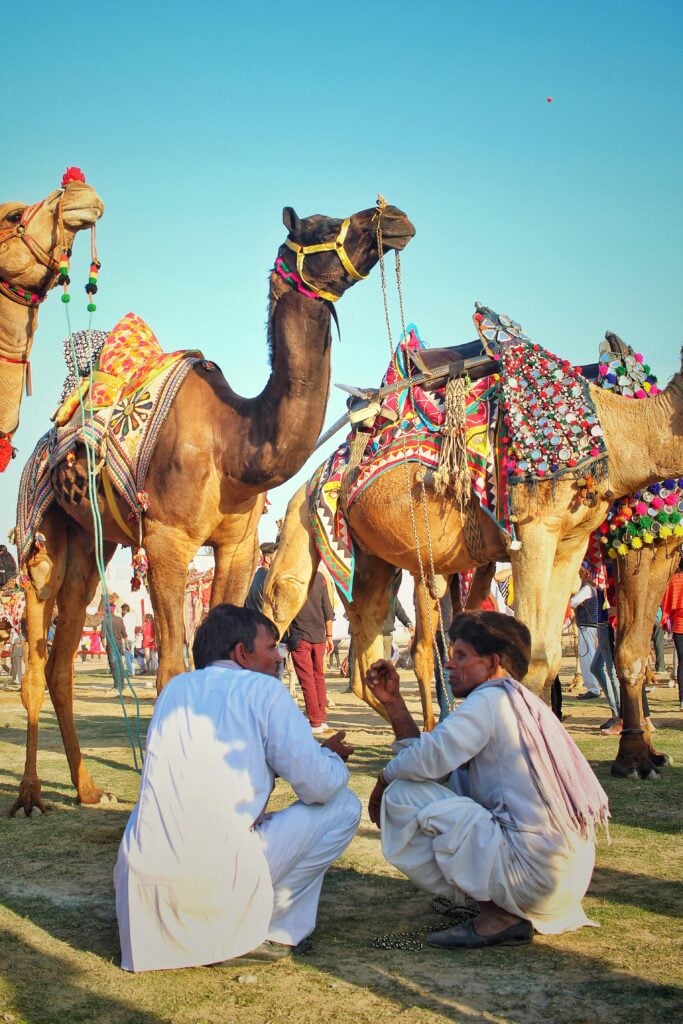
Photo by Pranav Jain via Pexels
https://www.pexels.com/photo/two-men-sitting-in-front-of-camels-1707965/
https://www.pexels.com/license/
In that sense, the scandal is less about camels and more about the people who own, train, and present them.
Similar dynamics can be observed beyond camel pageants. In some contexts, animals are increasingly being bred or presented for aesthetic purposes (e.g., an increasing number of selectively bred pets; show animals that have been groomed to perfection; and ‘pet influencers’ on social media). The line between caring for animals and manipulating them can become harder to define in these contexts.
Tradition under pressure
The tension between tradition and modernity is another key element of the story.
Camel beauty contests originated as celebrations of heritage, emphasizing the natural qualities that made camels valuable in desert life. Today, those contests exist in a world shaped by global media, technology, and shifting cultural norms.
As a result, these competitions are being pulled in two directions. On one hand, there is a desire to preserve authenticity and cultural identity. On the other, there is the influence of modern aesthetics and competitive pressures that encourage enhancement.
The use of cosmetic procedures can be seen as a potential breaking point in that tension. It challenges the very idea of what these contests are meant to represent.
What the scandal reveals
It would be easy to dismiss the camel cosmetic scandal as a bizarre curiosity. However, doing so may overlook its broader significance.
First, this situation can highlight how far the pursuit of beauty and perfection can extend. It shows how cultural traditions can shift under pressure, sometimes moving away from their original purpose. It also raises questions about the ethical boundaries of manipulating animals.
Lastly, it highlights a common pattern: a heightened desire to win—driven by status and prestige—can create opportunities for cheating. This dynamic appears across many forms of competition (athletic, business, beauty, etc.), both for human and non-human entities.
A mirror, not an anomaly
Applying cosmetics to a camel may seem absurd, but it reflects recognizable human behavior.
In that sense, the scandal is not an outlier. It is an extension.
Ultimately, the controversy reflects broader human pressures around beauty, competition, and control. It is a story about how human values—particularly those surrounding beauty—are spreading into new and unexpected domains.
If aesthetic pressure even affects camels, this raises a broader question: where should we draw the line?
Sources:
Forbes — “Another Camel Beauty Contest Is Hit By A Botox Cheating Scandal”
The Guardian — “Camels enhanced with Botox barred from Saudi beauty contest”
Popular Mechanics — “People Are Giving Camels Botox to Cheat at Beauty Pageants”
Editor’s Disclaimer: This article discusses reported incidents involving cosmetic enhancements in camel beauty competitions. While based on publicly available reporting, details may vary across sources and regions. The piece is intended as an analysis of broader cultural, ethical, and social themes rather than a definitive account of any single event.
The views expressed are for informational and editorial purposes only and do not seek to generalize or misrepresent any specific culture, community, or tradition. Readers are encouraged to consult multiple sources for a comprehensive understanding of the topic.
