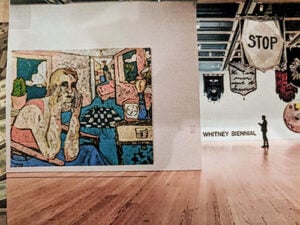
The Whitney Biennial 2026 is now open, showcasing leading contemporary American art. The exhibition runs from March through August at the Whitney Museum of American Art in New York. The exhibition features 56 artists and collectives exploring today’s overlapping crises. Additionally, the artworks engage with shifting identities and rapid technological change.
Instead of a single theme, this year’s Biennial is more diffuse—reflecting the present moment. The exhibition centers on what the Whitney describes as forms of “relationality,” spanning kinship, geopolitics, and technological entanglements.
As the Whitney Museum of American Art explains, the exhibition examines “interspecies kinships, familial relations, geopolitical entanglements, and technological affinities,” among other forms of relationality. In this way, art is used to understand how individuals and systems are increasingly interconnected.
A Biennial Built on Connection
The Whitney Biennial 2026, curated by Marcela Guerrero and Drew Sawyer, moves away from strictly categorized themes. Instead, it adopts a more open and fluid structure. As a result, the exhibition emphasizes how artists situate their work in relation to people, nations, ecosystems, and machines.
This scale—bringing together 56 artists from diverse backgrounds, many shaped by immigration, war, and technological change—reinforces that theme.
Rather than presenting a single overarching narrative, the Biennial aims to map the interconnected concerns of contemporary communities. The intersection of family histories, geopolitical conflict, ecological crisis, and technological change reflects what critics describe as a ‘poly-crisis’—a convergence of social, political, and environmental challenges.
From Politics to Emotion
One of the most notable aspects of the Whitney Biennial 2026 is its tonal shift. While recent editions leaned heavily into overt political critique, this year’s exhibition often favors a more introspective, emotional register.
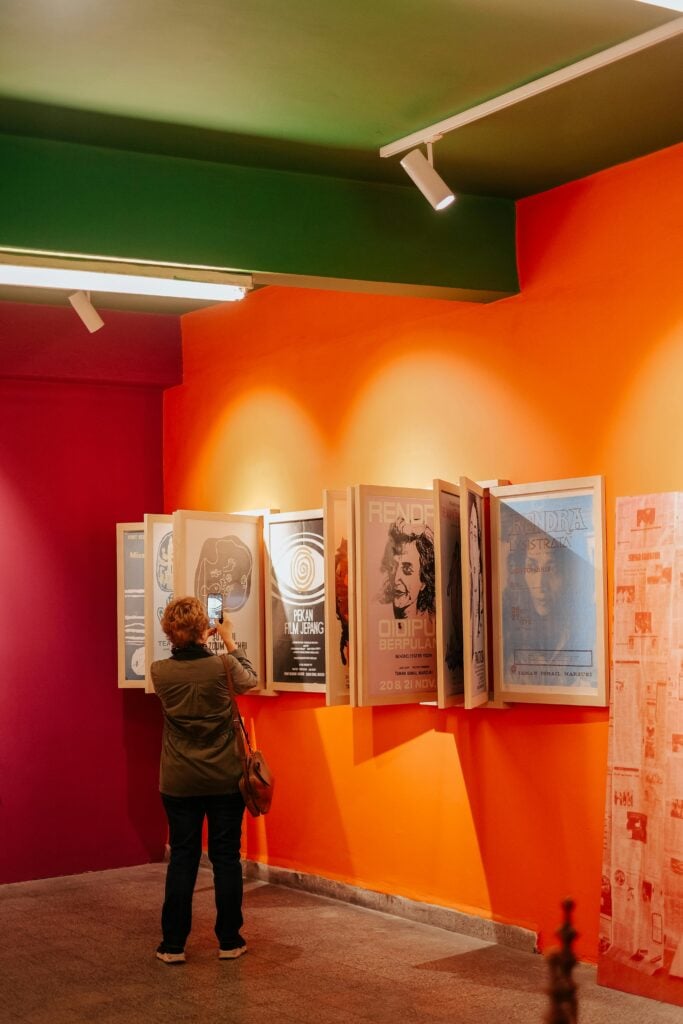
Photo by Hatice Baran via Pexels — https://www.pexels.com/photo/woman-in-green-jacket-taking-picture-of-posters-on-wooden-frame-13762159/ https://www.pexels.com/license/
A review in The Week notes that the show offers a broad, emotionally resonant collection that emphasizes “personal emotion, community, grief, and resilience.”
While political content is less overt, it is embedded within individual narratives and expressed through varied media. For instance, works addressing border policy, climate disasters, and technological dominance offer nuanced perspectives rather than direct ideological confrontation.
This approach has polarized critics; some see it as a meaningful acknowledgment that social and political realities shape lived experience.
A “Feelings-First” Art World
The shift in tone has been described as a move toward mood and affect. According to a review in Artnet News, the Biennial reflects a “feelings-first” approach. This shift is signaling a broader change in how contemporary art engages with its audience.
The focus on emotional experience, kinship, and relationality aligns closely with the exhibition’s overall approach. Additionally, many artworks explore the themes of care, dependency, and vulnerability as seen through the lenses of family, ecology, and human-machine relationships.
Technology plays a central role in exploring how digital infrastructures shape identity. Artists present ‘technological entanglement’ as lived experience rather than abstraction.
Criticism and Contradiction
Although expectations were high, not all critics were impressed. Some believe that an open concept—and therefore a lack of clear communication—hinders the overall message.
Writing in Hyperallergic, a critic argues that the exhibition attempts to act as a broad survey, noting it “wants to revert to an older model of taking the temperature of the art world.”
Some critics argue this results in a show that feels fragmented rather than unified. In contrast, however, others interpret the fragmented nature of the artwork to be significant.
The exhibition captures the tension between unity and multiplicity of existence, reflecting broader themes in contemporary society. The convergence of multiple crises highlights a growing disillusionment with traditional narratives. This includes a growing skepticism toward the idea of a single, unified perspective.
Questions of Originality and Influence
Another thread running through the Biennial is the question of authorship and originality, and their current status in today’s cultural landscape. Pervasive digital reproduction and artificial intelligence help define this moment.
While discussing the show for The New Yorker, the critic Hilton Als highlights tensions around originality, arguing that some works feel overly indebted to established styles, while others assert more distinct artistic voices.
The overall theme of this exhibition reflects much larger issues in contemporary art. With advancements in technology allowing for new ways to create and share works, the boundaries separating inspiration from imitation and innovation are becoming increasingly difficult to determine.
The Biennial’s emphasis on technological entanglement gives it heightened significance within the broader ecosystem of artists, galleries, and curators. The Biennial reflects the tools available to artists and how those tools influence artistic production. Furthermore, it considers the systems that produce, circulate, and interpret art.
A Snapshot of the Present
Ultimately, the Whitney Biennial 2026 serves less as a definitive statement than as a snapshot of the present moment. The Biennial’s emphasis on kinship, geopolitics, and technology is indicative of the forces that are shaping art and society today.
Though viewers may find that there isn’t one theme running through the entirety of the exhibit, it does allow for nuanced and multifaceted exploration of contemporary life by including the work of 56 artists from various perspectives. The show ultimately reflects a world defined by both fragmentation and interconnection.
Moreover, the exhibit poses an important question on how we understand ourselves and others within increasingly complex systems of connection.
As suggested by the Biennial, it is not through grand narratives or final conclusions that we find our answers, but in the collection of individual voices trying to process the challenges and opportunities they face today.
Sources:
Whitney Museum of American Art — “WHITNEY BIENNIAL 2026 THROUGH AUGUST 23”
Hyperallergic — “The Polycrisis Sublime of the Whitney Biennial”
Artnet News — “The 2026 Whitney Biennial Just Wants You to Feel Something”
The Week — “Art review: Whitney Biennial 2026”
Observer — “The 2026 Whitney Biennial Delivers American Art for a Fractured Age”
The New Yorker — “UNDER THE INFLUENCE AT THE WHITNEY BIENNIAL”
Editor’s Disclaimer: This article is intended for informational and editorial purposes. It reflects a synthesis of publicly available information and critical perspectives on the Whitney Biennial 2026. Any quoted or paraphrased material from third-party sources is used for commentary and analysis. Readers are encouraged to consult original publications and official museum materials for further details.
