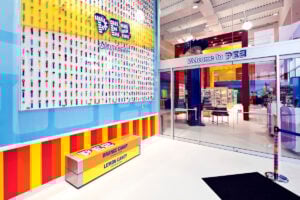
ORANGE, CONNECTICUT – What began as a peppermint alternative to smoking in 1920s Austria is now a global candy brand approaching its 100th anniversary. Today, PEZ candy continues to evolve while maintaining its nostalgic appeal. “I never imagined being here,” Shawn Peterson, the Direct to Consumer Business Manager of PEZ, said March 26. For both Peterson and the PEZ company, Connecticut may seem like an unlikely place to put down roots. Yet Peterson’s journey and the evolution of the PEZ brand reflect a broader theme of adaptation and reinvention.
Peterson spoke with Presence News about how PEZ has retained its appeal. Originally conceived as a way to help people quit smoking, PEZ candies entered a fast-paced modern world. The candy endured the ramifications of World War II and eventually moved to the United States, where the brand took on a new identity.
What is the secret to PEZ’s ongoing success and what lies on the horizon as the company anticipates its 100th birthday in 2027?
Evergreen
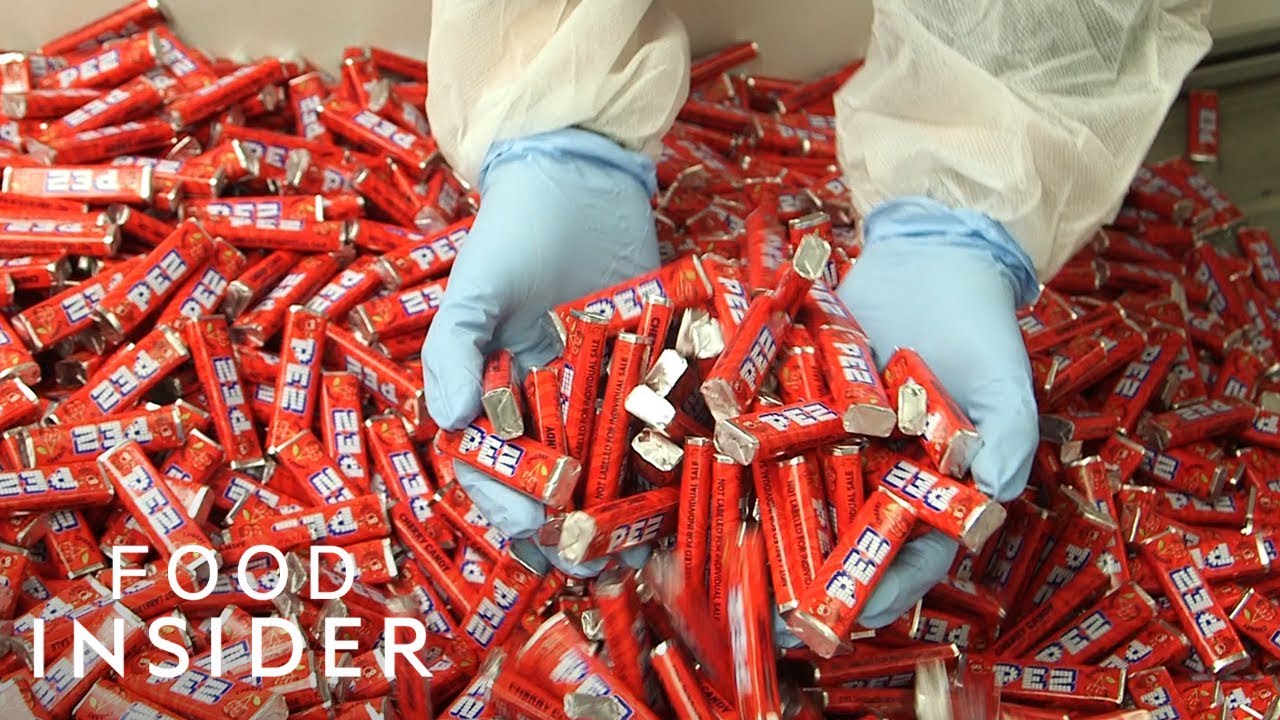
Founded in 1927, PEZ was originally created to help Europeans—particularly Austrians—quit smoking. Smithsonian Magazine reports that Eduard Haas developed what became the first PEZ tablet.
Haas, born near Vienna in 1897, entered the confectionery business in the 1920s after inheriting his father’s baking supply company.
Haas named the small, brick-shaped candies “PEZ,” derived from Pfefferminz, the German word for peppermint, the Lemelson-MIT website explains.
The peppermint tablets originated in Austria and were promoted as an anti-smoking aid, eventually gaining popularity, the publication reports. The article also describes the marketing strategies of the 1930s: “The women, known as ‘PEZ Girls,’ would soon arrive at famous landmarks around the world, offering the public a new way to freshen breath and refrain from smoking.’”
New Soil
After World War II, PEZ arrived on the shores of the United States. Curtis Allina, who was raised in Vienna, immigrated to the United States in 1947. According to the New York Times, Allina sought a new life after surviving imprisonment in multiple concentration camps.
The New York Times reports that Curtis Allina played a key role in reshaping PEZ’s image in the 1950s. After joining the company, he rose to become a vice president. At his urging, PEZ reconsidered its traditional tin packaging and introduced plastic dispensers designed to appeal to children. The first two dispensers, Santa Claus and a “Space Trooper,” hit the American retail market in 1955.
PEZ expanded by developing new fruit flavors and character dispensers. Its popularity grew and sales increased, according to the PEZ website. Over the coming decades, PEZ launched thousands of recognizable characters, including Mickey and Minnie Mouse, Kermit the Frog, and Bugs Bunny and others, and relocated its U.S. factory from New York to Orange, Connecticut, in 1973.
Open Road
Shawn Peterson’s personal collection serves as the foundation of the PEZ Visitor Center and Museum. Originally from the Midwest, Peterson came to Connecticut after signing on with PEZ and proposing the idea for the current museum and visitor center.
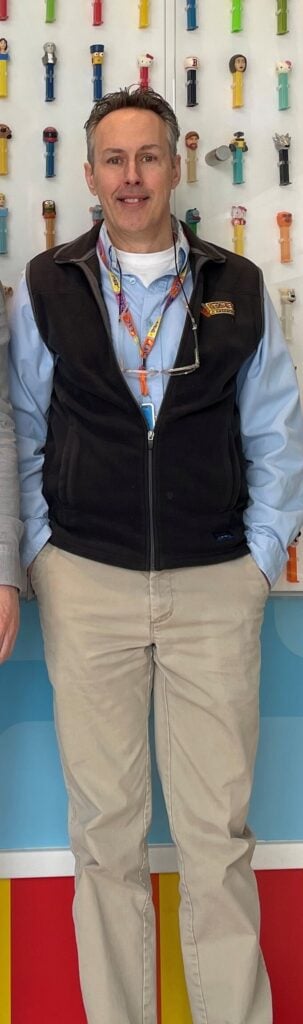
Photo courtesy of Shawn Peterson and PEZ
“I was chasing a passion of mine,” Peterson explained. He has worked at PEZ for 16 years. Before coming to Connecticut, Peterson worked for a major greeting card company and lived in Kansas. During his spare time, Peterson amassed a collection of PEZ dispensers with a wide range of unique characters. As his tenure with the card company came to an end, Peterson “pitched” an idea to PEZ: create a place for visitors to come and see the factory.
In a 2018 Q&A published by AMC Networks, Peterson explained that he pitched the idea for the visitor center directly to PEZ executives.
Peterson explained his vision, stating that a colorful and interactive space would give a “face” to the long-standing candy. PEZ executives kept in touch with Peterson for three years as his idea slowly took shape. Then, in 2009, Peterson received the call inviting him to Connecticut.
“I was surprised,” Peterson said, describing the change in his life. He exchanged the flatlands of Kansas for the East Coast and an entirely new career.
Model Idea
The PEZ Visitor Center and Museum opened in 2011, according to the company’s website. The 4,000-square-foot space features PEZ memorabilia, a gift shop, and a place for guests to view production.
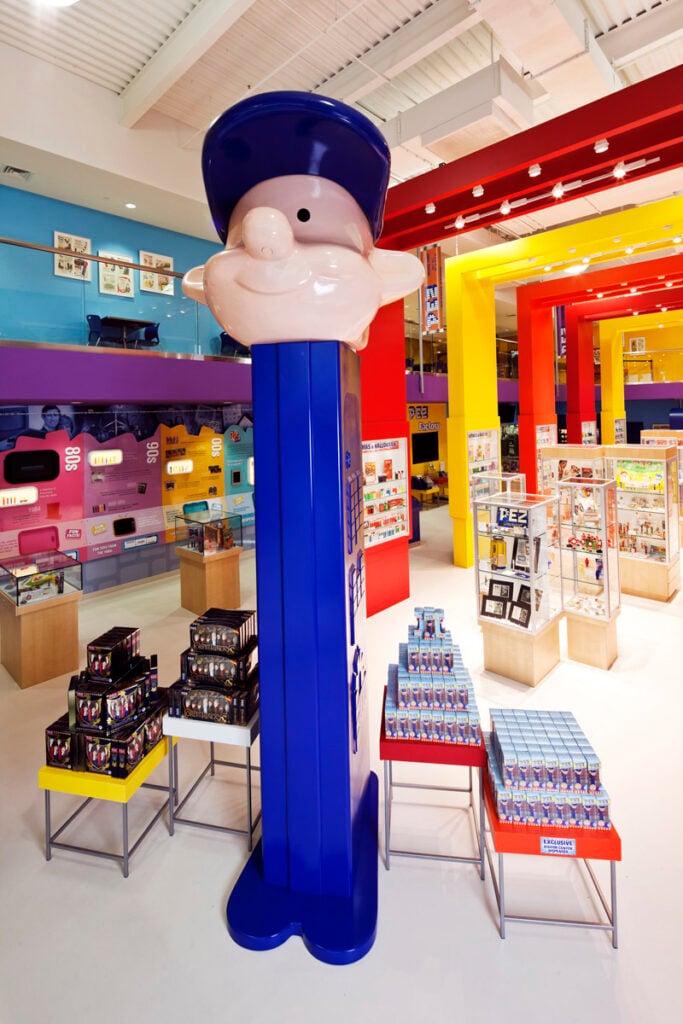
Photo courtesy of Shawn Peterson and PEZ
“Now I’ve seen both sides of the business,” Peterson said. “I understand how it works.” Before the COVID-19 pandemic, approximately 80,000 visited annually.
Like many businesses, PEZ followed state and federal mandates. “It was a challenge to figure out,” Peterson said, as he recalled how the company navigated a “new normal.” Peterson said PEZ was classified as an “essential” business, allowing the company to continue shipping inventory while the visitor center remained closed for four months.
According to Peterson, it took two to three years to completely recover from the pandemic. In 2025, the center saw an estimated 76,000 guests. Peterson said he is optimistic about even larger crowds in 2026.
Sweet Success
From school tours and senior groups to curious locals, visitors continue to come to the PEZ Museum and Visitor Center. Peterson sees the continued interest as a sign of the brand’s lasting appeal.
“Come visit us,” Peterson said. “It’s a fun thing.” Among his list of responsibilities, Peterson is also planning the company’s 100th anniversary celebration for 2027. He said he remains focused on the company’s future as it approaches its 100th anniversary.
Sources:
FOX 61 — “Pez Collector’s Convention has fanatics flocking to Orange” YouTube.
Insider Food — “How PEZ Is Made | The Making Of” YouTube.
Smithsonian Magazine — “How PEZ Evolved From an Anti-Smoking Tool to a Beloved Collector’s Item”
The New York Times — “Curtis Allina Dies at 87; He Put the Heads on Pez”—
AMC Networks — “Comic Book Men Q&A — Shawn Peterson (PEZ Visitor Center)”
PEZ — “The PEZ Visitor Center | Orange, CT”
Editor’s Disclaimer: This article is based on an interview with PEZ representative Shawn Peterson and includes historical information from publicly available sources. While every effort has been made to ensure accuracy, some details have been condensed for clarity and readability.
