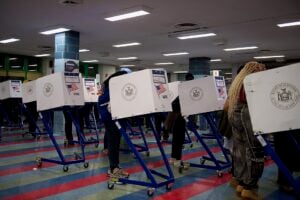
Because the United States uses the Electoral College, presidential election results have long been examined across the states. Because of their large populations, some of the country’s largest cities can have a substantial effect on statewide presidential results. In addition, examining a metropolitan area’s voting habits can provide insight into how large populations vote in national elections. New York City, the nation’s most populous city, has a presidential election history dating back to George Washington. The analysis uses official election records from New York City and its five boroughs to examine how presidential voting has changed over time.
New York City’s Early Presidential Election History
New York City’s early presidential election history reflects a political landscape vastly different from the modern era. In the late 18th and early 19th centuries, voting was more decentralized than it is today, and standardized secret ballots had not yet become the norm.
During this period, New York City did not yet have the consistent Democratic voting pattern associated with it today. Local politics were shaped by changing alliances between competing political factions. The early rivalry between Alexander Hamilton’s Federalists and Thomas Jefferson’s Democratic-Republicans set the stage for intense local polarization.
As the mid-19th century approached, urbanization, immigration, and the rise of Tammany Hall changed the city’s political landscape. Those changes also became part of the political environment in which later presidential campaigns competed for votes in the city.
By the late 1800s, New York City’s presidential voting had begun to diverge from much of the state. New York City never voted for Abraham Lincoln in either of his presidential campaigns. Afterward, Democratic candidates began to dominate presidential elections in the Big Apple. Democratic nominees Horatio Seymour, Samuel Tilden, and Grover Cleveland won the city by wide margins. New York City’s presidential results during the late 19th century reflected the city’s increasingly Democratic political alignment, although Republican candidates remained competitive in some elections.
Presidential Elections and the Changing Political Landscape
At the start of the 20th century, presidential contests in New York City were more competitive than they would become later in the century. In 1904, Theodore Roosevelt won New York State, although Democrat Alton Parker remained competitive in New York City. Democrat Woodrow Wilson carried the city in 1912 and again, narrowly, in 1916. The 1920s were the last period in which Republicans won New York City in consecutive presidential elections. Amid Democratic divisions and dissatisfaction following Wilson’s presidency and World War I, Warren G. Harding and Calvin Coolidge won New York City in 1920 and 1924. Coolidge’s victory was the last Republican presidential win in the city for decades.
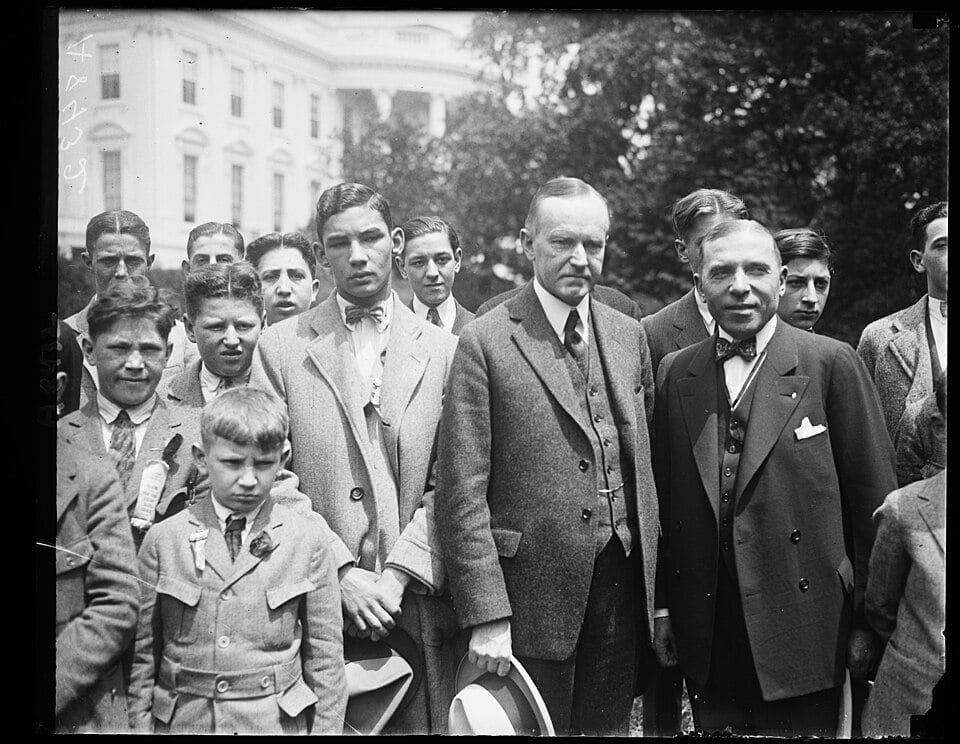
In 1928, Democrat Al Smith carried New York City by a wide margin despite Herbert Hoover’s nationwide Republican landslide. Smith’s strong performance reflected the growing strength of the Democratic Party among many of the city’s urban and immigrant voters.
During the Great Depression and its aftermath, Democratic nominee Franklin D. Roosevelt won both nationally and in New York City in all four of his presidential elections. After Harry Truman continued the pattern in 1948, Dwight D. Eisenhower showed a little bit of competitiveness in the Big Apple. Eisenhower, also known as “Ike,” was a World War II hero who positioned himself as a moderate Republican. His popularity extended beyond traditional Republican voters. Eisenhower lost New York City by about 10.5 percentage points in 1952 and came closest Republican to winning it since 1924 in 1956. Eisenhower carried Queens and Richmond County while running more competitively in Manhattan, the Bronx and Brooklyn.
From the 1960s to Democratic Dominance
In 1960, John F. Kennedy carried New York City by a wide margin. After Kennedy’s assassination, Democrat Lyndon B. Johnson easily carried the city in 1964, followed by Hubert Humphrey in 1968.
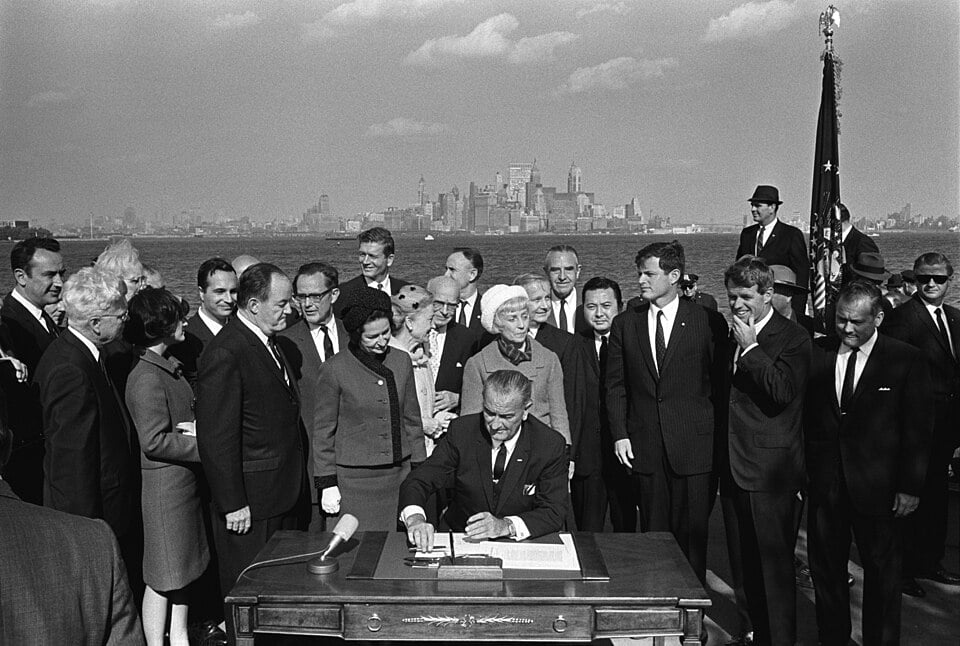
In 1972, Democrat George McGovern again carried New York City, despite Richard Nixon winning nationally in a landslide. Nixon’s strong performance reflected support from some working-class, culturally conservative voters and skeptical Democrats. The relatively close 1972 result was one of the city’s last presidential contests in which the Republican candidate came close to winning.
In 1976, New York City continued its shift toward solid Democratic support. Jimmy Carter campaigned in the aftermath of Watergate and the Vietnam War and carried New York City, while President Gerald Ford faced criticism over comments about the city. Carter carried the city and narrowly won New York State. In 1980, Carter again won New York City despite losing nationally to Ronald Reagan. Carter’s margin was smaller than in 1976. Republican Ronald Reagan gained support in the city, while independent candidate John Anderson also received a share of the vote. In 1984, Democrat Walter Mondale, with New Yorker Geraldine Ferraro as his running mate, won New York City, while Reagan carried New York State and won the national election. Reagan received about 38.7% in New York City, marking the last time a Republican presidential nominee approached 40% there during this period.
From the Late Twentieth Century to the Modern Era
In 1988, Republican George H.W. Bush won the presidency by a wide margin. New York City, however, remained firmly Democratic, with Massachusetts Gov. Michael Dukakis carrying the city. Bush’s 1988 performance was the last time a Republican presidential nominee received at least 30% of the vote in New York City until 2024. Bush also came closer than any Republican presidential nominee since 1984 to winning New York State; the statewide margin was just over four percentage points.
In 1992, Democrat Bill Clinton presented himself as a “New Democrat,” while independent Ross Perot offered an alternative to both Clinton and Republican George H.W. Bush. Bush entered the election after a recession and faced a challenge from independent candidate Ross Perot. Clinton carried New York City by a wide margin, while Perot performed less strongly there than nationally. In 1996, Clinton again carried New York City by a wide margin, while Perot’s share of the vote declined from 1992.
The 2000s and a Changing Political Landscape
The 2000 presidential election produced a particularly close national contest, but Democrat Al Gore carried New York City decisively. After the September 11, 2001, attacks, Bush visited Ground Zero in New York City and initially received strong public support. His administration’s subsequent policies, including the wars in Afghanistan and Iraq, became subjects of political debate. In 2004, Democrat John Kerry again won New York City decisively, while Bush received just over 24% there. Despite losing the city, Bush remained competitive statewide, winning more than 40% of New York’s vote—the last Republican presidential performance to reach that mark until 2024.
From Obama to the Present
In 2008, Barack Obama carried New York City by a decisive margin as the country was dealing with the wars in Iraq and Afghanistan and a major economic downturn. Obama carried the city by an even larger margin in 2012. In 2016, Republican Donald Trump, a native New Yorker, won the Electoral College while Democrat Hillary Clinton won the national popular vote. Clinton nevertheless carried New York City decisively. Joe Biden again carried New York City in 2020, while Trump received more votes in the city than he had in 2016. In 2024, Democrat Kamala Harris carried New York City with 68% of the vote, while Trump improved his performance again, receiving more than 30% in the city. Trump received about 43% of the statewide vote, making 2024 the first presidential election since 2004 in which a Republican nominee exceeded 40% in New York.
New York City has generally favored Democratic presidential candidates, although Republicans won the city in several elections during the first half of the 20th century. Republican candidates including Eisenhower, Nixon, Reagan and George H.W. Bush received substantial shares of the city’s vote during different periods. Since 2000, Democratic presidential nominees have carried New York City in every election, although Republican candidates have continued to receive millions of votes in some elections. The size of the Democratic margin, however, has varied considerably across elections.
How the Five Boroughs Have Voted
New York City’s presidential results can also be viewed through its five boroughs, which correspond to five counties: Manhattan/New York County, Brooklyn/Kings County, Queens, the Bronx and Staten Island/Richmond County.
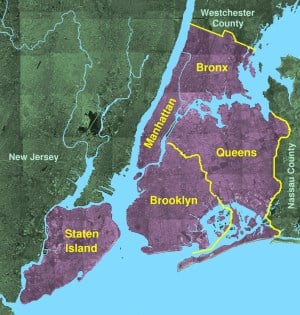
Borough-level results provide a more detailed view of how votes were distributed across the city. The NYC Board of Elections publishes presidential results separately for each borough, allowing researchers to compare voting patterns within the city.
In 2024, the Board of Elections reported separate President/Vice President results for each of the five boroughs, in addition to the citywide total.
The five boroughs have produced different voting margins in presidential elections. Staten Island, for example, has historically produced different presidential voting patterns from the other four boroughs, while Manhattan, Brooklyn, Queens and the Bronx have each contributed different numbers of votes to the overall citywide result.
Borough-level results also show how different parts of the city have contributed to the overall vote. The official results can therefore be examined by borough as well as citywide.
What the Historical Results Tell Us
New York City’s presidential results have changed substantially across different periods of its history.
City-level results can differ sharply from national results. A candidate can win New York City while losing the presidency, as happened several times in the modern era.
Borough-level results provide additional detail.
A Record of Change
New York City’s presidential voting record reflects several distinct periods, from the competitive elections of the early 20th century to the city’s more consistent Democratic voting pattern in recent decades. Borough-level results show that those citywide totals have not always been evenly distributed across the five boroughs.
Sources:
NYC Board of Elections — Election Results Summary
270toWin — Historical Presidential Elections
New York State Board of Elections — Elections Database
CUNY Graduate Center, Center for Urban Research
National Archives — Electoral College
Editor’s Disclaimer: This article is intended as a historical and informational analysis of presidential voting patterns in New York City. It draws on official election records and historical reference sources. Election results and historical interpretations are presented for informational purposes and do not represent an endorsement of any candidate, political party, or political position. Vote totals and percentages may be rounded for readability.
