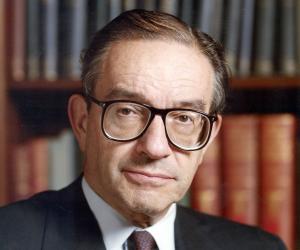
Economist and former Federal Reserve Chair Alan Greenspan died Monday at the age of 100. Economists, historians, and policymakers will debate Alan Greenspan’s legacy for years to come. Greenspan served as chair of the Federal Reserve under four U.S. Presidents. Throughout his career, Greenspan drew both praise and criticism for his economic policies. Nonetheless, he left a lasting mark on the U.S. government.
Although retired for more than 20 years, Greenspan’s legacy remains highly relevant today. His tenure as Federal Reserve chairman is directly linked to modern monetary policy. Greenspan led an influential career in economics and public policy.
Greenspan left a lasting mark on both the U.S. and global economy. One early example was Greenspan’s effort to add liquidity following the 1987 stock market crash. Among others are the approach he took in cutting interest rates during market downturns and the implementation of deregulatory measures. While many praised Greenspan’s policies, critics argue they contributed to economic problems, including the 2008 financial crisis.
Early Life
Born in New York City in 1926, Greenspan demonstrated an early aptitude for mathematics. At just five years old, he was already reciting baseball batting averages and making other calculations. After graduating from Juilliard School, Greenspan attended New York University, earning a B.A. and M.A. in economics. Greenspan later became associated with Ayn Rand and left Columbia University before completing his doctorate.
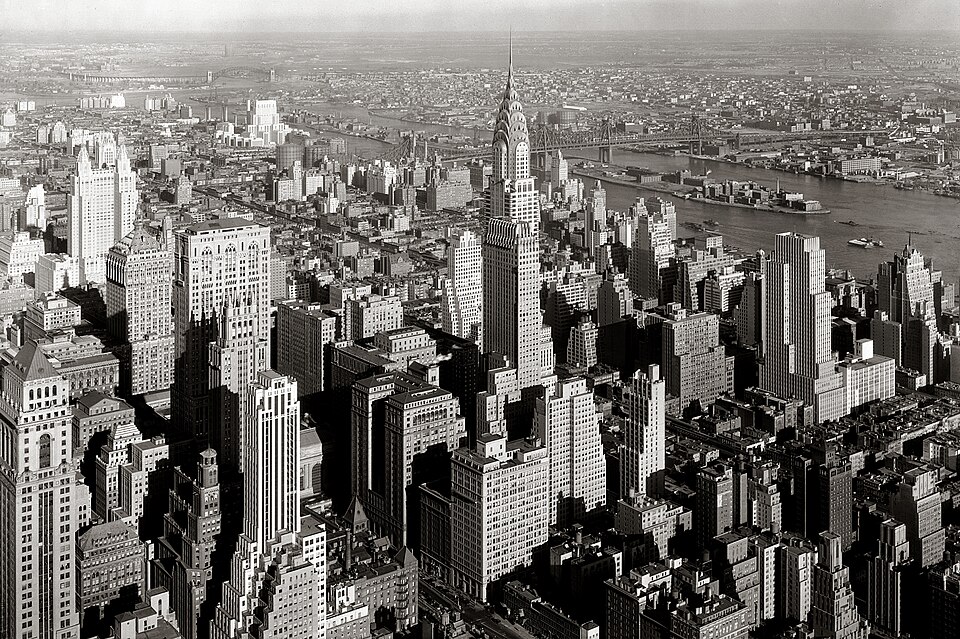
In 1953, he formed an economic consulting firm in New York known as Townsend-Greenspan & Co, Inc.
At Townsend-Greenspan & Co., Greenspan advised corporations on supply and demand, particularly in the steel, aluminum, and copper industries. In fact, the firm provided advisement to several major Fortune 500 corporations. Greenspan served as chairman and president of Townsend-Greenspan & Co. from 1954 to 1974 and again from 1977 to 1987. These early experiences in economic consulting would later become an important foundation of the Alan Greenspan legacy.
Pal to U.S. Presidents
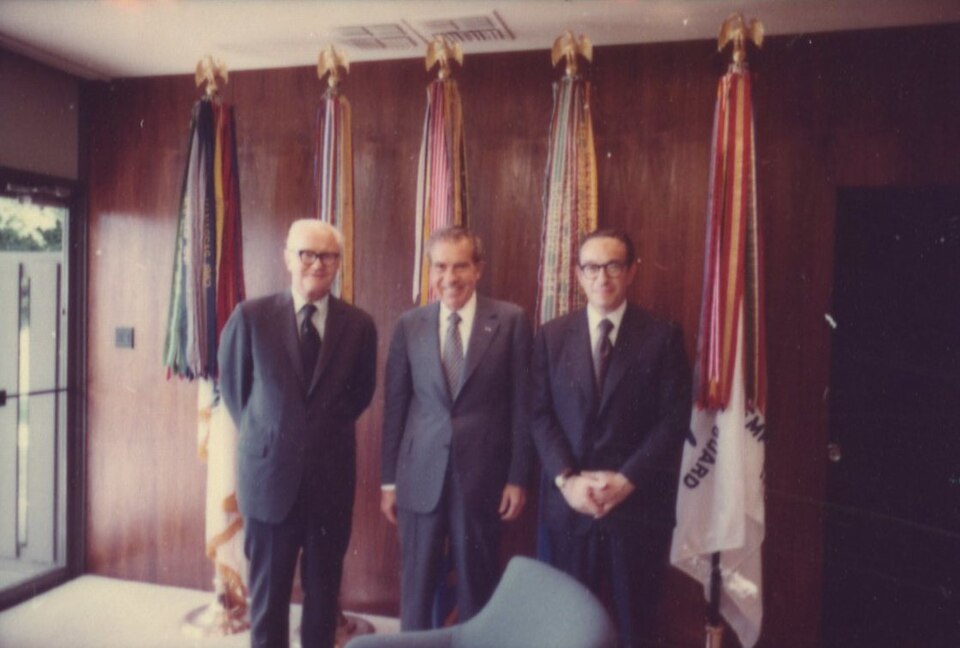
Greenspan gained prominence not only through his consulting work but also as an adviser to Richard Nixon’s 1968 presidential campaign. Serving as Director of Domestic Policy Research for Nixon’s campaign, Greenspan’s mathematical expertise impressed his cohorts. His advanced polling methods included forecasting models and measures of collecting metrics that had not been seen before. Interestingly, at first, Greenspan refused to accept permanent government positions to build up his consulting firm’s reputation. This was ironic in that he would end up serving four U.S. Presidents.
https://commons.wikimedia.org/wiki/File:Nixon_Contact_Sheet_WHPO-E3322_(cropped).jpg https://commons.wikimedia.org/wiki/Commons:Licensing#Material_in_the_public_domain
Nixon Administration
In 1974, Greenspan became chair of the President’s Council of Economic Advisers. Following Nixon’s resignation that same year, Greenspan remained in his position under President Gerald Ford.
Ford Administration
By the time that Greenspan became involved in the Ford administration, the United States was facing a major economic issue: runaway inflation. Greenspan’s approach to fighting this dilemma involved raising interest rates and a strict monetary policy. He also heavily supported libertarian economic philosophies such as the deregulation of Wall Street. In addition, Greenspan advocated for free-market solutions to curb 1970s stagflation and even lobbied President Ford for a $15.2 billion tax cut in 1975 to stimulate growth. Some of the measures that were suggested to Ford to fight inflation were continued by his successors, Jimmy Carter and Ronald Reagan.
Federal Reserve Chair
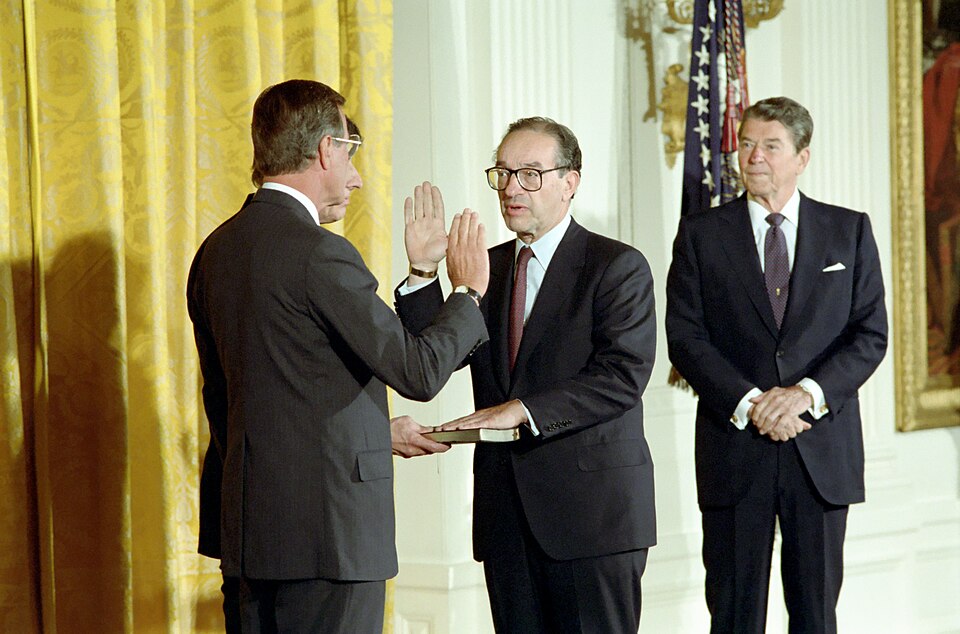
While president, Reagan appointed Greenspan as chairman of the Federal Reserve in 1987. After Reagan, Greenspan would be appointed again for this role under three more U.S. Presidents: George H.W. Bush, Bill Clinton, and George W. Bush. Throughout these administrations, Greenspan largely maintained the economic philosophies that had shaped his earlier public service.
However, his initial implementation of them, while praised as successful, would eventually be criticized for setting the tone for things much worse to come. These debates remain an important part of the Alan Greenspan legacy and continue to influence discussions about monetary policy today.
Borrowing from Greenspan’s playbook
There are some who argue that Greenspan’s suggestion of using strict monetary policies and high interest rates to fight inflation, while temporarily beneficial, eventually resulted in dire consequences for the U.S. economy. Ford’s immediate successor, Jimmy Carter, saw his administration struggle with inflation just as much, if not more so. After failed attempts at keeping inflation under control, Carter ended up appointing Paul Volcker, who championed many of the same ideas as Alan Greenspan, to the Federal Reserve. After Ronald Reagan defeated Carter in the 1980 presidential election, Reagan kept him on board, urging him to continue what he’d been doing. Volcker took a similar approach to Greenspan’s in raising interest rates, which, while causing a huge economic recession in the early 1980s, saw inflation eventually get under control, and is often cited as one of the key factors behind the 1980s economic boom. However, some have said that this approach from Volcker, which was similar to Greenspan’s approach under Ford, set the stage for the easy money policies that Greenspan would later utilize under George W. Bush’s administration in fueling the 2008 economic crisis.
The 2008 Economic Crisis
One of the most debated aspects of the Alan Greenspan legacy concerns the events leading up to the 2008 financial crisis. 2008 was one of the most severe economic downturns in modern U.S. history. George W. Bush was the last U.S. President that Greenspan worked for. 2001 is remembered mostly for the 9/11 terrorist attacks. However, that year, the nation also experienced the infamous dot-com crash. With the rapid rise of the internet, investors poured billions of dollars into internet-based startups. When many of these companies went bankrupt, the market collapsed. In response, with Greenspan as Federal Reserve Chair, federal funds rates were slashed to a record low. Critics have argued that by doing this, a “cheap money” environment was created, which in turn contributed to the growth of subprime mortgages.
Besides subprime mortgages, other critics have maintained that this “cheap money” system saw cheap credit flood the financial system, pushing investors out of stocks and into real estate. In 2004, Greenspan had encouraged homeowners to take out adjustable-rate mortgages (ARMs). This, in turn, has been said to leave them highly vulnerable when interest rates rose.
Conclusion
Alan Greenspan’s legacy remains one of the most debated in modern economic history. Greenspan was viewed by supporters as a steady force during periods of economic uncertainty. While nearly all economists and policymakers will agree on the broad dimensions of his impact on monetary policy, financial markets, and government policy decisions, they do not agree about how or why he exercised his influence. In the future, Greenspan’s legacy will continue to shape debates about inflation, interest rates, regulation of financial institutions, and the role of the Federal Reserve. As such, both economists and historians will remember Alan Greenspan as one of the most significant economic leaders of the past century due to his long professional career during some of the most important economic times of American history and the continuing effects of his ideas on today’s economic landscape.
Sources:
Associated Press – “Former Federal Reserve Chairman Alan Greenspan Dies at 100”
Federal Reserve History – Alan Greenspan
Britannica Money – Alan Greenspan Biography
Federal Reserve History – Board of Governors Historical Records, Alan Greenspan
Britannica – Alan Greenspan Summary
The Guardian – Alan Greenspan Obituary
Council of Economic Advisers – Britannica
The Guardian – “Alan Greenspan, longtime head of the US federal reserve, dies aged 100”
Editor’s Disclaimer: This article is a historical and biographical overview of economist and former Federal Reserve Chair Alan Greenspan. It is intended for informational and educational purposes and draws upon publicly available records, historical accounts, and reputable news reporting. Discussions regarding Greenspan’s economic policies and legacy reflect viewpoints and analyses that have been debated by economists, historians, policymakers, and financial experts over time. Presence News does not endorse any particular interpretation of these events and encourages readers to consult multiple sources when evaluating historical and economic topics.
